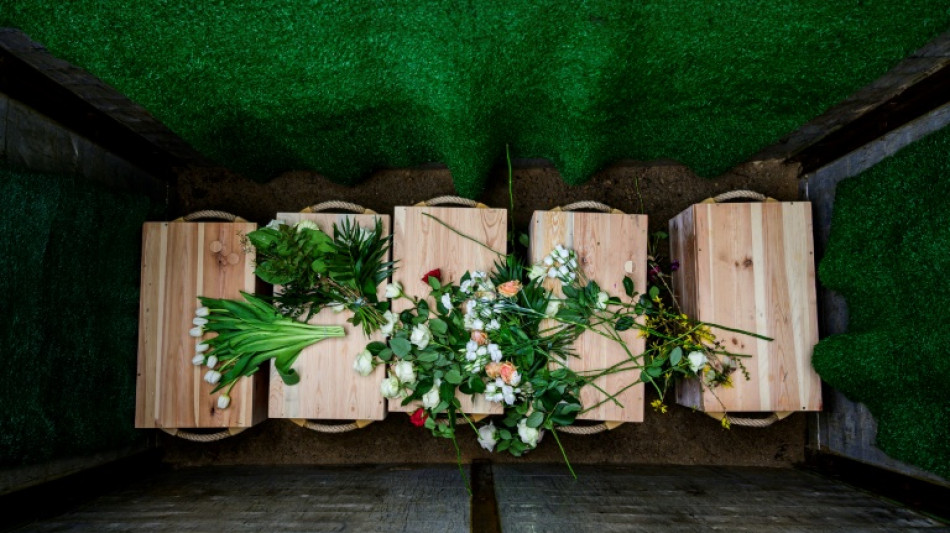
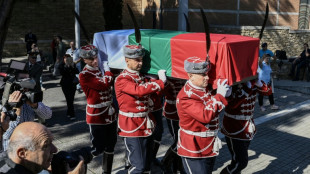
Bone fragments held by Nazis get funeral in Berlin / Photo: John MACDOUGALL - AFP

 Lula, Bolsonaro in final push for votes ahead of knife-edge election

 Boisterous fashion week barnstorms 'sleepy' Nigerian capital

 UAE investigators say flydubai co-pilot was planning 'terrorist act'
 Rahul smacks century in India v Windies ODI

 Daryz seeks to join exclusive club of dual Arc winners

 Russia warns diplomats to leave Kyiv over new strikes threat
 Olympic champ Zheng rebukes rowdy home crowd at China Open
 World No.1 Sinner pulls out of Shanghai Masters to delay return
 Red Bull's Verstappen grabs pole position for Bahrain GP
 India beat Pakistan in blockbuster as golfer Kim wins 'crazy' gold

 India beat arch-rivals Pakistan to win Asian Games cricket gold
 Ethiopia's Tigray rebels abandon regional capital as govt advances: journalist

 Tom Kim powers to Games gold and exemption from military service

 Split loyalties for Indian football fans at Brazil friendly

 India-Pakistan blockbuster brings cricket fever to Japan baseball field

 Wong waiting on Rafa after winning Asian Games tennis gold
 With Russia next door and rising costs, Latvia goes to the polls

 Penalty hero rues empty seats as Games hosts Japan win football gold

 North Korea fires ballistic missile after Seoul's apology demand

 US regulator finds Boeing 737 MAX software bug 'not a safety concern'

 Ohtani 'managing' injuries as Dodgers launch MLB post-season

 Botched US execution leaves murderer unconscious on ventilator: lawyers
 Cornell rape case exposes sexual violence at US colleges
 France held by Italy in Zidane's homecoming after Olise stunner

 Ethiopian pro-government militia claims Tigray airport as regional tensions spike

A funeral was held on Thursday for thousands of human bone fragments found during excavations at Berlin's Freie Universitaet, thought to have been part of "scientific" collections held by the Nazis.
The fragments belonging to at least 54 men, women and children, mostly dating from at least two centuries ago, were buried at a ceremony organised by the Freie Universitaet at a cemetery in the west of the German capital.
Following a musical introduction from a pianist and cellist, five wooden boxes containing the bones were lowered into the ground.
A rectangular gravestone on the plot was surrounded by colourful wreaths of flowers and inscribed with the words: "In memory of the victims of the crimes committed in the name of science."
"There are atrocities over which no grass can grow or should be allowed to grow. It is our duty to remember," Guenter Ziegler, president of Freie Universitaet, told around 40 mourners.
The bone fragments, ranging from the size of a fingernail to around 12 centimetres, were first discovered during construction work at the university in 2014.
Over the next two years, a total of around 16,000 more were found during archaeological digs on the site.
As well as human bones, they also included fragments of the skeletons of rats, rabbits, pigs and sheep.
- Colonial crimes -
The site where they were found was once home to the notorious Kaiser Wilhelm Institute of Anthropology, Human Heredity and Eugenics (KWIA).
Founded in 1927, the KWIA was a hub for Nazi scientists during World War II -- including doctor Josef Mengele, notorious for his experiments on prisoners in the Auschwitz concentration camp.
Traces of glue and inscriptions on the bones suggested they were part of collections held by the institute, experts say.
The experts concluded that the bones came from "criminal contexts" dating back to the colonial period in particular, but that "some of the bones may also have come from victims of Nazi crimes".
After lengthy consultations, the university decided not to perform any further investigations on the bones, out of respect for the victims.
Separating them into categories "according to different sources, different crimes and different parts of the world" would risk repeating history, Ziegler told AFP ahead of the funeral.
"We would then have reproduced exactly what we wanted to avoid, a division into different classes," he said.
- 'Show solidarity' -
"Of course, I would like to know who these people were, but it wouldn't be appropriate given what was done to people in the name of the institute," Susan Pollock, the archaeologist who led the research, told AFP.
Pollock noted that the KWIA's first director, Eugen Fischer, conducted research in the German colonies in southern Africa at the beginning of the 20th century.
A collection of human remains from around the world named for the anthropologist Felix von Luschan -- who carried out the collecting partly in the colonial context -- was also housed in the institute.
The KWIA "turned human lives into things, into research objects", Pollock said.
Mengele sent "eyes of people who were murdered in Auschwitz to this institute", but also other organs, she said.
The decision not to pursue further investigations into the bones was taken in consultation with groups representing the alleged victims -- including the Central Council of Jews in Germany, the Central Council of German Sinti and Roma and the Central Council of the African Community.
"Victims are victims. We do not want to categorise the victims or establish their origin. We simply want our society to show solidarity when minorities are attacked," Daniel Botmann, managing director of the Central Council of Jews, said at the funeral.
Ferreira--PC



