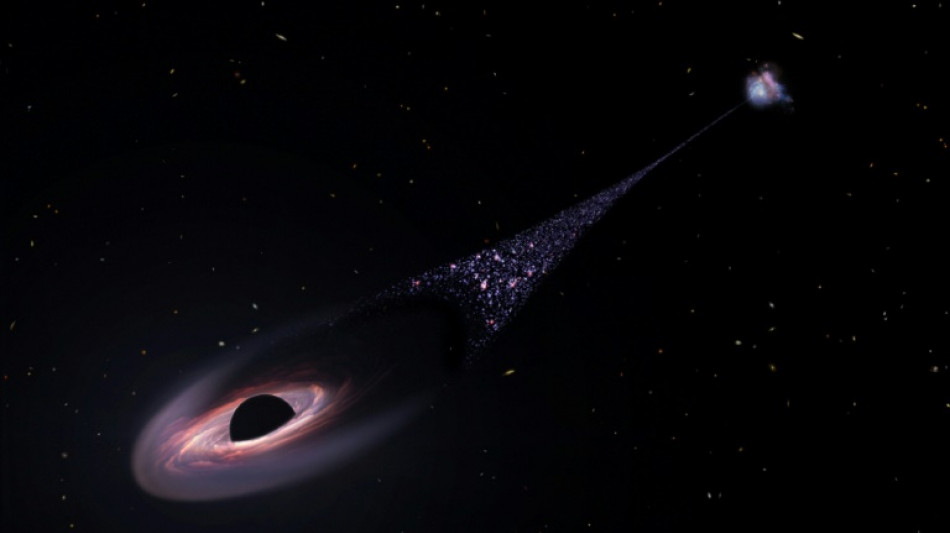
Runaway black hole creating trail of new stars: scientists / Photo: Handout - NASA/ESA/AFP

 #IAmJaneDoe: online support campaign in US university rape case

 Brazil shine on Selecao's first visit to India

 Zverev sets up Djokovic quarter-final at China Open, Rybakina out

 Happier at home, Bordeaux hammer Lyon in Top 14

 Lula, Bolsonaro in final push for votes ahead of knife-edge election

 Boisterous fashion week barnstorms 'sleepy' Nigerian capital

 UAE investigators say flydubai co-pilot was planning 'terrorist act'

 Rahul smacks century in India v Windies ODI

 Daryz seeks to join exclusive club of dual Arc winners

 Russia warns diplomats to leave Kyiv over new strikes threat

 Olympic champ Zheng rebukes rowdy home crowd at China Open

 World No.1 Sinner pulls out of Shanghai Masters to delay return

 Red Bull's Verstappen grabs pole position for Bahrain GP

 India beat Pakistan in blockbuster as golfer Kim wins 'crazy' gold

 India beat arch-rivals Pakistan to win Asian Games cricket gold

 Ethiopia's Tigray rebels abandon regional capital as govt advances: journalist

 Tom Kim powers to Games gold and exemption from military service

 Split loyalties for Indian football fans at Brazil friendly

 India-Pakistan blockbuster brings cricket fever to Japan baseball field

 Wong waiting on Rafa after winning Asian Games tennis gold

 With Russia next door and rising costs, Latvia goes to the polls

 Penalty hero rues empty seats as Games hosts Japan win football gold

 North Korea fires ballistic missile after Seoul's apology demand

 US regulator finds Boeing 737 MAX software bug 'not a safety concern'

 Ohtani 'managing' injuries as Dodgers launch MLB post-season

A huge black hole is tearing through space, leaving behind a 200,000-light-year-long trail of newborn stars, space scientists say.
The supermassive monster -- likely born of a bizarre game of intergalactic billiards -- is rampaging through the blackness and plowing into gas clouds in its path.
The incredible forces at play mean this gas is being forged into a contrail of new stars, which have been captured on camera by NASA's powerful Hubble Space Telescope.
"We think we're seeing a wake behind the black hole where the gas cools and is able to form stars," said Pieter van Dokkum of Yale University.
"What we're seeing is the aftermath. Like the wake behind a ship, we're seeing the wake behind the black hole."
Researchers believe gas is probably being blasted and warmed by the motion of the black hole.
"Gas in front of it gets shocked because of this supersonic, very high-velocity impact of the black hole moving through the gas," said van Dokkum.
The black hole weighs about the same as 20 million of our Suns.
Scientists believe it began its rampage after being ejected from a celestial menage-a-trois.
The working theory is that two galaxies probably merged about 50 million years earlier, bringing together two supermassive black holes, which whirled around each other harmoniously.
But a third galaxy butted in with its own black hole, creating an unstable and chaotic scene that eventually saw one of them ejected at high speed -- fast enough to travel between the Earth and the Moon in just 14 minutes.
Stargazers say there is no cause for earthly concern because this is all very far away.
It's also a long time ago -- back when the universe was half of its current age. We are seeing it now because of the time it has taken for light to arrive here.
The runaway black hole, which has never been seen before, was discovered by accident, says van Dokkum.
"I was just scanning through the Hubble image and then I noticed that we have a little streak.
"It didn't look like anything we've seen before," he said, adding the star trail is "quite astonishing, very, very bright and very unusual."
While this is the first tearaway black hole ever spotted, it might not be the only one, says NASA.
Their Nancy Grace Roman Space Telescope, which is expected to launch some time this decade, should give astronomers a much wider view of the universe -- and could lead to the discovery of more of these star-forming runaways.
T.Vitorino--PC



