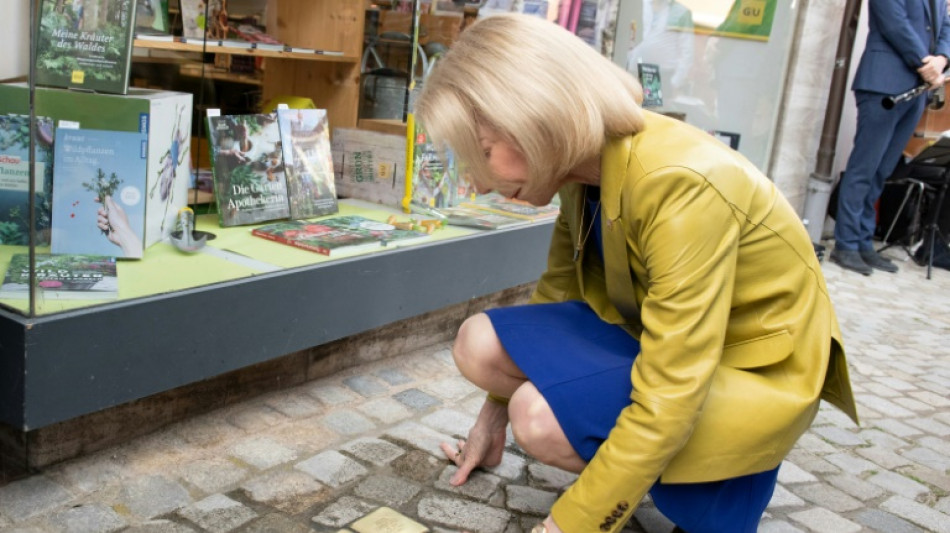
Giant Holocaust project marks 100,000-plaque milestone / Photo: THOMAS KIENZLE - AFP

 Tuchel hails 'complete' England after Croatia demolition

 Fury to invite Trump to lead ring walk before Joshua showdown

 Fashion industry in 'precarious moment', says Vivienne Westwood supremo

 Seventh heaven for England in Nations League rout of Croatia

 Storms, flooding cause chaos on Greek holiday island of Crete

 #IAmJaneDoe: online support campaign in US university rape case

 Brazil shine on Selecao's first visit to India
 Zverev sets up Djokovic quarter-final at China Open, Rybakina out
 Happier at home, Bordeaux hammer Lyon in Top 14

 Lula, Bolsonaro in final push for votes ahead of knife-edge election

 Boisterous fashion week barnstorms 'sleepy' Nigerian capital

 UAE investigators say flydubai co-pilot was planning 'terrorist act'

 Rahul smacks century in India v Windies ODI

 Daryz seeks to join exclusive club of dual Arc winners

 Russia warns diplomats to leave Kyiv over new strikes threat

 Olympic champ Zheng rebukes rowdy home crowd at China Open

 World No.1 Sinner pulls out of Shanghai Masters to delay return

 Red Bull's Verstappen grabs pole position for Bahrain GP
 India beat Pakistan in blockbuster as golfer Kim wins 'crazy' gold

 India beat arch-rivals Pakistan to win Asian Games cricket gold

 Ethiopia's Tigray rebels abandon regional capital as govt advances: journalist

 Tom Kim powers to Games gold and exemption from military service

 Split loyalties for Indian football fans at Brazil friendly

 India-Pakistan blockbuster brings cricket fever to Japan baseball field

 Wong waiting on Rafa after winning Asian Games tennis gold
The world's largest grassroots Holocaust memorial project has laid its 100,000th personalised plaque, as the US ambassador to Germany honoured her family members who fled the Nazis with an emotional ceremony.
When sculptor Gunter Demnig started the Stolpersteine, or "stumbling blocks", initiative three decades ago, he had little idea it would spread to more than 20 countries in Europe and crystallise many of the fraught contemporary questions around historical remembrance.
Each block, or Stolperstein, the size of a cobblestone, bears a stark engraving with the name of a victim, birthdate, date of deportation or escape and, if known, date and place of death.
The shiny brass of the plaques, embedded in the pavement in front of the victim's last home, catches the light, encouraging passers-by to stop and read the small inscriptions.
Last Friday, Demnig placed the 100,000th plaque in Nuremberg, the German city associated with the Nazis' giant torchlight parades and the 1935 race laws that stripped Jews of their rights.
On Tuesday, he joined US Ambassador Amy Gutmann in the picturesque southern city of Feuchtwangen to lay eight blocks for her German Jewish relatives.
"As the US ambassador, the daughter of Kurt Gutmann, a Jewish refugee from Feuchtwangen, I feel like we have come full circle from trauma to tribute," she said.
- 'Madness' -
While still a college student in 1934, Kurt Gutmann realised he and his family would not be safe in the country under Adolf Hitler and escaped to India, where his parents and five other relatives eventually joined him as the Nazis' extermination campaign gathered pace.
He later settled in New York, where Amy Gutmann was born.
"With enormous foresight for a young man of only 23, Kurt Gutmann, my father, recognised the madness that was sweeping his home country," said Gutmann, 73, fighting back tears. "He was a hero."
She said that over the past year, "I have learned more about what my family experienced in Nazi Germany than I ever heard from them," describing a "wall of silence" around Holocaust survivors.
Gutmann told guests at the commemoration in Feuchtwangen, which had an 800-year-old history of Jewish life, that the Stolpersteine gave her "the honour of bringing some closure for my family".
Demnig started the Stolpersteine in 1996, hoping to bring the unfathomable dimensions of the Holocaust down to a human scale. The project stands in marked contrast to the sprawling, more abstract memorial that later opened in central Berlin for the Nazis' six million Jewish victims.
"My 100,000 stones are only so many," Demnig, 75, told AFP, squeezing together two fingers in a pinch.
"But maybe someday there will be 200,000," he said. "It will always remain a symbol. But I think this symbol is very important."
- 'Different image' -
The Stolpersteine are rooted in the Talmud, the central text of Judaism, which says that a person is forgotten only when their name is forgotten. They also aim to keep the memory of the Holocaust alive as the last survivors die off.
"The origin of the project is of course no reason for joy," Demnig said.
"But when I see how happy these relatives are that their name is now back here, and I think that many go home again with a different image of Germany, then I know why I do it."
Descendants often travel from abroad to lay the stones, which cost around 130 euros ($139) to cover Demnig's expenses, and which are often financed by local sponsors.
Current residents of homes from which Nazi victims were deported frequently attend the inauguration ceremonies and lay flowers for victims, while high school students research the biographies as part of history classes.
Although the Stolpersteine are now part of the landscape throughout Germany and many other European countries, some critics say the placement of the stones in pavement invites passers-by to tread on them, desecrating the victims' memory.
The Stolpersteine project has grown during a time in which Germany's Jewish community has flourished, now numbering more than 200,000 people.
Ferreira--PC



