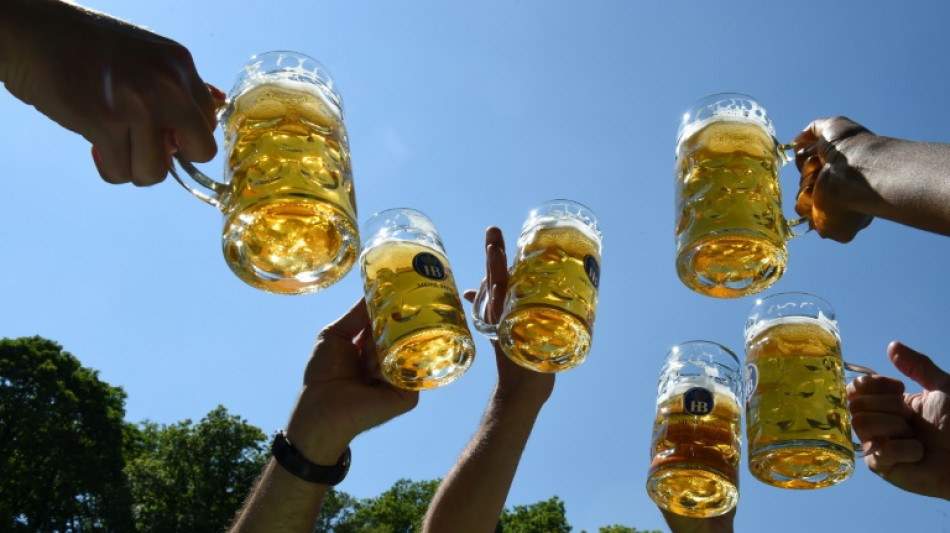
Scientists explain why peanuts 'dance' when dropped in beer / Photo: Christof STACHE - AFP/File

 Yamal on target as Spain hold off Czech Republic

 Latvian exit polls suggest pro-European choice

 Lula, Bolsonaro wrap up campaigns ahead of knife-edge election

 Tuchel hails 'complete' England after Croatia demolition

 Fury to invite Trump to lead ring walk before Joshua showdown

 Fashion industry in 'precarious moment', says Vivienne Westwood supremo

 Seventh heaven for England in Nations League rout of Croatia

 Storms, flooding cause chaos on Greek holiday island of Crete

 #IAmJaneDoe: online support campaign in US university rape case

 Brazil shine on Selecao's first visit to India

 Zverev sets up Djokovic quarter-final at China Open, Rybakina out

 Happier at home, Bordeaux hammer Lyon in Top 14

 Lula, Bolsonaro in final push for votes ahead of knife-edge election

 Boisterous fashion week barnstorms 'sleepy' Nigerian capital

 UAE investigators say flydubai co-pilot was planning 'terrorist act'

 Rahul smacks century in India v Windies ODI

 Daryz seeks to join exclusive club of dual Arc winners

 Russia warns diplomats to leave Kyiv over new strikes threat

 Olympic champ Zheng rebukes rowdy home crowd at China Open

 World No.1 Sinner pulls out of Shanghai Masters to delay return

 Red Bull's Verstappen grabs pole position for Bahrain GP

 India beat Pakistan in blockbuster as golfer Kim wins 'crazy' gold

 India beat arch-rivals Pakistan to win Asian Games cricket gold

 Ethiopia's Tigray rebels abandon regional capital as govt advances: journalist

 Tom Kim powers to Games gold and exemption from military service

When peanuts are dropped into a pint of beer, they initially sink to the bottom before floating up and "dancing" in the glass.
Scientists have dug deep seeking to investigate this phenomenon in a new study published on Wednesday, saying it has implications for understanding mineral extraction or bubbling magma in the Earth's crust.
Brazilian researcher Luiz Pereira, the study's lead author, told AFP that he first had the idea when passing through Argentina's capital Buenos Aires to learn Spanish.
It was a "bartender thing" in the city to take a few peanuts and pop them into beers, Pereira said.
Because the peanuts are denser than the beer, they first sink down to the bottom of the glass.
Then each peanut becomes what is called a "nucleation site". Hundreds of tiny bubbles of carbon dioxide form on their surface, acting as buoys to drag them upwards.
"The bubbles prefer to form on the peanuts rather than on the glass walls," explained Pereira, a researcher at Germany's Ludwig Maximilian University of Munich.
When the bubbles reach the surface, they burst.
The peanuts then dive down before being propelled up again by freshly formed bubbles, in a dance that continues until the carbon dioxide runs out -- or someone interrupts by drinking the beer.
In a series of experiments, the team of researchers in Germany, Britain and France examined how roasted, shelled peanuts fared in a lager-style beer.
- Next up: more beers -
The study, published in the journal Royal Society Open Science, describes two key factors in what the researchers dubbed the "beer–gas–peanut system".
They found that the larger the "contact angle" between the curve of an individual bubble and the surface of the peanut was, the more likely it was to form and grow.
But it cannot grow too much -- a radius of under 1.3 millimetres is ideal, the study said.
Pereira said he hoped that "by deeply researching this simple system, which everyone can grasp, we can understand a system" that would be useful for industry or explaining natural phenomena.
For example, he said the floatation process was similar to the one used to separate iron from ore.
Air is injected, in a controlled way, into a mixture in which a mineral -- such as iron -- "will rise because bubbles attach themselves more easily to it, while other (minerals) sink to the bottom," he said.
The same process could also explain why volcanologists find that the mineral magnetite rises to higher layers in the crystallised magma of the Earth's crust than would be expected.
Like peanuts, magnetite is denser, so should sit at the bottom. But due to a high contact angle, the researchers theorise, the mineral rises through the magma with help from gas bubbles.
Of course, science is never settled -- particularly when beer is involved.
Hoping to create a better model of the dancing peanut phenomenon, Pereira said the scientists will continue to "play with the characteristics of different peanuts and different beers".
A.F.Rosado--PC



