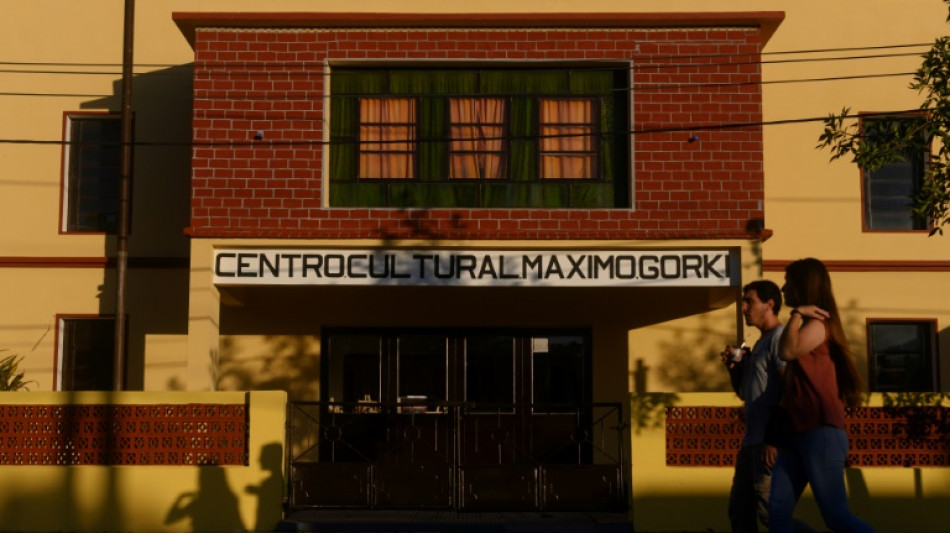
Uruguay's century-old Russian colony troubled over war from afar

 US regulator finds Boeing 737 MAX software bug 'not a safety concern'

 Ohtani 'managing' injuries as Dodgers launch MLB post-season

 Botched US execution leaves murderer unconscious on ventilator: lawyers

 Cornell rape case exposes sexual violence at US colleges

 France held by Italy in Zidane's homecoming after Olise stunner

 Ethiopian pro-government militia claims Tigray airport as regional tensions spike

 Ohtani shaking off injuries as Dodgers launch MLB post-season

 Sea levels to rise in California as coastal wave surges up west coast

 New rallies urged in France as protests disrupt over 730 schools

 Djokovic survives China Open scare, Sabalenka starts strong

 King Charles to evoke colonial 'darkest days' on Caribbean tour

 Tesla shares jump after global car sales top estimates

 DR Congo Ebola outbreak killed more than 4,000: official figures

 Djokovic survives China Open scare against wildcard world no. 104
 Lula, Bolsonaro trade blows in final scramble for votes in Brazil
 New clashes erupt as protests disrupt over 560 French schools
 NY governor vows to close loophole after alleged Cornell gang rape

 Ethiopia Tigray rebels pushed back as regional tensions spike

 Stocks rise, yields fall as US job numbers disappoint
 Man City verdict a 'big topic' for England players, says Tuchel

 NY attorney general tasked with investigating alleged Cornell gang rape

 China widens military footprint with Laos air base
 G7 talks as US pressures Europe over diesel stocks
 Man City launch appeal against explosive financial ruling
 Swiss president to quit government
Far away from Kyiv and even further from Moscow, residents of the small Uruguayan village of San Javier -- an old Russian settlement -- look on with dismay at the invasion of Ukraine.
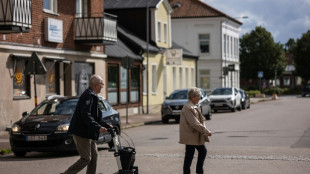
At a first glance, the community's grid plan, low houses and surrounding fields resembles any other rural Uruguayan village -- but a scratch below the surface reveals the history of a site founded more than a century ago by Russian peasants.
Although few of their descendants speak Russian or even carry Russian names, the inhabitants here insist they are "proud" of their Slavic heritage, while also firmly denouncing the motherland's invasion of Ukraine.
San Javier has several Cyrillic inscriptions on display, a "Maximo Gorki" cultural center and five giant matryoshka dolls on the central square.
It all points to a history that is "unique in Uruguay and South America," says Leonardo Martinez, the deputy mayor of the village of 1,800 people.
San Javier's story began in 1913 when 300 families -- originally from Russia's western Voronezh region and followers of the "New Israel" Christian sect that was persecuted by Tsarist Russia -- arrived in Montevideo.
A few months later, around 600 people settled in San Javier, a five-hour drive northwest of Montevideo and flanked by the Uruguay River.
It was the largest autonomous Russian agricultural colony in South America, and quickly became a roaring success.
A century later, the sunflower -- which the colonists introduced to Uruguay -- appears everywhere as the village symbol.
"Looking at photos we feel a bit nostalgic... for the great sacrifice they made," said Martinez, 43, the great-grandson of an original settler.
The mayoral office claims a "high percentage" of the current inhabitants descend from the Russian colonizers, although over time the village has seen a blending of people and cultures, like the country as a whole.
The local restaurant offers the typical Uruguayan grilled meat "asado" as well as "shashlik," a type of lemon-seasoned skewered meat popular across much of the former Soviet Union.
The village square hosts Uruguayan creole folk dances as well as traditional Russian ones.
- Killing 'brothers' -
The village, which has its own museum, has become a tourist site for its Russian history.
But despite those ties, not a single flag or banner proclaiming partisanship can be found in its streets.
"I've not seen explicit support in San Javier" for either country, said Martinez about the war between Russia and Ukraine more than 10,000 kilometers (6,200 miles) away.
"We're against the war, that's obvious," he said. "Against all armed conflict."
Leonardo Lorduguin, a 22-year-old San Javier resident, has set up a Facebook page dedicated to his village.
He is fascinated by the Russian language, which he has been learning for two years -- one of the few of his generation to speak it.
But he would not commit to either side in the conflict.
Like many other villagers, he insists that the first settlers came from "Great Russia" -- an old term that includes territories outside the modern Russian borders.
"In 1913, only Russians came but some had Ukrainian names. They came to Montevideo and were told there was a Russian colony in San Javier," said Lorduguin, reeling off the Russian and Ukrainian surnames of some villagers.
Alejandro Sabelin, 80, is one of the only other villagers who speaks Russian alongside Spanish.
His father was born in San Javier three months after his grandparents arrived there.
He recognizes that the language is being lost in the community. His own children understand Russian better than they speak it.
A picture of his grandparents hangs in his small house.
"I'm really sorry about what is happening because it is almost like killing your brothers," he said of Russia's invasion of its neighbor.
Although he has never visited the homeland of his grandparents, Sabelin says, "I will never stop supporting Russia."
But "the war is awful, what's happening is horrible," he adds.
L.E.Campos--PC



