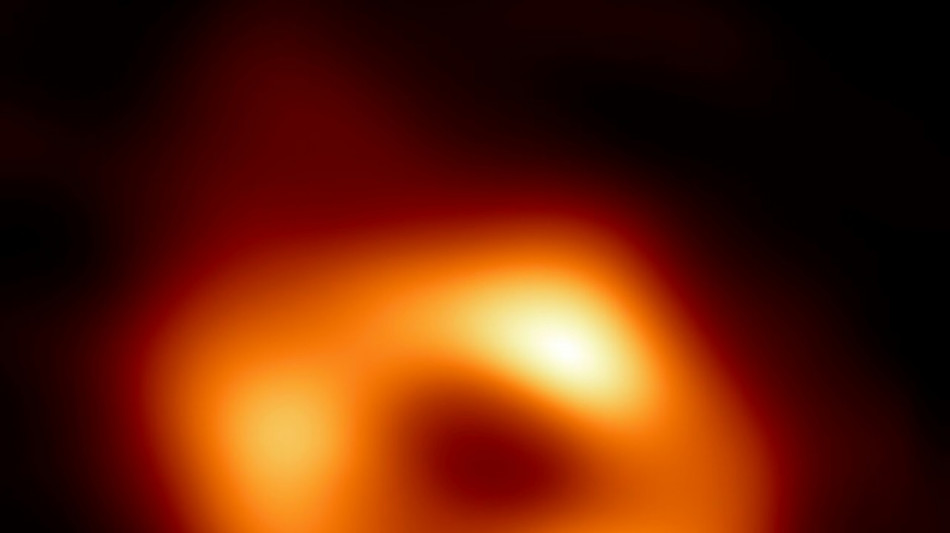
Our galaxy's black hole not as sleepy as thought: astronomers / Photo: Handout - European Southern Observatory/AFP/File

 Yamal on target as Spain hold off Czech Republic

 Latvian exit polls suggest pro-European choice

 Lula, Bolsonaro wrap up campaigns ahead of knife-edge election

 Tuchel hails 'complete' England after Croatia demolition

 Fury to invite Trump to lead ring walk before Joshua showdown

 Fashion industry in 'precarious moment', says Vivienne Westwood supremo
 Seventh heaven for England in Nations League rout of Croatia

 Storms, flooding cause chaos on Greek holiday island of Crete

 #IAmJaneDoe: online support campaign in US university rape case

 Brazil shine on Selecao's first visit to India

 Zverev sets up Djokovic quarter-final at China Open, Rybakina out

 Happier at home, Bordeaux hammer Lyon in Top 14

 Lula, Bolsonaro in final push for votes ahead of knife-edge election

 Boisterous fashion week barnstorms 'sleepy' Nigerian capital

 UAE investigators say flydubai co-pilot was planning 'terrorist act'

 Rahul smacks century in India v Windies ODI

 Daryz seeks to join exclusive club of dual Arc winners
 Russia warns diplomats to leave Kyiv over new strikes threat

 Olympic champ Zheng rebukes rowdy home crowd at China Open

 World No.1 Sinner pulls out of Shanghai Masters to delay return
 Red Bull's Verstappen grabs pole position for Bahrain GP

 India beat Pakistan in blockbuster as golfer Kim wins 'crazy' gold

 India beat arch-rivals Pakistan to win Asian Games cricket gold

 Ethiopia's Tigray rebels abandon regional capital as govt advances: journalist

 Tom Kim powers to Games gold and exemption from military service

The supermassive black hole lurking at the centre of our Milky Way galaxy is not as dormant as had been thought, a new study shows.
The slumbering giant woke up around 200 years ago to gobble up some nearby cosmic objects before going back to sleep, according to the study published in the journal Nature on Wednesday.
NASA's IXPE space observatory spotted an x-ray echo of this powerful resurgence of activity, the researchers said.
The supermassive black hole Sagittarius A* -- abbreviated to Sgr A* -- is four million times more massive than the Sun. It sits 27,000 light years from Earth at the centre of the Milky Way's spiral.
Last year astronomers revealed the first-ever image of the black hole -- or rather, the glowing ring of gas that surrounds its blackness.
Sgr A* has "always been seen as a dormant black hole," said Frederic Marin, a researcher at France's Strasbourg Astronomical Observatory and the study's first author.
Most supermassive black holes squatting at the middle of their galaxies go dormant after swallowing up all the nearby matter.
"Imagine a bear going into hibernation after devouring everything around it," Marin told AFP.
But the international team of researchers discovered that at around the end of the 19th century, Sgr A* came out of its slumber and consumed any gas and dust unlucky enough to be within its reach.
The feeding frenzy lasted from several months to a year, before the beast went back into hibernation.
- Million times brighter -
When it was active, the black hole was "at least a million times brighter than it is today," Marin said.
Its awakening was noticable because nearby galactic molecular clouds started giving off vastly more x-ray light.
The surge in x-ray light was as "if a single glow-worm hidden in a forest suddenly became as bright as the Sun," French research agency CNRS said in a statement.
Astronomers using NASA's IXPE (Imaging X-ray Polarimetry Explorer) space observatory managed to track the x-ray light and found that it pointed straight back at Sgr A*.
The black hole "emitted an echo of its past activity, which we managed to observe for the first time," Marin said.
The pull of gravity from black holes is so intense that nothing can escape, including light.
But when matter is sucked beyond the black hole's final boundary, known as the event horizon, it emits a massive amount of heat and light before disappearing into the darkness.
Exactly what caused Sgr A* to briefly emerge from its dormant state remains unclear. Could a star or cloud of gas and dust have ventured too close?
The astronomers hope that further observations from the IXPE observatory will help them better understand what happened -- and perhaps reveal more about the origin of supermassive black holes, which remains shrouded in mystery.
A.Santos--PC



