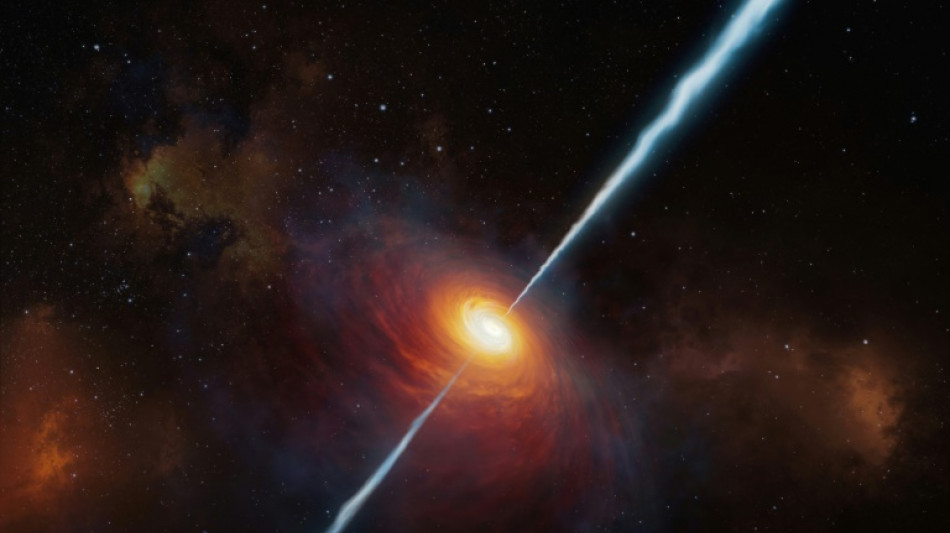
Time appears five times slower in early universe: study / Photo: M. KORNMESSER - European Southern Observatory/AFP/File

 Yamal on target as Spain hold off Czech Republic

 Latvian exit polls suggest pro-European choice

 Lula, Bolsonaro wrap up campaigns ahead of knife-edge election

 Tuchel hails 'complete' England after Croatia demolition

 Fury to invite Trump to lead ring walk before Joshua showdown

 Fashion industry in 'precarious moment', says Vivienne Westwood supremo

 Seventh heaven for England in Nations League rout of Croatia

 Storms, flooding cause chaos on Greek holiday island of Crete

 #IAmJaneDoe: online support campaign in US university rape case
 Brazil shine on Selecao's first visit to India
 Zverev sets up Djokovic quarter-final at China Open, Rybakina out

 Happier at home, Bordeaux hammer Lyon in Top 14

 Lula, Bolsonaro in final push for votes ahead of knife-edge election

 Boisterous fashion week barnstorms 'sleepy' Nigerian capital

 UAE investigators say flydubai co-pilot was planning 'terrorist act'

 Rahul smacks century in India v Windies ODI

 Daryz seeks to join exclusive club of dual Arc winners

 Russia warns diplomats to leave Kyiv over new strikes threat

 Olympic champ Zheng rebukes rowdy home crowd at China Open

 World No.1 Sinner pulls out of Shanghai Masters to delay return
 Red Bull's Verstappen grabs pole position for Bahrain GP

 India beat Pakistan in blockbuster as golfer Kim wins 'crazy' gold

 India beat arch-rivals Pakistan to win Asian Games cricket gold

 Ethiopia's Tigray rebels abandon regional capital as govt advances: journalist

 Tom Kim powers to Games gold and exemption from military service

Time appears to run five times slower in the early universe, scientists said on Monday, for the first time using extraordinarily bright cosmic objects called quasars as "clocks" to confirm this strange phenomenon.
Einstein's theory of relativity predicts that because space is expanding, "we should see the distant universe run in slow motion," said Geraint Lewis, an astrophysicist at the University of Sydney and the lead author of a new study.
Researchers had previously used observations of very bright exploding stars called supernovas as cosmic clocks to show that time ran twice as slowly back when the universe was half its current age.
The new study used even brighter quasars to peer further back into the history of the 13.8-billion-year-old universe.
Just over a billion years after the Big Bang, time appeared to flow five times slower, according to the study in the journal Nature Astronomy.
While "everything looks like it's slowed down" from here, Lewis emphasised that the experience of time in these distant places was not different.
"If I could magically transport you back 10 billion years and drop you next to one of these quasars, and you've got a stopwatch, time would just be normal," he told AFP.
"One second would be one second."
- Cosmic clocks -
Aiming to measure this phenomenon, which is called cosmological time dilation, Lewis and University of Auckland statistician Brendon Brewer analysed data from 190 quasars collected over two decades.
Quasars -- supermassive black holes at the centres of distant galaxies -- are thought to be the brightest and most powerful objects in the universe.
This makes them "useful beacons for charting the universe," Lewis said.
But they have proved more difficult to turn into cosmic clocks than supernovas, which provide a reliable single flash as a "tick".
Previous attempts to use quasars to measure time dilation had failed, leading to some "strange suggestions," Lewis said.
These included theories that perhaps quasars were not as distant as had been thought -- or even that "something fundamental was broken" in cosmology, he said.
But the new research "puts everything back in the right place," Lewis said.
It also confirmed that "Einstein is right again," he added.
The researchers were able to succeed where other attempts had fallen short because they had far more data on quasars, according to Lewis. Recent advances in the statistical understanding of randomness also helped.
To turn quasars into clocks with measurable ticks, the researchers had to make sense of the turbulent explosions that occurred as the black holes swallowed material.
Lewis compared it to watching a fireworks display, in which the great flashes seem random but different elements are "brightening and fading on their own kind of timescales".
"What we have done is unravel this firework display, showing that quasars, too, can be used as standard markers of time for the early universe."
B.Godinho--PC



