In UK 'rhubarb triangle', spring arrives in January

 Botched US execution leaves murderer unconscious on ventilator: lawyers

 Cornell rape case exposes sexual violence at US colleges

 France held by Italy in Zidane's homecoming after Olise stunner

 Ethiopian pro-government militia claims Tigray airport as regional tensions spike

 Ohtani shaking off injuries as Dodgers launch MLB post-season

 Sea levels to rise in California as coastal wave surges up west coast

 New rallies urged in France as protests disrupt over 730 schools

 Djokovic survives China Open scare, Sabalenka starts strong

 King Charles to evoke colonial 'darkest days' on Caribbean tour

 Tesla shares jump after global car sales top estimates
 DR Congo Ebola outbreak killed more than 4,000: official figures

 Djokovic survives China Open scare against wildcard world no. 104

 Lula, Bolsonaro trade blows in final scramble for votes in Brazil

 New clashes erupt as protests disrupt over 560 French schools

 NY governor vows to close loophole after alleged Cornell gang rape

 Ethiopia Tigray rebels pushed back as regional tensions spike

 Stocks rise, yields fall as US job numbers disappoint
 Man City verdict a 'big topic' for England players, says Tuchel

 NY attorney general tasked with investigating alleged Cornell gang rape

 China widens military footprint with Laos air base

 G7 talks as US pressures Europe over diesel stocks
 Man City launch appeal against explosive financial ruling

 Swiss president to quit government
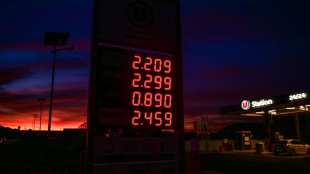 Europe rejects US threats over diesel stocks, urges joint G7 action

 Philippines tennis star Eala says 'I get overwhelmed sometimes'

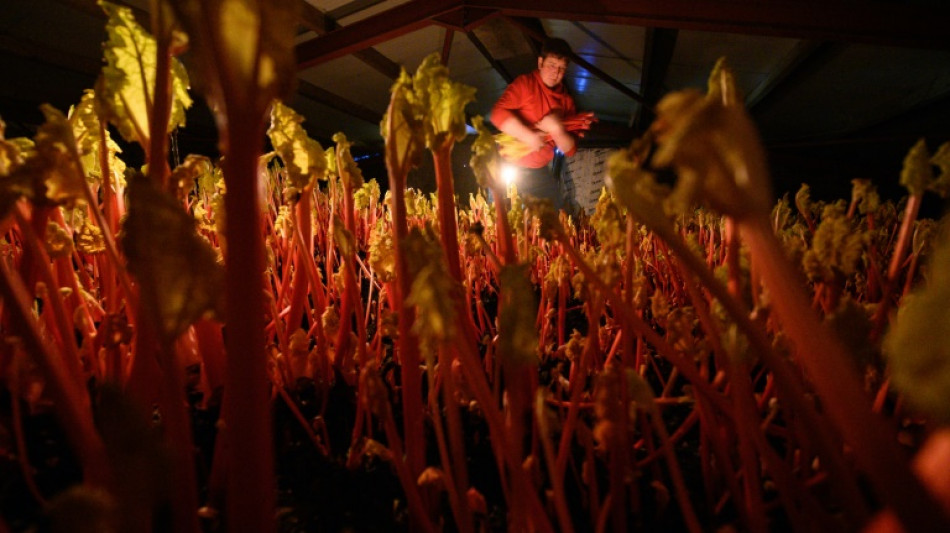
Robert Tomlinson picks rhubarb stalks by candlelight in the dark, carrying on a century-old family tradition that survives today despite the challenges posed to his business by Brexit and climate change.
For four generations, Tomlinson's family have been cultivating "forced rhubarb" in the winter months at their farm in Pudsey, northern England, and are profiting from a resurgence in the plant's popularity.
Hundreds of bright pink stems of the "Harbinger" variety reach for the ceiling after they were brought into sheds from fields to be finished off indoors.
The temperature is kept heated to around 14 degrees Celsius (57 degrees Fahrenheit), and it is almost completely dark.
With this mildness in the air, "we are tricking them into thinking it is spring", Tomlinson, 41, said as he walked around his plants, which benefit from a government-protected designation of origin.
In the absence of stronger light, the plants cannot produce chlorophyll and sugar grows in the stalk rather than the leaf, "so you get a far more tender, sweeter stick than you do in summer with outdoor rhubarb".
The stems can therefore be harvested in winter, when few fresh fruit and vegetables are produced in Britain, and command a higher price than free-range rhubarb, which is typically picked from May.
"You can hear them growing, it makes just like a pop," says Tomlinson, whose farm lies in a part of Yorkshire known as Britain's "rhubarb triangle" because of its concentration of growers.
His great-grandfather started growing the plant, which originated in Asia and Russia, in the late 1880s. Until the 1960s, its tangy taste was popular in Britain.
- Duck a la rhubarb -
But rhubarb then fell out of fashion and many growers gave up. Today there are only 10 left in Yorkshire, according to Tomlinson, down from a peak of more than 200.
In recent years, however, chefs have embraced rhubarb with relish.
They include Tom Cenci of the 26 Grains group, which manages two high-end restaurants in London which use mostly British produce.
"The recipes are endless," he said, before sauteing a few pieces of forced rhubarb in orange juice, adding sugar and a little ginger.
Forced rhubarb grown indoors "has a slightly sweeter taste", and outdoor rhubarb can be more "stringy". Cenci recommends pairing it with fish or duck.
Forced rhubarb is also used in drinks, from flavoured soda to gin, sparkling wine and syrups.
Tomlinson says the wide array of uses has helped him weather the closure of UK restaurants during successive pandemic lockdowns.
Foreign demand has also helped, from restaurants and hotels in Paris, Berlin, Zurich and even New York, he said.
- ' Rising costs' -
But owing to new customs checks since Britain left the EU's single market, "it is far more expensive to send it to Europe now".
And like other British farmers, the rhubarb grower is struggling with labour shortages.
"Costs have gone up. There are so many jobs out there that pay a lot more money," Tomlinson said.
His wife Paula assists, as do his children aged 13 and 14 on weekends.
Milder weather brought about by climate change is another headwind.
The plants need a period of cold in the autumn "to re-energise before we fetch them in the sheds" for indoor harvesting.
"The way in which we are growing is almost identical as it was back then because there is no other way to do it.
"So, I will go on picking by candlelight, by hand," the farmer said. "There are no machines to do it."
A.F.Rosado--PC



