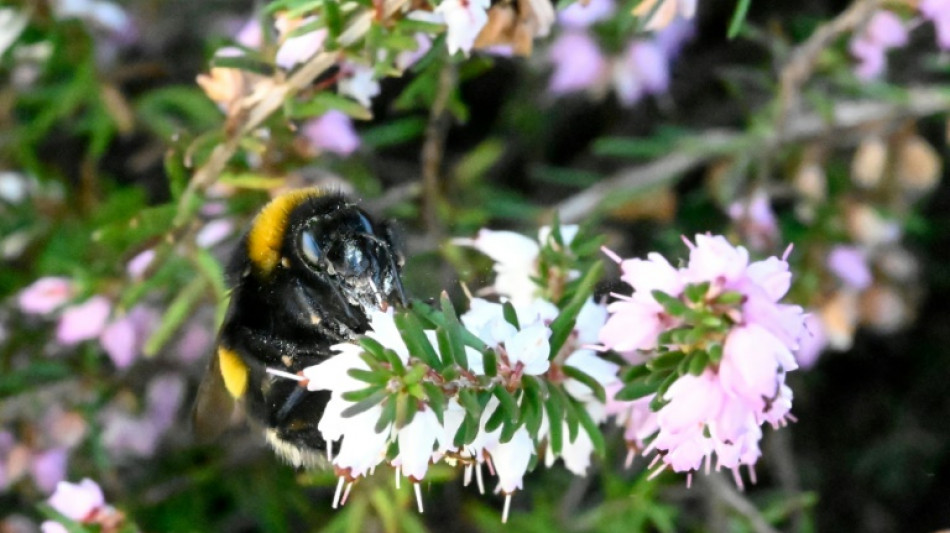
Small bees better at coping with warming, bumblebees struggle: study / Photo: Damien MEYER - AFP/File

 Botched US execution leaves murderer unconscious on ventilator: lawyers

 Cornell rape case exposes sexual violence at US colleges

 France held by Italy in Zidane's homecoming after Olise stunner

 Ethiopian pro-government militia claims Tigray airport as regional tensions spike

 Ohtani shaking off injuries as Dodgers launch MLB post-season

 Sea levels to rise in California as coastal wave surges up west coast

 New rallies urged in France as protests disrupt over 730 schools

 Djokovic survives China Open scare, Sabalenka starts strong

 King Charles to evoke colonial 'darkest days' on Caribbean tour

 Tesla shares jump after global car sales top estimates

 DR Congo Ebola outbreak killed more than 4,000: official figures

 Djokovic survives China Open scare against wildcard world no. 104

 Lula, Bolsonaro trade blows in final scramble for votes in Brazil

 New clashes erupt as protests disrupt over 560 French schools

 NY governor vows to close loophole after alleged Cornell gang rape

 Ethiopia Tigray rebels pushed back as regional tensions spike

 Stocks rise, yields fall as US job numbers disappoint

 Man City verdict a 'big topic' for England players, says Tuchel

 NY attorney general tasked with investigating alleged Cornell gang rape

 China widens military footprint with Laos air base

 G7 talks as US pressures Europe over diesel stocks

 Man City launch appeal against explosive financial ruling

 Swiss president to quit government

 Europe rejects US threats over diesel stocks, urges joint G7 action

 Philippines tennis star Eala says 'I get overwhelmed sometimes'

Climate change could lead to more small-bodied bees but fewer bumblebees, according to research published Wednesday, warning of potential "cascading" effects on plant pollination and across whole ecosystems.
Scientists in the United States trapped and studied more than 20,000 bees over eight years in an area of the Rocky Mountains to find out how different types of bees reacted to changing climatic conditions.
The authors said that while environmental conditions varied from year to year, the sub-alpine region from which they took samples is "particularly vulnerable to climate change", with generally warming spring temperatures and earlier snow melt.
They found that comb-building cavity nesters and larger bodied bees declined in abundance as temperatures increased, while smaller, soil-nesting bees increased.
"Our research suggests that climate-induced changes in temperature, snowpack and summer precipitation may drastically reshape bee communities," the authors said.
- Bumblebees 'more threatened' -
Researchers said the findings suggest a reduction of bigger bees, including in the families of bumblebee, leafcutters and mason bees, with higher temperatures.
Declines were particularly marked for bumblebees, which the researchers said suggests "this group is more threatened under climate warming than other bees in our system".
That tallies with other studies showing that bumblebees, the dominant pollinators in many ecosystems, have a lower heat tolerance than other bees and move to cooler regions at higher altitudes as temperatures warm.
Researchers said their findings suggest both bumblebees' body size and nest behaviour could also make them more vulnerable in a warming world.
In general, the authors said climate-driven changes to pollinator communities "could have cascading effects on pollination and ecosystem functioning".
For example, they said losing bigger bees, which tend to fly further for food, may mean a reduction in longer-distance pollination.
The study, published in the journal Proceedings of the Royal Society B, was specifically focused on mountainous areas, but the researchers said other research across the US showed declines in larger bees in response to environmental changes.
They did however say their findings that drier conditions favoured bees with specialist diets may not be applicable to other ecosystems, where climate change is expected to bring more rainfall.
Insects are the world's top pollinators -- 75 percent of 115 top global food crops depend on animal pollination, including cocoa, coffee, almonds and cherries, according to the UN.
In a landmark 2019 report, scientists concluded that nearly half of all insect species worldwide are in decline and a third could disappear altogether by century's end.
One in six species of bees have gone regionally extinct somewhere in the world.
The main drivers of extinction are thought to be habitat loss and pesticide use.
N.Esteves--PC



