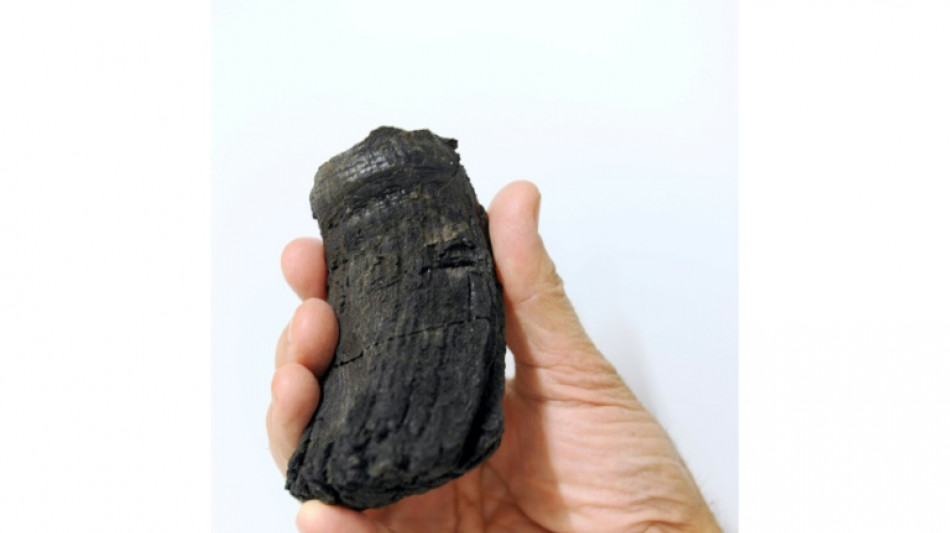
Giant tooth of ancient marine reptile discovered in Alps / Photo: Rosi ROTH - EUREKALERT!/AFP

 US regulator finds Boeing 737 MAX software bug 'not a safety concern'

 Ohtani 'managing' injuries as Dodgers launch MLB post-season

 Botched US execution leaves murderer unconscious on ventilator: lawyers

 Cornell rape case exposes sexual violence at US colleges

 France held by Italy in Zidane's homecoming after Olise stunner

 Ethiopian pro-government militia claims Tigray airport as regional tensions spike

 Ohtani shaking off injuries as Dodgers launch MLB post-season

 Sea levels to rise in California as coastal wave surges up west coast

 New rallies urged in France as protests disrupt over 730 schools

 Djokovic survives China Open scare, Sabalenka starts strong

 King Charles to evoke colonial 'darkest days' on Caribbean tour

 Tesla shares jump after global car sales top estimates

 DR Congo Ebola outbreak killed more than 4,000: official figures

 Djokovic survives China Open scare against wildcard world no. 104

 Lula, Bolsonaro trade blows in final scramble for votes in Brazil

 New clashes erupt as protests disrupt over 560 French schools

 NY governor vows to close loophole after alleged Cornell gang rape

 Ethiopia Tigray rebels pushed back as regional tensions spike

 Stocks rise, yields fall as US job numbers disappoint

 Man City verdict a 'big topic' for England players, says Tuchel

 NY attorney general tasked with investigating alleged Cornell gang rape

 China widens military footprint with Laos air base

 G7 talks as US pressures Europe over diesel stocks

 Man City launch appeal against explosive financial ruling

 Swiss president to quit government

The fossils of three ichthyosaurs -- giant marine reptiles that patrolled primordial oceans -- have been discovered high up in the Swiss Alps, and include the largest ever tooth found for the species, a study said Thursday.
With elongated bodies and small heads, the prehistoric leviathans weighed up to 80 metric tons (88 US tons) and grew to 20 meters (yards), making them among the largest animals to have ever lived.
They first appeared 250 million years ago in the early Triassic, and a smaller, dolphin-like subtype survived until 90 million years ago. But the gigantic ichthyosaurs, which comprised most of the species, died out 200 million years ago.
Unlike dinosaurs, ichthyosaurs barely left a trace of fossil remains, and "why that is remains a great mystery to this day," said Martin Sander of the University of Bonn, lead author of the paper in the Journal of Vertebrate Paleontology.
The specimens in question, dated to 205 million years ago in the study, were unearthed between 1976 and 1990 during geological surveys, but were only recently analyzed in detail.
Fun fact: they were discovered at an altitude of 2,800 meters (9,100 feet). During their lifetimes the three swam in waters around the supercontinent Pangea-- but due to plate tectonics and the folding of the Alps, the fossils kept rising.
Ichthyosaurs were previously thought to have only inhabited the deep ocean, but the rocks from which the new fossils derive are believed to have been at the bottom of a shallow coastal area. It could be that some of the giants followed schools of fish there.
There are two sets of skeletal remains. One consists of ten rib fragments and a vertebra, suggesting an animal some 20 meters long, which is more or less equivalent to the largest ichthyosaur to have been found, in Canada.
The second animal measured 15 meters, according to an estimate from the seven vertebrae found.
"From our point of view, however, the tooth is particularly exciting," explained Sander.
"Because this is huge by ichthyosaur standards: Its root was 60 millimeters (2.4 inches) in diameter - the largest specimen still in a complete skull to date was 20 millimeters and came from an ichthyosaur that was nearly 18 meters long."
While this could indicate a beast of epic proportions, it's more likely to have come from an ichthyosaur with particularly gigantic teeth, rather than a particularly gigantic ichthyosaur.
Current research holds that extreme gigantism is incompatible with a predatory lifestyle requiring teeth.
That's why the largest known animal to have ever lived -- the blue whale at 30 meters long and 150 tons -- lacks teeth.
Blue whales are filter feeders, while the much smaller sperm whales, at 20 meters long and 50 tons, are hunters, and use more of their energy to fuel their muscles.
"Marine predators therefore probably can't get much bigger than a sperm whale," Sander said, though more fossils would need to be found to know for certain. "Maybe there are more remains of the giant sea creatures hidden beneath the glaciers," he said.
A.Aguiar--PC



