
SpaceX makes history with first spacewalks by private citizens / Photo: - - Polaris Program/AFP

 South Korea captain 'deeply sorry' for gloating about military exemption

 Alcaraz through to Japan Open semis after Shapovalov injury

 Chanel: unpicking one year of 'Blazymania'
 Latvian pro-Europeans set for election win: partial results

 China swim sensation Yu Zidi, 13, says 'I'm no prodigy'

 Yu Zidi to Ohashi: Asian Games stars who can light up LA Olympics

 'Act before it's too late': Tokyo residents fight for more trees

 'Disappointing' as South Korea flag mishap sees Games end on sour note

 Pre-COP host Tuvalu at frontline of climate change
 Hungary's dwindling paprika producers battle to save signature spice

 Cornell president vows review in wake of alleged student gang rape

 Latvian partial election results suggest pro-European choice

 In Egypt's Sinai, Gazan builds school for children displaced by war

 Trump tariffs a mixed bag for US auto industry

 Yemen government forces say struck Houthi targets

 Music links past, present for Pedro Pascal's cellist in 'Behemoth!'

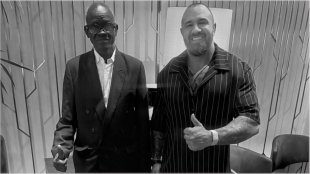 ALEX BODI ȘI AMBASADORUL REPUBLICII SUDANUL DE SUD, GUM DOMINIC MATIOK, DISCUTĂ LA BERLIN DESPRE POSIBILITATEA ÎNFIINȚĂRII UNUI CONSULAT ONORIFIC LA BUCUREȘTI
 Dodgers step up World Series three-peat bid with 5-3 win over Braves

 Spain break down Czechs as England outclass Croatia in Nations League

 Yamal on target as Spain hold off Czech Republic

 Latvian exit polls suggest pro-European choice

 Lula, Bolsonaro wrap up campaigns ahead of knife-edge election

 Tuchel hails 'complete' England after Croatia demolition

 Fury to invite Trump to lead ring walk before Joshua showdown

 Fashion industry in 'precarious moment', says Vivienne Westwood supremo

A pioneering private crew made history Thursday by becoming the first civilians to perform spacewalks, marking a giant leap forward for the commercial space industry.
The SpaceX Polaris Dawn mission, led by fintech billionaire Jared Isaacman, launched early Tuesday from the Kennedy Space Center in Florida, journeying deeper into the cosmos than any humans in the past 50 years, since the Apollo program.
Then, with the four-member crew's Dragon spacecraft lowered to an orbit with a high of 430 miles, pure oxygen began flowing into their suits, marking the official start of their extravehicular activity (EVA) at 1012 GMT on Thursday.
A short time later, Isaacman unlatched the hatch and climbed through, gripping a structure known as "Skywalker," outfitted with hand and footholds, as a breathtaking view of Earth unfolded below him.
"It's gorgeous," he told mission control in Hawthorne, California, where teams cheered on important checkpoints.
It was yet another major milestone for SpaceX, the company founded by Elon Musk in 2002. Initially dismissed by traditionalists, it has since grown into a powerhouse that has reshaped the space industry.
In 2020, it beat aerospace giant Boeing in delivering a safe crewed spaceship to provide rides for NASA astronauts to the International Space Station.
Today, it launches more rockets than any competitor, and its Starlink satellite constellation provides internet service to dozens of countries.
- 'Bit of a dance' -
Prior to hatch opening, the crew completed a "prebreathe" process to purge nitrogen from their blood, preventing decompression sickness caused by nitrogen bubbles. The cabin pressure was gradually reduced to match that of space.
Isaacman and crewmate Sarah Gillis, a SpaceX engineer, spent a few minutes each peeking out into open space, performing mobility tests on SpaceX's next-generation suits that boast heads-up displays, helmet cameras and enhanced joint mobility systems -- before returning inside.
They didn't however float away on a tether like early spacefarers such as Soviet cosmonaut Alexei Leonov or NASA's Ed White did in 1965 -- nor, for that matter, did they use jetpacks to fly away untethered as Space Shuttle astronauts did on three missions in 1984.
Since Dragon doesn't have an airlock, the entire crew were exposed to the vacuum of space. Mission pilot Scott Poteet and SpaceX engineer Anna Menon remained strapped in throughout as they monitored vital support systems during the activity.
"The risk is greater than zero, that's for sure, and it's certainly higher than anything that has been accomplished on a commercial basis," former NASA administrator Sean O'Keefe told AFP.
"This is another watershed event in the march toward commercialization of space for transportation," he added, comparing the crewmates to early aviators who paved the way for modern air travel.
- First of three Polaris missions -
The spacewalk follows a daring first phase of the mission, during which the Dragon spacecraft reached a peak altitude of 870 miles (1,400 kilometers).
This put the crew more than three times higher than the International Space Station, in a region known as the inner Van Allen radiation belt -- a zone filled with dangerous, high-energy particles.
All four underwent more than two years of training in preparation for the landmark mission, logging hundreds of hours on simulators as well as skydiving, centrifuge training, scuba diving and summiting an Ecuadoran volcano.
Upcoming tasks include testing laser-based satellite communications between the spacecraft and the vast Starlink satellite constellation, and completing dozens of experiments, including tests on contact lenses with embedded microelectronics to monitor changes in eye pressure and shape in space.
Polaris Dawn is the first of three missions under the Polaris program, a collaboration between Isaacman and SpaceX.
Financial terms of the partnership remain under wraps, but Isaacman, the 41-year-old founder and CEO of Shift4Payments, reportedly poured $200 million of his fortune into leading the 2021 all-civilian SpaceX Inspiration4 orbital mission.
The final Polaris mission aims to be the first crewed flight of SpaceX's Starship, a prototype next-generation rocket that is key to founder Musk's ambitions of colonizing Mars.
J.Oliveira--PC



