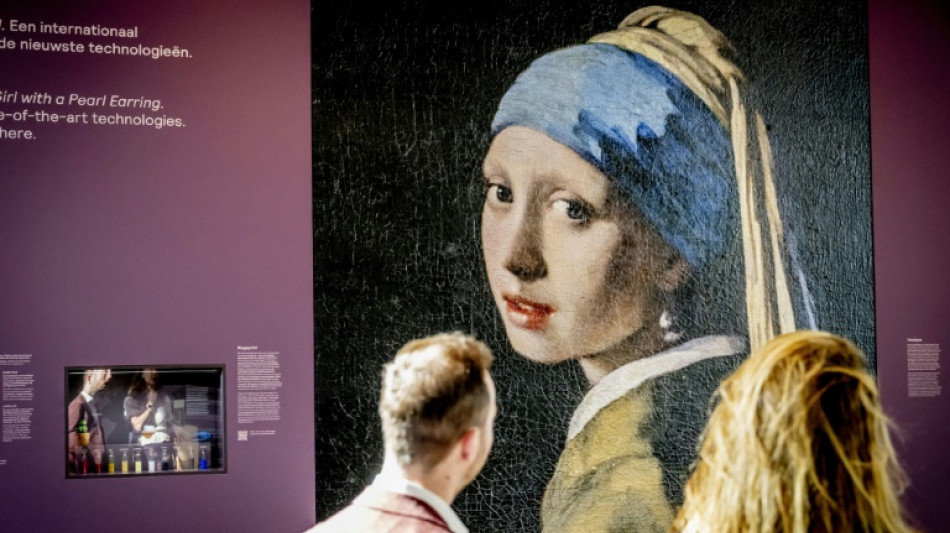
Scientists unlock secret of 'Girl With Pearl Earring' / Photo: Robin UTRECHT - ANP/AFP

 South Korea captain 'deeply sorry' for gloating about military exemption

 Alcaraz through to Japan Open semis after Shapovalov injury

 Chanel: unpicking one year of 'Blazymania'

 Latvian pro-Europeans set for election win: partial results

 China swim sensation Yu Zidi, 13, says 'I'm no prodigy'

 Yu Zidi to Ohashi: Asian Games stars who can light up LA Olympics

 'Act before it's too late': Tokyo residents fight for more trees

 'Disappointing' as South Korea flag mishap sees Games end on sour note

 Pre-COP host Tuvalu at frontline of climate change

 Hungary's dwindling paprika producers battle to save signature spice

 Cornell president vows review in wake of alleged student gang rape

 Latvian partial election results suggest pro-European choice

 In Egypt's Sinai, Gazan builds school for children displaced by war

 Trump tariffs a mixed bag for US auto industry

 Yemen government forces say struck Houthi targets

 Music links past, present for Pedro Pascal's cellist in 'Behemoth!'

 ALEX BODI ȘI AMBASADORUL REPUBLICII SUDANUL DE SUD, GUM DOMINIC MATIOK, DISCUTĂ LA BERLIN DESPRE POSIBILITATEA ÎNFIINȚĂRII UNUI CONSULAT ONORIFIC LA BUCUREȘTI

 Dodgers step up World Series three-peat bid with 5-3 win over Braves

 Spain break down Czechs as England outclass Croatia in Nations League

 Yamal on target as Spain hold off Czech Republic

 Latvian exit polls suggest pro-European choice

 Lula, Bolsonaro wrap up campaigns ahead of knife-edge election

 Tuchel hails 'complete' England after Croatia demolition

 Fury to invite Trump to lead ring walk before Joshua showdown

 Fashion industry in 'precarious moment', says Vivienne Westwood supremo

Johannes Vermeer's "Girl With The Pearl Earring" is one of the world's most popular paintings -- and now scientists believe they know why, by measuring how the brain reacts when the work is viewed.
The Mauritshuis museum in The Hague, which houses the 17th century masterpiece, commissioned neuroscientists to measure brain output when viewing the portrait and other well-known works.
They discovered that the viewer is held captive by a special neurological phenomenon they called "Sustained Attentional Loop", which they believe is unique to the "Girl With The Pearl Earring".
The viewer's eye is automatically drawn first to the girl's own eye, then down to her mouth, then across to the pearl, then back to the eye -- and so it continues.
This makes you look at the painting longer than others, explained Martin de Munnik, from research company Neurensics that carried out the study.
"You have to pay attention whether you want to or not. You have to love her whether you want to or not," he said.
By measuring brainwaves, the scientists also discovered the precuneus, the part of the brain governing consciousness and personal identity, was the most stimulated.
"It was predictable that the Girl was special. But the 'why' was also a surprise to us," said De Munnik.
He said it was the first known study to use EEG and MRI brain scanning machines to measure the neurological response to artwork.
"The longer you look at somebody, the more beautiful or more attractive somebody becomes," he noted, which also explains the popularity of the Dutch master's subject.
"Why are you familiar with this painting and not with the other paintings? Because of this special thing she has."
- 'The brain doesn't lie' -
The scientists also compared the neurological response when looking at the genuine painting in the museum versus being confronted with a reproduction.
They found the emotional reaction experienced by the viewer was ten times stronger for an original than a poster.
To carry out the tests, scientists attached an eye tracker and cap to track brainwaves on 10 subjects that were shown the real paintings but also reproductions.
It shows the importance of seeing original art, said Mauritshuis Director Martine Gosselink.
"It's so important to engage with art, whether it's photography, or dance, or old masters from the 17th century," the director, 55, told AFP in an interview.
"It is important, and it really helps to develop your brain... The brain doesn't lie," she added.
Vermeer often drew the focus onto one spot in his works, with the surrounding details more blurred, she explained.
However, the "Girl With The Pearl Earring" has three such focal points -- the eye, mouth, and pearl -- and Gosselink said this set the work apart from other Vermeer paintings.
"Here we see somebody really looking at you, whereas all other paintings by Vermeer, you see someone writing or doing some needlework, or a person busy doing something," she said.
"But that's the big difference with this girl. She's watching you."
De Munnik, 65, said it would be interesting to carry out similar studies on other famous paintings, such as Da Vinci's Mona Lisa for example.
Mauritshaus director Gosselink alluded to a friendly rivalry between the two great works.
"People sometimes call (The Girl With The Pearl Earring) the Mona Lisa of the North, but I think times are changing, so maybe the Mona Lisa is the Girl of the South," she joked.
J.Oliveira--PC