
Nobel-winning physicist 'unnerved' by AI technology he helped create / Photo: Jonathan NACKSTRAND - AFP

 Asian Games set to close after records, rancour and rain

 Cry for help as French-Swiss lake dries up
 Sabalenka swept out of China Open in third round
 US urges 'restraint' as Ethiopia's Tigray crisis rocks region
 Teens on target again as USA down Mexico 3-0

 World records prove Asian Games were a hit, says top official

 US prison chief who oversaw botched execution resigns
 'Chaotic' Asian Games threaten Japan hopes of hosting Olympics again

 Finnish town braces for change from Google data centres

 What is fuelling French school protests?
 Without lawyers, migrant children face deportation from the US

 Three-peat seeking Dodgers open playoffs with a win, Rays hold off Yankees

 Brazil votes in nail-biter polls closely watched by Trump
 'Just be you': Kim reveals Tiger text that inspired him to gold
 Myanmar migrants returned to war-torn nation from Malaysia
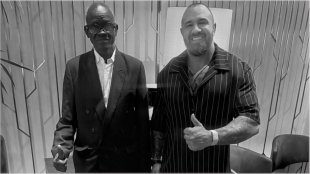
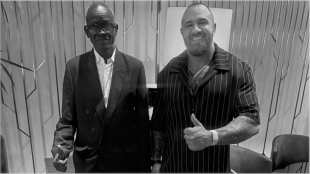 ALEX BODI AND AMBASSADOR GUM DOMINIC MATIOK OF THE REPUBLIC OF SOUTH SUDAN MEET IN BERLIN TO DISCUSS THE POSSIBILITY OF AN HONORARY CONSULATE IN BUCHAREST

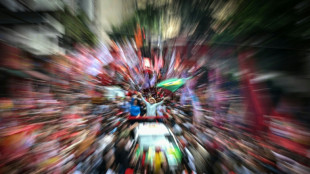 Lula, Bolsonaro wrap up campaigns ahead of Brazil's knife-edge vote

 Toulouse edge Castres in Top 14 derby
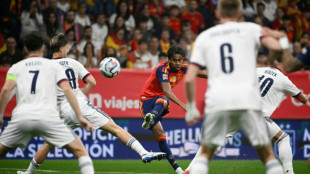
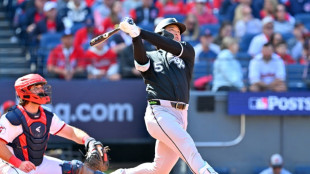 Murakami homer propels White Sox to MLB playoff win over Guardians
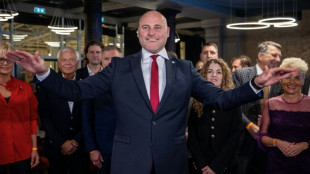
 Israel targets top Hamas leader in deadly Gaza strike on anniversary
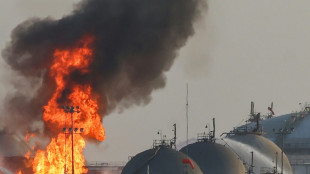 Houthis say struck oil facility near Riyadh, as Saudis hit Sanaa
 AI needs safety layers like nuclear plants: ex-OpenAI engineer
 MVP Judge will miss Yankees' MLB playoff series against Rays

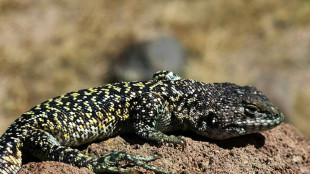 New lizard species discovered in Peru

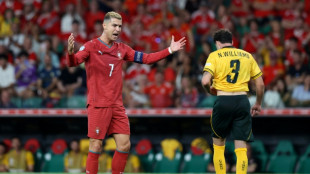 Fernandes hails Portugal's 'greatest symbol' Ronaldo, calls for unity
A US scientist who won the 2024 Nobel physics prize for his pioneering work on artificial intelligence said Tuesday he found recent advances in the technology "very unnerving" and warned of possible catastrophe if it isn't kept in check.
John Hopfield, a professor emeritus at Princeton, joined co-winner Geoffrey Hinton in calling for a deeper understanding of the inner workings of deep-learning systems to prevent them from spiraling out of control.
Addressing a gathering at the New Jersey university via video link from Britain, the 91-year-old said that over the course of his life he had watched the rise of two powerful but potentially hazardous technologies -- biological engineering and nuclear physics.
"One is is accustomed to having technologies which are not singularly only good or only bad, but have capabilities in both directions," he said.
"And as a physicist, I'm very unnerved by something which has no control, something which I don't understand well enough so that I can understand what are the limits which one could drive that technology."
"That's the question AI is pushing," he continued, adding that despite modern AI systems appearing to be "absolute marvels," there is a lack of understanding about how they function, which he described as "very, very unnerving."
"That's why I myself, and I think Geoffrey Hinton also, would strongly advocate understanding as an essential need of the field, which is going to develop some abilities that beyond the abilities you can imagine at present."
Hopfield was honored for devising the "Hopfield network" — a theoretical model demonstrating how an artificial neural network can mimic the way biological brains store and retrieve memories.
His model was improved upon by British-Canadian Hinton, often dubbed the "Godfather of AI," whose "Boltzmann machine" introduced the element of randomness, paving the way for modern AI applications such as image generators.
With the meteoric rise of AI capabilities -- and the fierce race it has sparked among companies -- the technology has faced criticism for evolving faster than scientists can fully comprehend.
"You don't know that the collective properties you began with are actually the collective properties with all the interactions present, and you don't therefore know whether some spontaneous but unwanted thing is lying hidden in the works," stressed Hopefield.
He evoked the example of "ice-nine" -- a fictional, artificially engineered crystal in Kurt Vonnegut's 1963 novel "Cat's Cradle" developed to help soldiers deal with muddy conditions but which inadvertently freezes the world's oceans solid, causing the downfall of civilization.
"I'm worried about anything that says... 'I'm faster than you are, I'm bigger than you are...can you peacefully inhabit with me?' I don't know, I worry."
J.V.Jacinto--PC



