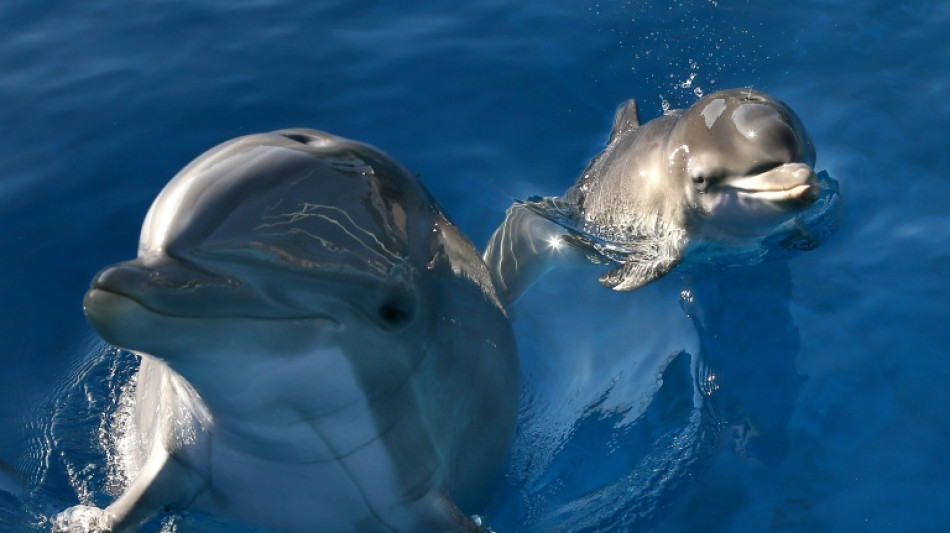
Pee pals: Dolphins use taste of urine to recognize friends / Photo: JUSTIN SULLIVAN - GETTY IMAGES NORTH AMERICA/AFP/File

 US regulator finds Boeing 737 MAX software bug 'not a safety concern'

 Ohtani 'managing' injuries as Dodgers launch MLB post-season

 Botched US execution leaves murderer unconscious on ventilator: lawyers

 Cornell rape case exposes sexual violence at US colleges

 France held by Italy in Zidane's homecoming after Olise stunner

 Ethiopian pro-government militia claims Tigray airport as regional tensions spike

 Ohtani shaking off injuries as Dodgers launch MLB post-season

 Sea levels to rise in California as coastal wave surges up west coast

 New rallies urged in France as protests disrupt over 730 schools

 Djokovic survives China Open scare, Sabalenka starts strong

 King Charles to evoke colonial 'darkest days' on Caribbean tour

 Tesla shares jump after global car sales top estimates

 DR Congo Ebola outbreak killed more than 4,000: official figures

 Djokovic survives China Open scare against wildcard world no. 104

 Lula, Bolsonaro trade blows in final scramble for votes in Brazil

 New clashes erupt as protests disrupt over 560 French schools

 NY governor vows to close loophole after alleged Cornell gang rape

 Ethiopia Tigray rebels pushed back as regional tensions spike

 Stocks rise, yields fall as US job numbers disappoint

 Man City verdict a 'big topic' for England players, says Tuchel

 NY attorney general tasked with investigating alleged Cornell gang rape

 China widens military footprint with Laos air base

 G7 talks as US pressures Europe over diesel stocks

 Man City launch appeal against explosive financial ruling

 Swiss president to quit government

Think about people you know, and how you could tell they were around even if you couldn't see them: their voice, perhaps, or even a favored deodorant.
For bottlenose dolphins, it's the taste of urine and signature whistles that allow them to recognize their friends at a distance, according to a study published Wednesday in Science Advances.
"The use of taste is highly beneficial in the open ocean because urine plumes will persist for a while after an animal has left," wrote the team, led by Jason Bruck at the University of St Andrews.
"By recognizing who caused a plume, dolphins would be alerted to the recent presence of that individual even if it had not signaled its presence vocally."
The question of whether animals can attach "labels" to their friends in their minds has been difficult to answer. Prior research has focused on lab-based experiments, leaving it unclear whether animals use labeling when communicating naturally.
Bottlenose dolphins, which use "signature whistles" to selectively address specific individuals, and can remember these for over 20 years, were thus an interesting test case to study.
To investigate, the team presented eight dolphins with urine samples from familiar and unfamiliar individuals, finding they spent around three times as long sampling urine from those they knew.
Genital inspection, in which a dolphin uses its jaw to touch the genitals of another individual, is common in their social interactions, providing a good opportunity to learn the taste of others' urine.
For the purposes of this study, the dolphins were trained to provide urine samples on demand in exchange for food.
Dolphins do not have olfactory bulbs, and the corresponding nerve is underdeveloped, leaving the team certain it was taste and not smell at play.
Next, the team paired urine samples with recordings of signature whistles played via underwater speakers, corresponding to either the same dolphin that provided the urine sample, or a mismatched sample.
Dolphins remained close to the speaker longer when the vocalizations matched the urine samples -- indicating that the two lines of evidence together evoked more interest.
The team suggested that major urinary proteins, as well as lipids, were likely responsible for individual chemical signatures.
"Given the recognition skills revealed in our study, we think that it is likely that dolphins can also extract other information from urine, such as reproductive state, or use pheromones to influence each other's behavior," they said.
O.Salvador--PC



