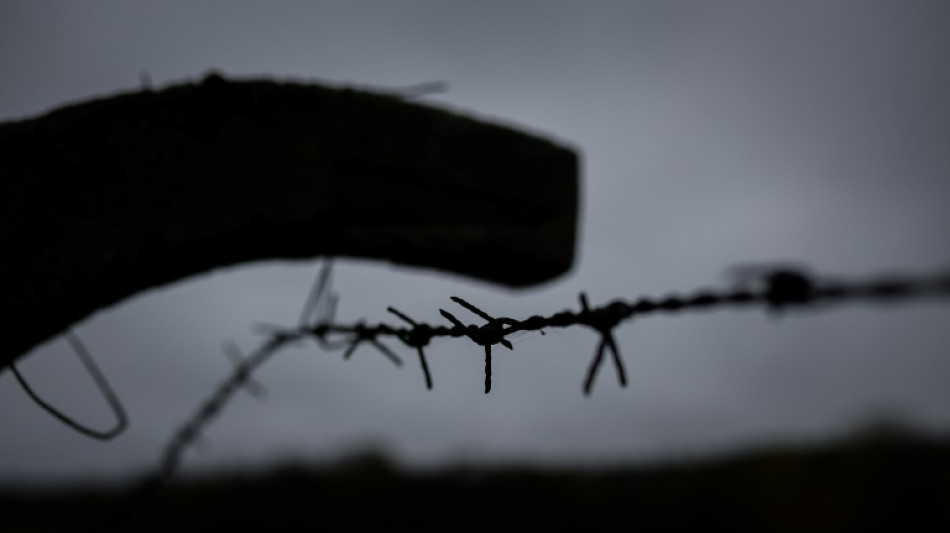
Anger at plan to turn Nazi tunnels into bunker for super-rich / Photo: Ronny Hartmann - AFP

 'Act before it's too late': Tokyo residents fight for more trees
 'Disappointing' as South Korea flag mishap sees Games end on sour note
 Pre-COP host Tuvalu at frontline of climate change
 Hungary's dwindling paprika producers battle to save signature spice
 Cornell president vows review in wake of alleged student gang rape
 Latvian partial election results suggest pro-European choice

 In Egypt's Sinai, Gazan builds school for children displaced by war
 Trump tariffs a mixed bag for US auto industry
 Yemen government forces say struck Houthi targets

 Music links past, present for Pedro Pascal's cellist in 'Behemoth!'
 ALEX BODI ȘI AMBASADORUL REPUBLICII SUDANUL DE SUD, GUM DOMINIC MATIOK, DISCUTĂ LA BERLIN DESPRE POSIBILITATEA ÎNFIINȚĂRII UNUI CONSULAT ONORIFIC LA BUCUREȘTI
 Dodgers step up World Series three-peat bid with 5-3 win over Braves
 Spain break down Czechs as England outclass Croatia in Nations League
 Yamal on target as Spain hold off Czech Republic

 Latvian exit polls suggest pro-European choice

 Lula, Bolsonaro wrap up campaigns ahead of knife-edge election

 Tuchel hails 'complete' England after Croatia demolition

 Fury to invite Trump to lead ring walk before Joshua showdown

 Fashion industry in 'precarious moment', says Vivienne Westwood supremo

 Seventh heaven for England in Nations League rout of Croatia

 Storms, flooding cause chaos on Greek holiday island of Crete
 #IAmJaneDoe: online support campaign in US university rape case
 Brazil shine on Selecao's first visit to India
 Zverev sets up Djokovic quarter-final at China Open, Rybakina out
 Happier at home, Bordeaux hammer Lyon in Top 14

A German property developer has sparked outrage with a plan to turn a World War II tunnel system into a luxury bunker for rich survivalists who fear the outbreak of World War III.
Relatives of the prison labourers who built it under the Nazis are aghast at the business venture that is offering a crypto-currency called "BunkerCoin" as entry tokens to the promised apocalypse shelter.
Others suspect an elaborate ploy to embarrass German authorities and raise the price for the sensitive historical property's eventual re-sale to the state.
The tunnel site was constructed by prisoners held in an annex to the Buchenwald concentration camp, in a forest about 200 kilometres (120 miles) southwest of Berlin near the town of Halberstadt.
About 7,000 forced labourers were interned at the camp, more than half of whom died digging the 13-kilometre-long tunnel system where the Nazis manufactured aircraft in the latter phase of the war.
Today, a memorial centre at the nearby Langenstein-Zwieberge camp site honours the victims as well as the survivors, among them the French wartime prisoner Louis Bertrand.
After the end of World War II, Bertrand dreamed of a "ring of memory" pathway around the underground network where thousands perished, said his 72-year-old son Jean-Louis.
Bertrand died in 2013 and was buried at the camp where he had left behind "part of his youth", his son told AFP.
Jean-Louis Bertrand is furious at the plan to turn the hallowed site into "the largest private bunker in the world".
So far, the promised nuclear-proof underground complex exists only as a series of images on a website.
Well-heeled preppers are offered an underground safe space with its own clinic, school, workshop, casino, bar, gym and spa as well as "artificial sunrises and sunsets".
Housing will be "similar to luxurious yacht accommodations" and food provided through indoor farming and mushroom cultivation.
To gain access in the event of war or other major catastrophe, clients are asked to purchase BunkerCoins, each of which buys one cubic centimetre of future bunker space.
At that rate, a small room would cost around half a million euros.
The business says it is also planning a "safe city in Gambia".
- 'Unfairly treated, insulted' -
The head of the Langenstein-Zwieberge camp memorial site, Gero Fedtke, rejected the luxury bunker project in measured language, labelling it "not an appropriate way of dealing with the historical heritage of the tunnel".
The entrepreneur behind the venture is Peter Karl Jugl, who according to news weekly Der Spiegel has past links to far-right figures.
Jugl's firm, Global Project Management, says it specialises in the purchase of "problematic properties".
His other business interests reportedly include a stake in a dating app, a property he rents out to a table-dancing club and a love hotel.
Jugl bought the tunnel site in 2019 from an insolvency administrator after it had previously served as a munitions depot for the communist East German state.
In a phone interview with AFP, Jugl said he did not understand what all the fuss was about and said he had been "unfairly treated, insulted and threatened".
"I am building a facility there to save human lives in an emergency."
He also argued that "these underground shafts have nothing to do with the camp located two kilometres (1.2 miles) away."
- End-of-days hideout -
An association of prisoners' relatives disagrees, pointing out that the sole reason for the camp's existence was the construction of the nearby tunnel system.
"It is unthinkable to dissociate the two components of this whole, and therefore to ignore the tunnel," they wrote in a statement.
Jugl has allowed memorial visitors to access a section of the tunnel shaft, although he declined to grant entry to AFP.
Fedtke argued that the tunnels are of historical relevance because at the former prison camp site "hardly any historical traces from the Nazi era have been preserved".
"This is different in the tunnel," he told AFP.
As the controversy flares, Jugl has offered the state of Saxony-Anhalt the chance to buy the tunnels back.
His asking price, according to multiple sources, is eight million euros -- far beyond the 1.3 million euros he paid for it.
The state culture ministry told AFP it had not received an application for a building permit for the super-bunker and that, as it is "a cultural monument, all structural or usage changes require approval".
It confirmed that state culture minister Rainer Robra had addressed the issue of a potential repurchase in a letter to Germany's defence and interior ministers.
Bertrand said he suspected Jugl's motivation is not to build an end-of-days hideout for the super-rich but simply "to make money".
E.Ramalho--PC



