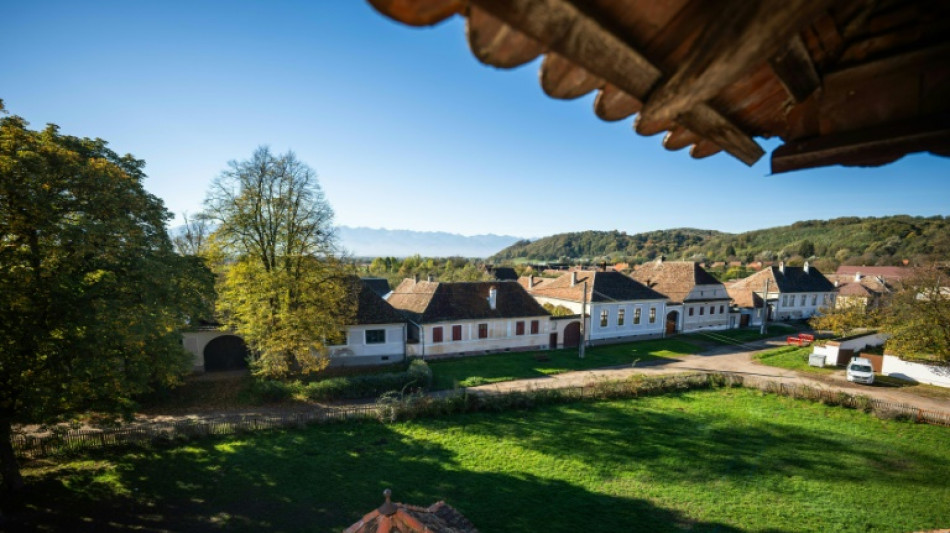
Transylvania's last Saxons revive its stunning ghost villages / Photo: Mihai Barbu - AFP

 'Act before it's too late': Tokyo residents fight for more trees

 'Disappointing' as South Korea flag mishap sees Games end on sour note

 Pre-COP host Tuvalu at frontline of climate change

 Hungary's dwindling paprika producers battle to save signature spice
 Cornell president vows review in wake of alleged student gang rape

 Latvian partial election results suggest pro-European choice

 In Egypt's Sinai, Gazan builds school for children displaced by war

 Trump tariffs a mixed bag for US auto industry

 Yemen government forces say struck Houthi targets

 Music links past, present for Pedro Pascal's cellist in 'Behemoth!'

 ALEX BODI ȘI AMBASADORUL REPUBLICII SUDANUL DE SUD, GUM DOMINIC MATIOK, DISCUTĂ LA BERLIN DESPRE POSIBILITATEA ÎNFIINȚĂRII UNUI CONSULAT ONORIFIC LA BUCUREȘTI

 Dodgers step up World Series three-peat bid with 5-3 win over Braves

 Spain break down Czechs as England outclass Croatia in Nations League

 Yamal on target as Spain hold off Czech Republic

 Latvian exit polls suggest pro-European choice

 Lula, Bolsonaro wrap up campaigns ahead of knife-edge election

 Tuchel hails 'complete' England after Croatia demolition

 Fury to invite Trump to lead ring walk before Joshua showdown

 Fashion industry in 'precarious moment', says Vivienne Westwood supremo

 Seventh heaven for England in Nations League rout of Croatia

 Storms, flooding cause chaos on Greek holiday island of Crete

 #IAmJaneDoe: online support campaign in US university rape case

 Brazil shine on Selecao's first visit to India
 Zverev sets up Djokovic quarter-final at China Open, Rybakina out
 Happier at home, Bordeaux hammer Lyon in Top 14

Carmen Schuster was a young woman when she left the Transylvanian village of Cincsor in Romania for West Germany in search of a better life 40 years ago.
After returning to Romania for work many years later, she was overcome by the urge to stay, attempting to save the centuries-old Saxon community she once called home.
Schuster is a member of the dwindling ethnic German minority, descendants of Saxons and others who were recruited by the Hungarian kings to settle in Transylvania from the 12th century onwards.
"We had to save the school, which was in ruins," Schuster, who is now in her 60s, told AFP.
Together with her husband Michael Lisske, she has been carefully restoring the historical heart of Cincsor for more than a decade -- including its former Saxon school -- and transforming the buildings into guesthouses.
"Other buildings have also been restored and the village once again revolves around its Protestant church," which still holds services for its seven remaining parishioners, Schuster said.
Britain's King Charles III -- who claims descent from a notorious 15th-century Transylvanian prince known as Vlad the Impaler -- also owns a number of properties nearby, renting out some to tourists.
- 'Belated victory' -
Before World War II, Romania boasted a Saxon population of up to 300,000. Today, there are only about 10,000, much of the population having emigrated in the 1970s and the 1980s to escape persecution by the communist dictatorship of Nicolae Ceaucescu.
Transylvania's abandoned Saxon villages were gradually repopulated by Romanians, who often had no connection to the region's 800-year-old history.
But the unique atmosphere of these historic villages at the foot of the Carpathian mountains never fully faded, with many of their fortress-like churches listed as UNESCO world heritage sites.
"In the 15th century, they fortified their churches so they could serve as a refuge for the inhabitants in the event of an attack," said 71-year-old Lisske.
"The Hungarians had promised the Saxons freedom in exchange for bringing them here, so they had no royal protection," the former history teacher said.
For Schuster, preserving the Saxon heritage symbolises a "belated victory" over the "inhumane and contemptuous" treatment during Ceaucescu's communist rule that "did everything to erase it".
- Idea 'catching on' -
Schuster's year-round guesthouses have become the village's main employer, she said, boosting tourism in a region heavily dependent on agriculture and farming.
Ramona Amariei is one of 15 locals who found work there as a chambermaid and waitress and seamstress during the off-season.
"There is no discrimination," said Amariei, who has Roma roots, and feels proud to be part of the "family". "Mrs Schuster is trying to integrate pretty much all types of people."
Adrian Boscu, a cook, said he is committed to putting a modern twist on "old Saxon recipes" to revive them, incorporating local produce as much as he can.
The guesthouse business has been booming, with the tower in a church now being converted into a bedroom, and the idea is spreading.
"I think that's catching on," said Schuster, with nearby villages also restoring their centuries-old heritage to revitalise the local economy. "There are lots of people who have interesting projects."
The house next door has also been renovated. Its Romanian owner, Nicolas Mioque, returned from France after 57 years.
Schuster and her husband "have breathed new life into this village," he said, noting that Cincsor without the guesthouses would be "sad".
H.Silva--PC



