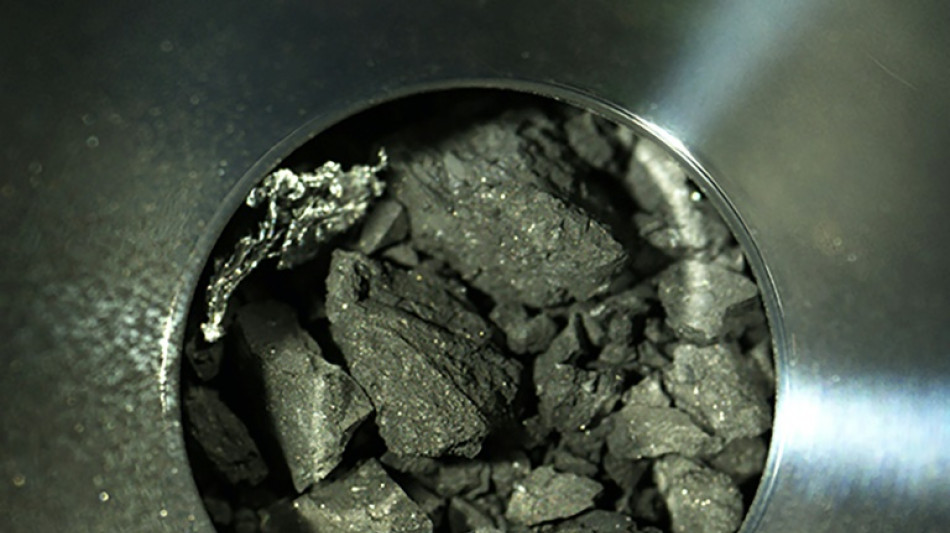
Asteroid samples contain 'clues to origin of life': Japan scientists / Photo: Handout - JAXA/AFP/File

 US regulator finds Boeing 737 MAX software bug 'not a safety concern'

 Ohtani 'managing' injuries as Dodgers launch MLB post-season

 Botched US execution leaves murderer unconscious on ventilator: lawyers

 Cornell rape case exposes sexual violence at US colleges

 France held by Italy in Zidane's homecoming after Olise stunner

 Ethiopian pro-government militia claims Tigray airport as regional tensions spike

 Ohtani shaking off injuries as Dodgers launch MLB post-season

 Sea levels to rise in California as coastal wave surges up west coast

 New rallies urged in France as protests disrupt over 730 schools

 Djokovic survives China Open scare, Sabalenka starts strong

 King Charles to evoke colonial 'darkest days' on Caribbean tour

 Tesla shares jump after global car sales top estimates

 DR Congo Ebola outbreak killed more than 4,000: official figures

 Djokovic survives China Open scare against wildcard world no. 104

 Lula, Bolsonaro trade blows in final scramble for votes in Brazil

 New clashes erupt as protests disrupt over 560 French schools

 NY governor vows to close loophole after alleged Cornell gang rape

 Ethiopia Tigray rebels pushed back as regional tensions spike

 Stocks rise, yields fall as US job numbers disappoint

 Man City verdict a 'big topic' for England players, says Tuchel

 NY attorney general tasked with investigating alleged Cornell gang rape

 China widens military footprint with Laos air base

 G7 talks as US pressures Europe over diesel stocks

 Man City launch appeal against explosive financial ruling

 Swiss president to quit government

Asteroid dust collected by a Japanese space probe contains organic material that shows some of the building blocks of life on Earth may have been formed in space, scientists said Friday.
Pristine material from the asteroid Ryugu was brought back to Earth in 2020 after a six-year mission to the celestial body around 300 million kilometres away.
But scientists are only just beginning to discover its secrets in the first studies on small portions of the 5.4 grams (0.2 ounces) of dust and dark, tiny rocks.
In one paper published Friday, a group of researchers led by Okayama University in western Japan said they had discovered "amino acids and other organic matter that could give clues to the origin of life on Earth".
"The discovery of protein-forming amino acids is important, because Ryugu has not been exposed to the Earth's biosphere, like meteorites, and as such their detection proves that at least some of the building blocks of life on Earth could have been formed in space environments," the study said.
The team said they found 23 different types of amino acid while examining the sample collected by Japan's Hayabusa-2 probe in 2019.
The dust and rocks were stirred up when the fridge-sized spacecraft fired an "impactor" into the asteroid.
"The Ryugu sample has the most primitive characteristics of any natural sample available to mankind, including meteorites," the Japan Aerospace Exploration Agency (JAXA) said in a statement.
It is believed that part of the material was created about five million years after the birth of the solar system and has not been heated above 100 degrees Celsius (210 degrees Fahrenheit).
Another study published in the US-based journal "Science" said the material has "a chemical composition that more closely resembles the Sun's photosphere than other natural samples".
Kensei Kobayashi, an astrobiology expert and professor emeritus at Yokohama National University, hailed the discovery.
"Scientists have been questioning how organic matter -- including amino acids -- was created or where it came from, and the fact that amino acids were discovered in the sample offers a reason to think that amino acids were brought to Earth from outer space," he told AFP.
Another mainstream theory about the origin of amino acids is that they were created in Earth's primitive atmosphere through lightning strikes, for example, after Earth cooled down.
E.Ramalho--PC



