Climate watchers fret over Trump's cut to sciences / Photo: Patrick T. Fallon - AFP

 Lula, Bolsonaro wrap up campaigns ahead of Brazil's knife-edge vote

 Toulouse edge Castres in Top 14 derby

 Murakami homer propels White Sox to MLB playoff win over Guardians

 Israel targets top Hamas leader in deadly Gaza strike on anniversary

 Houthis say struck oil facility near Riyadh, as Saudis hit Sanaa

 AI needs safety layers like nuclear plants: ex-OpenAI engineer

 MVP Judge will miss Yankees' MLB playoff series against Rays

 New lizard species discovered in Peru

 Fernandes hails Portugal's 'greatest symbol' Ronaldo, calls for unity

 Grandidier-Nkanang double takes Pau to Top 14 summit despite Vannes fightback

 Trainer Scott gets perfect Arc boost with top notch double

 Ex-PM says Putin cannot admit 'mistake' over Ukraine

 Houthis say Saudi Arabia launches dozens of strikes on Yemen capital

 Qatar and Abu Dhabi F1 Grand Prix to go ahead - F1 boss

 South Korea lift gloom with smash-and-grab Games football gold

 Ireland news conference before Israel game cut short amid tensions

 Protests over housing flare in Spain after relief measures rejected

 Zverev thrashes Shang to set up Djokovic quarter-final at China Open

 Turkey football ref chief jailed pending trial for graft

 North Korea says test of intermediate-range strategic missile included use of AI

 Rampant Sayers leads Hong Kong to third men's rugby gold in a row

 Ethiopia's Tigray rebels abandon regional capital as govt advances

 Bulgaria's Tsar Samuel returns 'home' after 1,000 years

 'Glad it's over': Kim powers to Games gold and military exemption

 After 11 World Cups, football finally comes home for one Indian fan

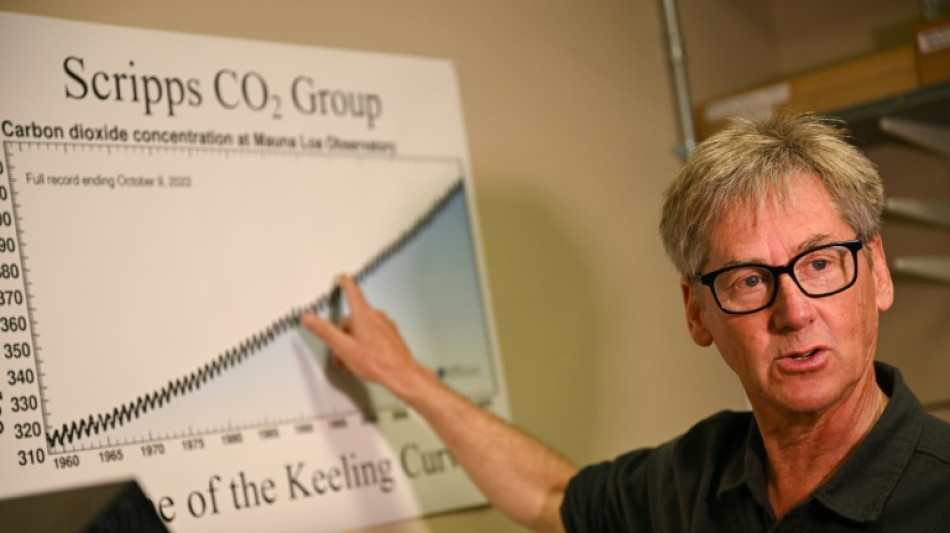
In his California laboratory, Ralph Keeling examines a graph created from data his father began collecting that keeps a record of the amount of carbon dioxide in the atmosphere.
After 67 years, the fate of this "major indicator of climate change" is uncertain under President Donald Trump's administration.
The United States "needs this information, there's no doubt about it," the geochemistry professor at the Scripps Institution of Oceanography in San Diego told AFP.
His father, Charles David Keeling, decided in 1958 to measure atmospheric CO2 concentrations at the summit of the Mauna Loa volcano in Hawaii.
This gave rise to the Keeling curve, which today represents the oldest continuous measurement of this greenhouse gas, which is produced by the burning of fossil fuels.
This graph "showed early on that humans were having an impact on the whole planet," even before the effects of climate change were palpable, Ralph Keeling said.
Even as science as evolved, the project remains an essential climate watchdog.
It provides a basis for thinking about how farmers can modify their crops in the face of a warming atmosphere, or how insurers can adapt their coverage to cope with increasingly fierce fires and more frequent flooding.
"This is very rock solid data, but the program that makes this is fragile," Keeling said.
- 'Concerning' -
Concerns arose in early March, when Elon Musk's so-called Department of Government Efficiency recommended canceling the lease on the National Oceanic and Atmospheric Administration (NOAA) office in Hawaii by the end of August.
This office, located in the town of Hilo, is responsible for maintaining the measurements at the summit of Mauna Loa.
But it's not just buildings. NOAA, a key agency for American climate research, has been targeted by hundreds of layoffs since the return to the White House of Trump, who has repeatedly called climate change a "hoax".
The administration also wants to cut the agency's budget by $1.6 billion, according to documents revealed in mid-April by The New York Times.
The plan also envisages eliminating the branch dedicated to oceanic and atmospheric research.
"It's concerning," said Keeling.
At the summit of Mauna Loa, an observatory houses machines from the Scripps Institute and NOAA, which simultaneously measure atmospheric CO2 concentrations at an altitude of 3,400 meters (11,000 feet).
To ensure they're working properly, local scientists also regularly collect air samples in glass carboys, following the method developed by Charles Keeling more than six decades ago in San Diego.
Since then, other countries have begun recording the amount of CO2 in the atmosphere, thanks to new methods sometimes involving satellites.
But these alone are not enough, according to Keeling.
"Although there's a bigger community now, and there's a constellation of methods being used, those additional efforts have assumed that this backbone from Scripps and NOAA is there," he said.
"A satellite measurement of CO2... gives you a lot of fine grained information, but it doesn't give you reliable long term trends, and it doesn't give you certain other measures that we can get from direct atmospheric measurements.
"You have to ground truth it, you need the calibration."
- Attack on climate science -
NOAA declined to comment on the potential impact of the proposed cuts on its program.
"We are not discussing internal management matters and we do not do speculative interviews," the agency told AFP.
"NOAA remains dedicated to its mission, providing timely information, research, and resources that serve the American public and ensure our nation's environmental and economic resilience."
For Tim Lueker, who spent his career with the atmospheric measurement program launched by the Scripps Institute, that is cold comfort.
The Trump administration "is not making these cuts to save money. It's so transparent what's going on," he said.
At 67, he is worried about a full-scale attack on climate science, with the government ordering the NOAA to identify funding for projects that mention the terms "climate crisis," "clean energy," "environmental quality," or "pollution."
"The idea of saving money... is kind of silly when you consider how much one fighter plane costs compared to the annual funding of NOAA Climate Research."
M.Carneiro--PC



