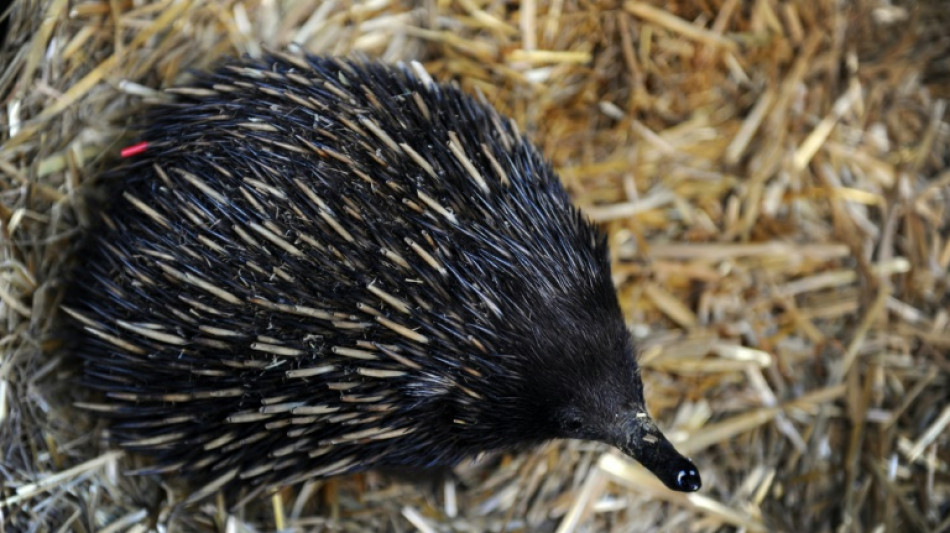
Study sheds light on origin of Australia's odd echidna / Photo: ROMEO GACAD - AFP

 Lula, Bolsonaro wrap up campaigns ahead of Brazil's knife-edge vote

 Toulouse edge Castres in Top 14 derby

 Murakami homer propels White Sox to MLB playoff win over Guardians

 Israel targets top Hamas leader in deadly Gaza strike on anniversary

 Houthis say struck oil facility near Riyadh, as Saudis hit Sanaa

 AI needs safety layers like nuclear plants: ex-OpenAI engineer

 MVP Judge will miss Yankees' MLB playoff series against Rays

 New lizard species discovered in Peru

 Fernandes hails Portugal's 'greatest symbol' Ronaldo, calls for unity
 Grandidier-Nkanang double takes Pau to Top 14 summit despite Vannes fightback

 Trainer Scott gets perfect Arc boost with top notch double

 Ex-PM says Putin cannot admit 'mistake' over Ukraine

 Houthis say Saudi Arabia launches dozens of strikes on Yemen capital

 Qatar and Abu Dhabi F1 Grand Prix to go ahead - F1 boss

 South Korea lift gloom with smash-and-grab Games football gold

 Ireland news conference before Israel game cut short amid tensions

 Protests over housing flare in Spain after relief measures rejected

 Zverev thrashes Shang to set up Djokovic quarter-final at China Open

 Turkey football ref chief jailed pending trial for graft
 North Korea says test of intermediate-range strategic missile included use of AI

 Rampant Sayers leads Hong Kong to third men's rugby gold in a row

 Ethiopia's Tigray rebels abandon regional capital as govt advances

 Bulgaria's Tsar Samuel returns 'home' after 1,000 years

 'Glad it's over': Kim powers to Games gold and military exemption

 After 11 World Cups, football finally comes home for one Indian fan

Australia's burrowing echidna evolved from a water-dwelling ancestor in an "extremely rare" biological event, scientists said Tuesday in a new study of the peculiar egg-laying mammals.
With powerful digging claws, protective spikes and highly sensitive beaks, echidnas are well suited to a life shuffling through the forest undergrowth.
But a team of Australian and international scientists believe many of the echidna's unusual traits were first developed millions of years ago when its ancestors splashed through the water.
"We're talking about a semiaquatic mammal that gave up the water for a terrestrial existence," said paleontologist Suzanne Hand, from the University of New South Wales.
"While that would be an extremely rare event, we think that's what happened with echidnas."
Echidnas and another Australian oddity, the semi-aquatic platypus, are believed to have evolved from a common ancestor called Kryoryctes cadburyi that lived in Australia more than 100 million years ago.
Researchers studied the single known bone fragment left by this ancestor, which was discovered among a trove of fossils at Dinosaur Cove in southern Australia some 30 years ago.
Platypus bones were similar to this ancient ancestor, Hand said, with a thick and heavy structure that provided ballast for diving.
Echidnas, in comparison, had very thin bone walls that made it easier to walk on land, Hand said.
This indicated echidnas were descended from a water-dwelling ancestor but had evolved to live on land, the research found.
It was far more common for prehistoric mammals to go from land to water, Hand said, pointing towards seals, whales, dolphins and dugongs.
The researchers said these findings appeared to be supported by other echidna traits.
Echidnas have backward-facing hind feet that help them shift mounds of soil when burrowing.
These feet may have first developed as rudders helping the echidna's ancestor navigate fast-moving waterways, Hand said.
Echidnas also have a "diving reflex" when submerged in water, which tells their body to conserve oxygen helping them hold their breath for longer.
Echidnas and platypus are monotremes, a rare group of mammals that lay eggs instead of live young.
"We're hoping we'll discover other ancestral monotremes that will help unravel the early history of this most fascinating group of mammals," said study co-author Michael Archer.
The research was published in peer-reviewed journal PNAS.
A.Seabra--PC



