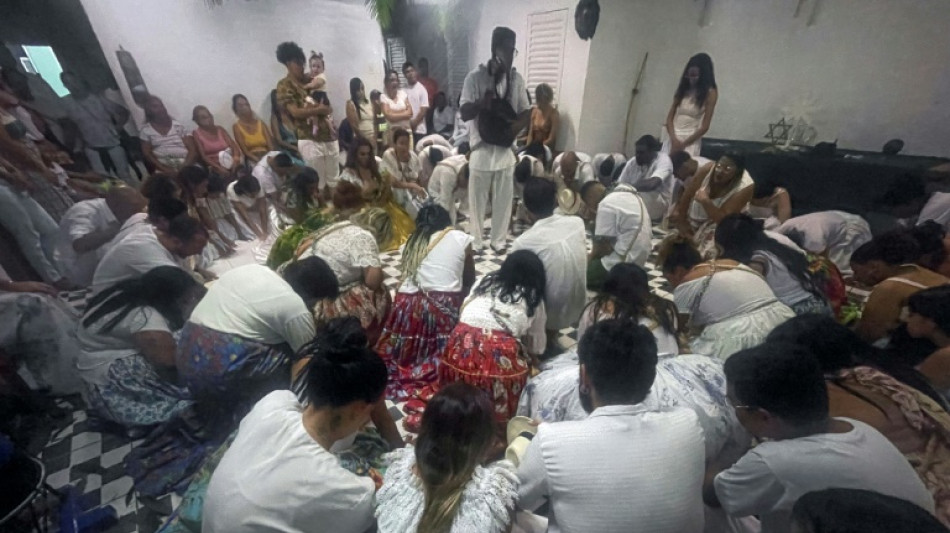
Brazilian ritual root gets second life as potential anti-depressant / Photo: Jose OSORIO - AFP

 Yamal on target as Spain hold off Czech Republic

 Latvian exit polls suggest pro-European choice

 Lula, Bolsonaro wrap up campaigns ahead of knife-edge election

 Tuchel hails 'complete' England after Croatia demolition

 Fury to invite Trump to lead ring walk before Joshua showdown

 Fashion industry in 'precarious moment', says Vivienne Westwood supremo

 Seventh heaven for England in Nations League rout of Croatia

 Storms, flooding cause chaos on Greek holiday island of Crete

 #IAmJaneDoe: online support campaign in US university rape case

 Brazil shine on Selecao's first visit to India

 Zverev sets up Djokovic quarter-final at China Open, Rybakina out

 Happier at home, Bordeaux hammer Lyon in Top 14

 Lula, Bolsonaro in final push for votes ahead of knife-edge election

 Boisterous fashion week barnstorms 'sleepy' Nigerian capital

 UAE investigators say flydubai co-pilot was planning 'terrorist act'

 Rahul smacks century in India v Windies ODI

 Daryz seeks to join exclusive club of dual Arc winners

 Russia warns diplomats to leave Kyiv over new strikes threat

 Olympic champ Zheng rebukes rowdy home crowd at China Open

 World No.1 Sinner pulls out of Shanghai Masters to delay return

 Red Bull's Verstappen grabs pole position for Bahrain GP

 India beat Pakistan in blockbuster as golfer Kim wins 'crazy' gold

 India beat arch-rivals Pakistan to win Asian Games cricket gold

 Ethiopia's Tigray rebels abandon regional capital as govt advances: journalist

 Tom Kim powers to Games gold and exemption from military service

Long used in Indigenous Brazilian rituals, the jurema preta plant, which contains a potent psychedelic, is gaining ground as a potential treatment for depression.
At street stalls where medicinal herbs are sold, customers can buy the plant's root which contains dimethyltryptamine (DMT), a hallucinogenic substance that researchers say could be used to alleviate symptoms.
Following instructions he found on the internet, Guaracy Carvajal extracted DMT at home in 2016 from roots he bought on the street.
The 31-year-old software programmer, who had tried various treatment for chronic depression he has suffered since adolescence, said the drug makes it "feel like you've solved something in your life."
Physicist Draulio Araujo, who has conducted extensive research on the drug, said "the response is rapid. One day after treatment, (patients) already showed a significant improvement in their depression symptoms."
Yet he also warned that it "is not a magic cure" and that psychedelics "are not for everyone."
As a researcher at the Brain Institute of the Federal University of Rio Grande do Norte, Araujo and his team treated 14 people with the drug for six months.
The patients inhaled vaporized DMT, under medical supervision.
"It's common for our patients to say that something changed, that a key opened something," he said.
His patients also received psychological therapy, and some continued with conventional pharmaceutical drugs.
Neuroscientist Fernanda Palhano-Fontes, also of the Brain Institute, said "we have patients who improve significantly, others who don't improve at all."
Araujo's findings were published in the scientific journal Nature in April. In 2024, he published another study with promising results in the journal Psychedelic Medicine.
As for Carvajal, who stopped using jurema preta some time ago, he said the drug really allows a person to "start to have a lighter life."
It helped him get through a time when he was in "a state of questioning myself" about "work, day-to-day life," he said.
- Spiritual channels -
Brazil occupies a fairly prominent place in DMT research due to the substance's prominence in society, Araujo said.
While there is no ban on the cultivation or possession of jurema, which is also known as Mimosa tenuiflora, consumption of DMT is prohibited, except for religious and scientific use.
Jurema's roots are combined with other plants in a wine-like beverage that is consumed at rituals that include dancing and drums, part of Indigenous tradition in northeast Brazil where the plant grows.
"It's not hallucination," said Joyce Souza, a young woman attending a jurema ceremony in Planaltina, on the outskirts of Brasília.
"My spiritual channels become more accessible, I can communicate better with myself," Souza said.
Gathered in a house courtyard and dressed in white, the group of mostly novices waited for more seasoned practitioners to enter a trance and bring messages from ancient spirits.
Meanwhile, back in the lab, Araujo is hoping to expand his DMT research to a study of 100 patents.
"Let's say that in five years we'll have... a clear picture on when it will reach a real clinical setting," he said.
Ferreira--PC



