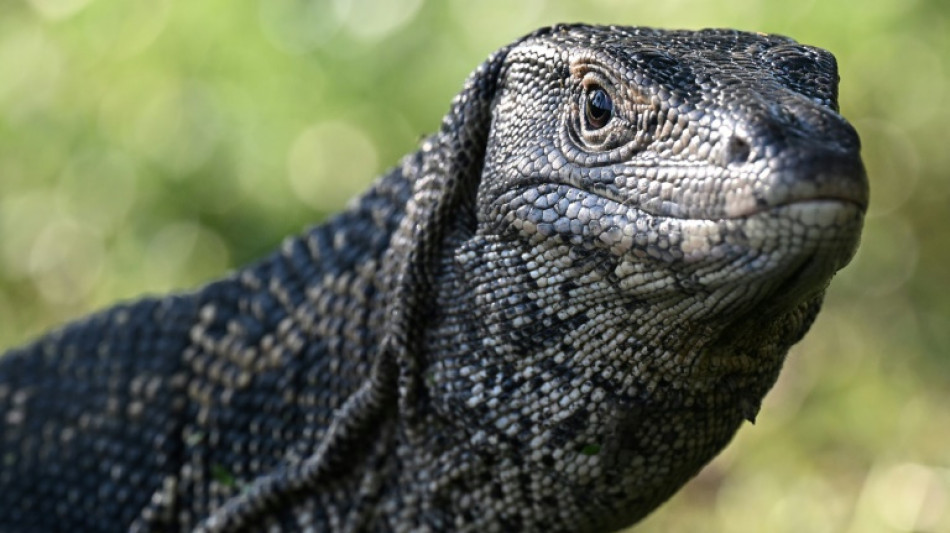
Ancient reptile tracks rewrite when animals conquered land / Photo: Lillian SUWANRUMPHA - AFP/File

 Yamal on target as Spain hold off Czech Republic

 Latvian exit polls suggest pro-European choice

 Lula, Bolsonaro wrap up campaigns ahead of knife-edge election

 Tuchel hails 'complete' England after Croatia demolition

 Fury to invite Trump to lead ring walk before Joshua showdown

 Fashion industry in 'precarious moment', says Vivienne Westwood supremo
 Seventh heaven for England in Nations League rout of Croatia

 Storms, flooding cause chaos on Greek holiday island of Crete

 #IAmJaneDoe: online support campaign in US university rape case

 Brazil shine on Selecao's first visit to India

 Zverev sets up Djokovic quarter-final at China Open, Rybakina out
 Happier at home, Bordeaux hammer Lyon in Top 14

 Lula, Bolsonaro in final push for votes ahead of knife-edge election

 Boisterous fashion week barnstorms 'sleepy' Nigerian capital

 UAE investigators say flydubai co-pilot was planning 'terrorist act'

 Rahul smacks century in India v Windies ODI

 Daryz seeks to join exclusive club of dual Arc winners

 Russia warns diplomats to leave Kyiv over new strikes threat

 Olympic champ Zheng rebukes rowdy home crowd at China Open

 World No.1 Sinner pulls out of Shanghai Masters to delay return

 Red Bull's Verstappen grabs pole position for Bahrain GP

 India beat Pakistan in blockbuster as golfer Kim wins 'crazy' gold

 India beat arch-rivals Pakistan to win Asian Games cricket gold

 Ethiopia's Tigray rebels abandon regional capital as govt advances: journalist

 Tom Kim powers to Games gold and exemption from military service

After a brief rain in part of the ancient supercontinent of Gondwana 350 million years ago, a reptile pressed its small claws into the still-wet ground.
Its tracks, which have been discovered in Australia, mean it is the oldest-known vertebrate animal to have permanently abandoned the oceans for dry land, a study suggested on Wednesday.
It also significantly pushes back the date for when these four-limbed pioneers made this important evolutionary step that would eventually lead to humans conquering the globe.
The tracks were found by amateur archaeologists on a 30-centimetre-wide sandstone slab in a mountainous area of the southeastern Australian state of Victoria.
First there was a single footprint of an unknown animal which has "raindrop pockmarks all over it," Per Ahlberg, a palaeontologist at Sweden's Uppsala University, told AFP.
This suggests it was made before the brief shower, said the senior author of a new Nature study describing the discovery.
Then there were two sets of tracks from after the rain.
The second set of tracks suggest this reptile ancestor "was in more of a hurry", he added.
"You see the claws making long scratches on the ground."
- 'Keyholes' into 'lost world' -
The researchers cannot determine whether both sets of tracks were made by the same individual animal, but Ahlberg thinks this is unlikely.
The animal was 60-80 centimetres long and would have looked "quite lizard-like", he added.
That the animal had claws is a clear sign it was an amniote, a group of animals which today includes mammals, birds and reptiles.
Its ancestor tetrapods -- notable for their four limbs -- split into two groups, amniotes and amphibians.
While amphibians had to return to water to lay their eggs, amniotes evolved to have eggs strong enough to survive on land, shedding its last connection to water life.
The discovery indicates that amniotes existed 35 to 40 million years earlier than previously thought, during the turn of the Devonian and Carboniferous periods, the study said.
This suggests the "water-to-land-dwelling transition" may have taken place in just 50 million years, much quicker than had been believed, Stuart Sumida of California State University commented in Nature.
That would be just the latest twist in the tale of how animals rose from the ocean to dominate the land.
"The only way to ever understand it is to look through these tiny little keyholes that we find into this strange, dark, lost world," Ahlberg said.
F.Ferraz--PC



