
Experts point out how TV's Dr House often got it wrong / Photo: KEVIN WINTER - GETTY IMAGES NORTH AMERICA/AFP

 Yamal on target as Spain hold off Czech Republic

 Latvian exit polls suggest pro-European choice

 Lula, Bolsonaro wrap up campaigns ahead of knife-edge election

 Tuchel hails 'complete' England after Croatia demolition

 Fury to invite Trump to lead ring walk before Joshua showdown

 Fashion industry in 'precarious moment', says Vivienne Westwood supremo

 Seventh heaven for England in Nations League rout of Croatia

 Storms, flooding cause chaos on Greek holiday island of Crete

 #IAmJaneDoe: online support campaign in US university rape case

 Brazil shine on Selecao's first visit to India

 Zverev sets up Djokovic quarter-final at China Open, Rybakina out

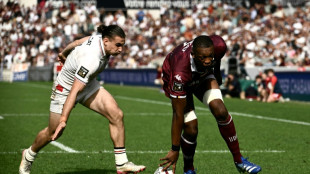 Happier at home, Bordeaux hammer Lyon in Top 14

 Lula, Bolsonaro in final push for votes ahead of knife-edge election

 Boisterous fashion week barnstorms 'sleepy' Nigerian capital

 UAE investigators say flydubai co-pilot was planning 'terrorist act'

 Rahul smacks century in India v Windies ODI

 Daryz seeks to join exclusive club of dual Arc winners

 Russia warns diplomats to leave Kyiv over new strikes threat

 Olympic champ Zheng rebukes rowdy home crowd at China Open

 World No.1 Sinner pulls out of Shanghai Masters to delay return

 Red Bull's Verstappen grabs pole position for Bahrain GP

 India beat Pakistan in blockbuster as golfer Kim wins 'crazy' gold

 India beat arch-rivals Pakistan to win Asian Games cricket gold

 Ethiopia's Tigray rebels abandon regional capital as govt advances: journalist

 Tom Kim powers to Games gold and exemption from military service

He's the maverick medic who loved to confound the medical establishment with his brilliant, unorthodox diagnoses.
But Dr Gregory House, the misanthropic genius who was the star of the long-running "House" television series, got an awful lot wrong himself, Croatian doctors claim.
From a neurologist at work on the wrong end of a patient by performing a colonoscopy, or an MRI scan done by a physician who is clearly not a radiologist, Croatian researchers have pulled the American series up on its medical accuracy in a paper published this month.
Denis Cerimagic, a professor at Dubrovnik University, and two fellow neurologists -- all big fans of the series -- listed 77 errors after analysing all 177 episodes of the show, which ran from 2004 to 2012.
"We focused on the diagnoses of main cases, reality of clinical practice presentation and detection of medical errors," Cerimagic told AFP.
He and his peers -- Goran Ivkic and Ervina Bilic -- broke the mistakes down into five categories including misuses of medical terminology, misinformation and simple weirdness -- something which the show's anti-hero, played by British star Hugh Laurie, possessed in abundance.
- That limp -
They included the use of mercury thermometers -- which had long given way to digital ones -- the term heart attack and cardiac arrest being used interchangeably when they are not the same, and that vitamin B12 deficiency can be corrected with just one injection.
Nor is there a universal chemotherapy for all types of malignant tumours, as one episode suggested.
But arguably the biggest error of all is that Laurie -- whose character's genius for deduction comes from the misdiagnosis that left him with a limp and chronic pain -- uses his cane on the wrong side.
The stick should be carried on his unaffected side, Cerimagic said, though he understood why the actor had done it because "it's more effective to see the pronounced limp on the screen".
Their research also found medical procedures being done by specialists who had no business being there, like an infectologist performing an autopsy.
At times the series also stretched reality beyond breaking point, with the findings of complex laboratory tests done in just a few hours. And doctors rarely turn detective and take it upon themselves to enter patients' homes to look for environmental causes of illnesses.
Not to mention Dr House's unethical behaviour -- "Brain tumour, she's gonna die" the paper quoted him as saying -- and the character's opiates addiction.
The researchers say they may have missed other mistakes.
"We are neurologists while other medical specialists would certainly establish additional errors," Cerimagic added.
- Medical errors -
Whatever their criticisms, the researchers say that modern medical series are far better produced than in the past, thanks to medical advisors.
It is not like some 20 years ago when you had doctors looking at X-rays upside down, the neurologist said.
"Now only medical professionals can notice errors," Cerimagic said.
Despite its flaws, they thought the series could even be used to help train medical students.
"The focus could be on recognising medical errors in the context of individual episodes, adopting the teamwork concept and a multidisciplinary approach in diagnosis and treatment," Cerimagic said.
He said he and his colleagues were taken aback by the response to their paper "House M.D.: Between reality and fiction" -- which is not the first academic study to cast doubt on the good doctor and his methods.
"The idea was to make a scientific paper interesting not only to doctors but also to people without specific medical knowledge."
A.F.Rosado--PC



