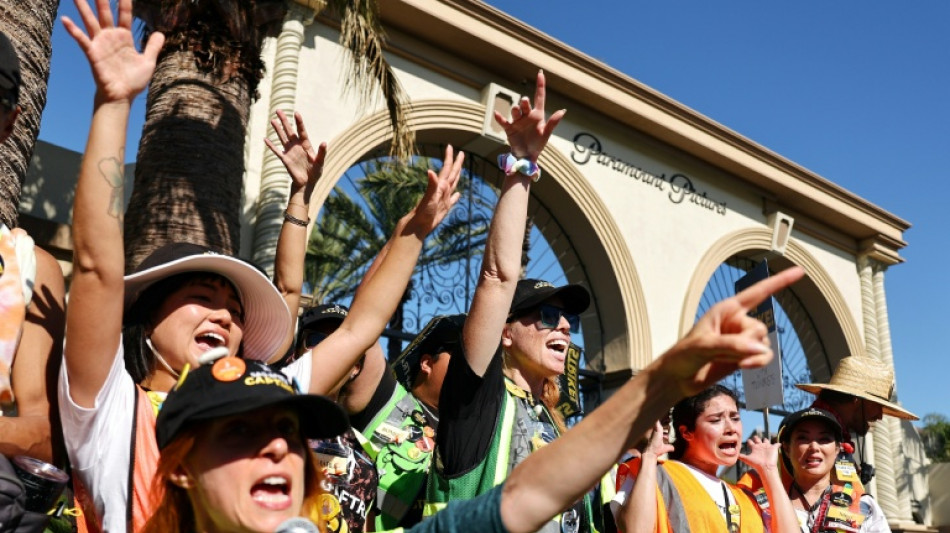
US labor unions fight to contain AI disruption / Photo: MARIO TAMA - GETTY IMAGES NORTH AMERICA/AFP/File

 Yamal on target as Spain hold off Czech Republic

 Latvian exit polls suggest pro-European choice

 Lula, Bolsonaro wrap up campaigns ahead of knife-edge election

 Tuchel hails 'complete' England after Croatia demolition

 Fury to invite Trump to lead ring walk before Joshua showdown

 Fashion industry in 'precarious moment', says Vivienne Westwood supremo

 Seventh heaven for England in Nations League rout of Croatia

 Storms, flooding cause chaos on Greek holiday island of Crete

 #IAmJaneDoe: online support campaign in US university rape case

 Brazil shine on Selecao's first visit to India

 Zverev sets up Djokovic quarter-final at China Open, Rybakina out

 Happier at home, Bordeaux hammer Lyon in Top 14

 Lula, Bolsonaro in final push for votes ahead of knife-edge election

 Boisterous fashion week barnstorms 'sleepy' Nigerian capital

 UAE investigators say flydubai co-pilot was planning 'terrorist act'

 Rahul smacks century in India v Windies ODI

 Daryz seeks to join exclusive club of dual Arc winners

 Russia warns diplomats to leave Kyiv over new strikes threat
 Olympic champ Zheng rebukes rowdy home crowd at China Open

 World No.1 Sinner pulls out of Shanghai Masters to delay return

 Red Bull's Verstappen grabs pole position for Bahrain GP

 India beat Pakistan in blockbuster as golfer Kim wins 'crazy' gold

 India beat arch-rivals Pakistan to win Asian Games cricket gold

 Ethiopia's Tigray rebels abandon regional capital as govt advances: journalist

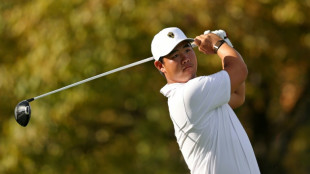 Tom Kim powers to Games gold and exemption from military service

As artificial intelligence threatens to upend entire sectors of the economy, American labor unions are scrambling to protect workers, demand corporate transparency, and rally political support—an uphill battle in a rapidly changing world.
"As laborers, the ability to withhold our labor is one of our only tools to improve our lives," explained Aaron Novik, a key organizer with Amazon's ALU union.
"What happens when that disappears (to AI)? It's a real existential issue," he added.
Automation has already transformed most industries since the 1960s, typically reducing workforce numbers in the process.
But the emergence of advanced "physical AI" promises a new generation of intelligent robots that won't be limited to repetitive tasks -- potentially displacing far more blue-collar workers than ever before.
The threat extends beyond manufacturing.
The CEO of Anthropic, which created Claude as a competitor to ChatGPT, warned last week that generative AI could eliminate half of all low-skilled white-collar jobs, potentially driving unemployment rates up to 10-20 percent.
"The potential displacement of workers and elimination of jobs is a significant concern not just for our members, but for the public in general," said Peter Finn of the International Brotherhood of Teamsters, America's largest union.
- Vetoes -
The Teamsters have focused their efforts on passing legislation limiting the spread of automation, but face significant political obstacles.
California's governor has twice vetoed bills that would ban autonomous trucks from public roads, despite intense lobbying from the state's hundreds of thousands of union members.
Colorado's governor followed suit last week, and similar battles are playing out in Indiana, Maryland, and other states.
At the federal level, the landscape shifted dramatically with the change in the White House.
Under former president Joe Biden, the Department of Labor issued guidelines encouraging companies to be transparent about AI use, involve workers in strategic decisions, and support employees whose jobs face elimination.
But US President Donald Trump canceled the protections within hours of taking office in January.
"Now it's clear. They want to fully open up AI without the safeguards that are necessary to ensure workers' rights and protections at work," said HeeWon Brindle-Khym of the Retail, Wholesale and Department Store Union (RWDSU), which represents workers in the retail sector.
- Rush to AI -
Meanwhile, companies are racing to implement AI technologies, often with poor results.
"By fear of missing out on innovations, there's been a real push (to release AI products)," observed Dan Reynolds of the Communications Workers of America (CWA).
The CWA has taken a proactive approach, publishing a comprehensive guide for members that urges negotiators to include AI provisions in all collective bargaining agreements.
The union is also developing educational toolkits to help workers understand and negotiate around AI implementation.
A handful of unions have successfully negotiated AI protections into their contracts.
Notable examples include agreements with media company Ziff Davis (which owns Mashable) and video game publisher ZeniMax Studios, a Microsoft subsidiary.
The most significant victories belong to two powerful unions: the International Longshoremen's Association, representing dock workers, secured a moratorium on full automation of certain port operations, while the Screen Actors Guild (SAG-AFTRA) won guarantees that actors must be consulted and compensated whenever their AI likeness is created.
These successes remain exceptional, however.
The American labor movement, as a whole, lacks the bargaining power enjoyed by those highly strategic or publicly visible sectors, said Brindle-Khym.
"Smaller contract-by-contract improvements are a long, slow process," she added.
Despite frequent accusations by corporate interests, the unions' goal isn't to halt technological progress entirely.
"Workers are usually not seeking to stop the march of technology," noted Virginia Doellgast, a Cornell University professor specializing in labor relations.
"They just want to have some control."
As AI continues its rapid advance, the question remains whether unions can adapt quickly enough to protect workers in an economy increasingly dominated by artificial intelligence.
V.Fontes--PC



