Huge planet discovered orbiting tiny star puzzles scientists / Photo: HO - ESO/AFP/File

 Yamal on target as Spain hold off Czech Republic

 Latvian exit polls suggest pro-European choice

 Lula, Bolsonaro wrap up campaigns ahead of knife-edge election

 Tuchel hails 'complete' England after Croatia demolition

 Fury to invite Trump to lead ring walk before Joshua showdown

 Fashion industry in 'precarious moment', says Vivienne Westwood supremo

 Seventh heaven for England in Nations League rout of Croatia

 Storms, flooding cause chaos on Greek holiday island of Crete

 #IAmJaneDoe: online support campaign in US university rape case

 Brazil shine on Selecao's first visit to India

 Zverev sets up Djokovic quarter-final at China Open, Rybakina out

 Happier at home, Bordeaux hammer Lyon in Top 14

 Lula, Bolsonaro in final push for votes ahead of knife-edge election

 Boisterous fashion week barnstorms 'sleepy' Nigerian capital

 UAE investigators say flydubai co-pilot was planning 'terrorist act'

 Rahul smacks century in India v Windies ODI

 Daryz seeks to join exclusive club of dual Arc winners

 Russia warns diplomats to leave Kyiv over new strikes threat

 Olympic champ Zheng rebukes rowdy home crowd at China Open

 World No.1 Sinner pulls out of Shanghai Masters to delay return

 Red Bull's Verstappen grabs pole position for Bahrain GP

 India beat Pakistan in blockbuster as golfer Kim wins 'crazy' gold

 India beat arch-rivals Pakistan to win Asian Games cricket gold

 Ethiopia's Tigray rebels abandon regional capital as govt advances: journalist

 Tom Kim powers to Games gold and exemption from military service

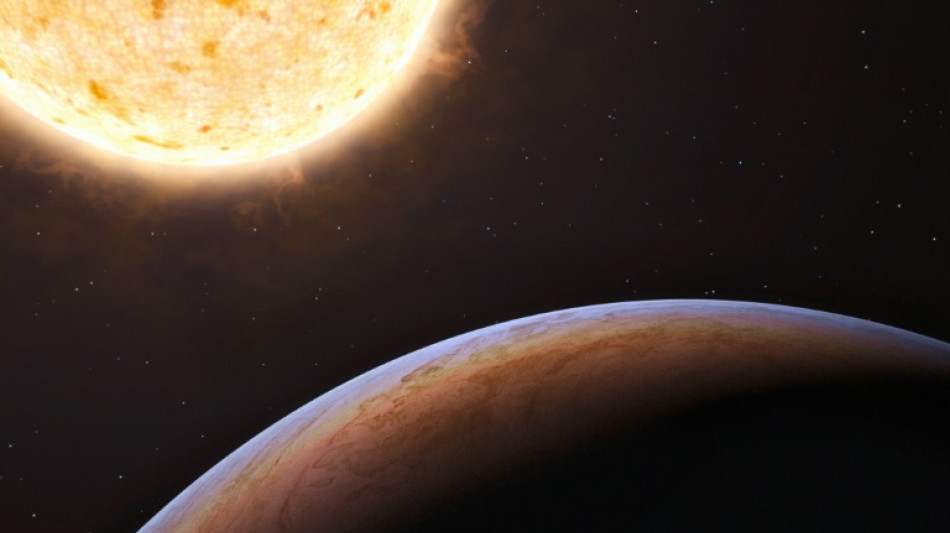
Astronomers announced Wednesday they have discovered a massive planet orbiting a tiny star, a bizarre pairing that has stumped scientists.
Most of the stars across the Milky Way are small red dwarfs like TOI-6894, which has only 20 percent the mass of our Sun.
It had not been thought possible that such puny, weak stars could provide the conditions needed to form and host huge planets.
But an international team of astronomers have detected the unmistakable signature of a gas giant planet orbiting the undersized TOI-6894, according to a study in the journal Nature Astronomy.
This makes the star the smallest star yet known to host a gas giant.
The planet has a slightly larger radius than Saturn, but only half its mass. It orbits its star in a little over three days.
The astronomers discovered the planet when searching through more than 91,000 low-mass red dwarfs observed by NASA's TESS space telescope.
Its existence was then confirmed by ground-based telescopes, including Chile's Very Large Telescope.
"The fact that this star hosts a giant planet has big implications for the total number of giant planets we estimate exist in our galaxy," study co-author Daniel Bayliss of the UK's Warwick University said in a statement.
Another co-author, Vincent Van Eylen, of University College London, said it was an "intriguing discovery".
"We don't really understand how a star with so little mass can form such a massive planet!" he said.
"This is one of the goals of the search for more exoplanets. By finding planetary systems different from our solar system, we can test our models and better understand how our own solar system formed."
- How do you make a planet? -
The most prominent theory for how planets form is called core accretion.
The process begins when a ring of gas and dust -- called a protoplanetary disc -- which surrounds a newly formed star builds up into a planetary core. This core attracts more gas that forms an atmosphere, eventually snowballing into a gas giant.
Under this theory, it is difficult for low-mass stars to host giant planets because there is not enough gas and dust to begin building a core in the first place.
A rival theory proposes that these planets instead form when their protoplanetary disc becomes gravitationally unstable and breaks up, with the collapsing gas and dust forming a planet.
However neither theory seems to explain the existence of the newly discovered planet, TOI-6894b, the researchers said.
The planet also interests scientists because it is strangely cold.
Most of the gas giants discovered outside our Solar System so far have been what are known as "hot Jupiters", where temperatures soar well over 1,000 degrees Celsius.
But the newly discovered planet appears to be under 150C, the researchers said.
"Temperatures are low enough that atmospheric observations could even show us ammonia, which would be the first time it is found in an exoplanet atmosphere," said study co-author Amaury Triaud of Birmingham University.
The James Webb space telescope is scheduled to turn its powerful gaze towards the planet in the next year, which could help uncover some more mysteries of this strange planet.
E.Borba--PC



