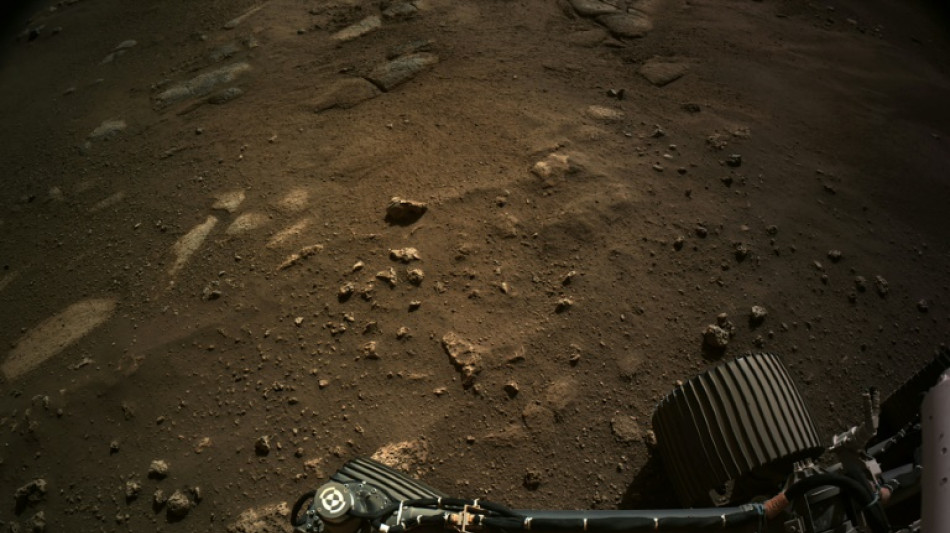
The promise and peril of a crewed Mars mission / Photo: Handout - NASA/JPL-CALTECH/AFP/File

 Yamal on target as Spain hold off Czech Republic

 Latvian exit polls suggest pro-European choice

 Lula, Bolsonaro wrap up campaigns ahead of knife-edge election

 Tuchel hails 'complete' England after Croatia demolition

 Fury to invite Trump to lead ring walk before Joshua showdown

 Fashion industry in 'precarious moment', says Vivienne Westwood supremo

 Seventh heaven for England in Nations League rout of Croatia

 Storms, flooding cause chaos on Greek holiday island of Crete

 #IAmJaneDoe: online support campaign in US university rape case

 Brazil shine on Selecao's first visit to India

 Zverev sets up Djokovic quarter-final at China Open, Rybakina out

 Happier at home, Bordeaux hammer Lyon in Top 14

 Lula, Bolsonaro in final push for votes ahead of knife-edge election

 Boisterous fashion week barnstorms 'sleepy' Nigerian capital

 UAE investigators say flydubai co-pilot was planning 'terrorist act'

 Rahul smacks century in India v Windies ODI

 Daryz seeks to join exclusive club of dual Arc winners

 Russia warns diplomats to leave Kyiv over new strikes threat

 Olympic champ Zheng rebukes rowdy home crowd at China Open

 World No.1 Sinner pulls out of Shanghai Masters to delay return

 Red Bull's Verstappen grabs pole position for Bahrain GP

 India beat Pakistan in blockbuster as golfer Kim wins 'crazy' gold

 India beat arch-rivals Pakistan to win Asian Games cricket gold

 Ethiopia's Tigray rebels abandon regional capital as govt advances: journalist

 Tom Kim powers to Games gold and exemption from military service

A crewed mission to Mars would rank among the most complex and costly undertakings in human history -- and US President Donald Trump has vowed to make it a national priority.
That political momentum, coupled with SpaceX chief Elon Musk's zeal, has breathed new life into a cause long championed by Red Planet advocates -- even as major obstacles remain, including Trump and Musk's latest feud.
- Why go? -
As NASA writes in its Moon to Mars blueprint, "exploration of the cosmos remains a great calling for humanity."
A mission to Mars would pursue scientific objectives like determining whether Mars ever hosted life and charting the evolution of its surface, as well as answering broader space physics questions -- such as the history of the Sun through studying Martian soil.
Geopolitics also looms large, as Trump has pledged to "plant the American flag on the planet Mars and even far beyond," invoking the "unlimited promise of the American dream."
Critics, however, say cuts to NASA's science budget and the cancellation of key projects -- including the return of rock samples collected by the Perseverance rover -- are undermining the research mission.
"The purpose of exploration is not just to go somewhere," Nobel-winning astrophysicist John Mather told AFP. "This is not a tourist thing. This is a fundamental knowledge thing."
- Getting there -
Musk is betting SpaceX's future on Starship, the largest rocket ever built, despite fiery failures in its nine test flights.
He's aiming for an uncrewed launch by late 2026, timed with the next favorable Earth-Mars alignment.
But the timeline is widely seen as optimistic: Starship has yet to land its upper stage or demonstrate in-orbit refueling -- both essential for deep space travel.
Some experts believe the system is fundamentally sound, while others say it's too soon to judge.
"A lot of the pertinent and relevant technical information... is not known to us," Kurt Polzin, chief engineer for NASA's space nuclear propulsion project, told AFP.
He backs Nuclear Thermal Propulsion (NTP), which uses fission to heat hydrogen and generate thrust.
NTP delivers "a lot of power in a very small package," Polzin said, eliminating the need for orbital refueling or fuel production on Mars.
Astronauts would spend seven to nine months in a cramped spacecraft, exposed to intense space radiation beyond Earth's magnetosphere.
Ideas to improve radiation shielding range from passive methods, like using dense materials, to active concepts such as plasma fields that deflect radiation, while drugs are being developed to reduce cell damage.
Without a system to simulate gravity -- such as rotational spin -- crews would also need grueling exercise routines to counteract muscle and bone loss.
Mental health is another concern. Growing plants aboard -- more for morale than sustenance -- has proved beneficial on the ISS.
Communication delays further complicate matters.
On the station, real-time data has helped prevent an average of 1.7 potentially fatal incidents per year, said Erik Antonsen, chair of NASA's human systems risk board -- but such communication will not be possible en route to Mars.
- Life on Mars -
Once on the surface, the uncertainties grow.
Probes and rovers have found hints -- organic molecules, seasonal methane -- but no definitive signs of life. If it ever existed, it likely died out long ago.
Still, Earth's own "extremophiles" offer intriguing clues -- from fungi that harness Chernobyl's radiation for energy, to microbes that survived 500,000 years in frozen stasis.
"If they can survive here in extreme environments, we have every reason to suspect they can be on Mars," said NASA astrobiologist Jennifer Eigenbrode at the recent Humans to the Moon and Mars Summit.
And while NASA has decided nuclear fission will power surface operations, other choices -- from crop selection to habitat design -- remain open.
"Mars has a 24-hour, 39-minute day -- that small difference creates strain, increases stress, and reduces sleep quality," said Phnam Bagley, a space architect who designs for comfort and crew well-being -- critical factors in preventing conflict.
The first trip would be around 500 days on the surface, but long-term colonization raises deeper questions.
For instance, scientists don't yet know whether mammalian embryos can develop in low gravity -- or what childbirth on Mars would entail.
"I think it's really important to take that seriously," said NASA's Antonsen.
"Even if you don't plan on it happening, people are still going to have sex, and somebody might get pregnant. Then it becomes a medical issue."
E.Borba--PC



