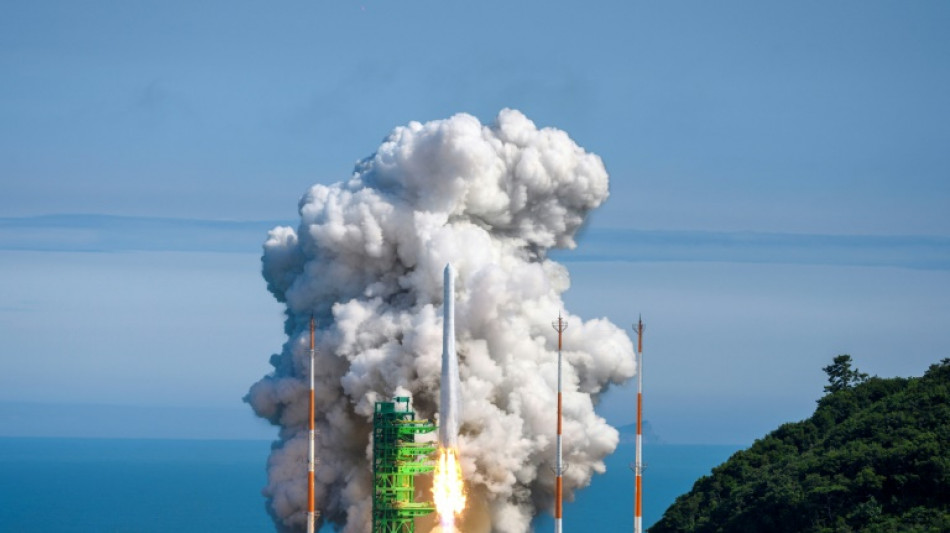
South Korea space rocket launch puts satellites in orbit / Photo: - - YONHAP/AFP

 Japan Olympic chief says 'lot more' athletes at Games than expected
 Asian carmakers besting US rivals at home, China poised to strike
 Widgets & Web Offers All-Inclusive Investor Relations Websites for Public Companies, IPOs and SPACs

 Adams named new US captain to 2030 World Cup

 China a better influence in Latin America than US: poll

 Judge pauses construction of border project in Texas national park

 Belgium's De Bruyne fires double to sink Turkey, France held by Italy
 US jobs data boosts stocks as oil prices dip

 US Supreme Court to hear high-stakes climate case

 Trump expected to name intel chief Clayton as AI czar: reports

 Argentina unveils passports-for-investment scheme

 Brazil election debate chaos sparks censorship row
 England's Carse charged by cricket body over nightclub incident

 Amazon vows $1 bn for data center towns, decries 'myths'

 Oil prices drop on G7 fuel release, US jobs data boosts stocks

 G7 agrees deal to ease global energy supply concerns

 Spain's government dealt blow as lawmakers reject housing bills

 Food, medicine shortages deepen in Russian-occupied Oleshky

 Man City whistleblower Rui Pinto facing 'dire consequences' - lawyers
 Russia 'tearing Kyiv apart', mayor says, as strikes paralyse traffic

 Taiwan boxer Lin wins Games gold as Japan edge North Korea on penalties

 Japan tame North Korea to win Games gold after shootout drama

 US posts weak job growth data in September
 Ethiopia's conflict: the regional dimension

 Life expectancy almost back to pre-Covid levels, says WHO

South Korea said Tuesday it had successfully launched its homegrown space rocket and placed a payload into orbit in a "giant leap" for the country's quest to become an advanced space-faring nation.
The Korea Satellite Launch Vehicle II, nicknamed Nuri and emblazoned with the South Korean flag, lifted off at 4:00pm (0700 GMT) from the launch site in Goheung on the southern coast, trailing a column of flame.
All three stages of the rocket worked, taking it to its target altitude of 700 kilometres (430 miles), and it successfully separated a performance verification satellite and put it into orbit, Seoul said.
South Korea's space program "has taken a giant leap forward," said Lee Jong-ho, minister of science and technology, adding he declared the mission a success.
"South Korea has now become the seventh nation in the world to launch a space vehicle with homegrown technology," he said, adding the government would continue its quest to become "an advanced space-faring nation".
South Korea will launch a Moon orbiter in August, Lee added.
The Tuesday test, South Korea's second test launch of its homegrown space rocket, comes eight months after the first test failed to put a dummy satellite into orbit.
In the first test last October, all three stages of the rocket worked with the vehicle reaching an altitude of 700 kilometres, and the 1.5-tonne payload separating successfully.
But it failed to put a dummy satellite into orbit after the third-stage engine stopped burning earlier than scheduled.
In Tuesday's test, in addition to a dummy satellite, Nuri carried a rocket performance verification satellite and four cube satellites developed by four local universities for research purposes.
The three-stage Nuri rocket has been a decade in development at a cost of 2 trillion won ($1.5 billion).
It weighs 200 tonnes and is 47.2 metres (155 feet) long, fitted with a total of six liquid-fuelled engines.
In Asia, China, Japan and India all have advanced space programmes, and the South's nuclear-armed neighbour North Korea was the most recent entrant to the club of countries with their own satellite launch capability.
- Lunar ambitions -
Ballistic missiles and space rockets use similar technology and Pyongyang put a 300-kilogram (660-pound) satellite into orbit in 2012 in what Washington condemned as a disguised missile test.
South Korea becomes the seventh nation -- not including North Korea -- to have successfully launched a one-tonne payload on their own rockets.
The South Korean space programme has a mixed record -- its first two launches in 2009 and 2010, which in part used Russian technology, both ended in failure.
The second one exploded two minutes into the flight, with Seoul and Moscow blaming each other.
Eventually a 2013 launch succeeded, but still relied on a Russian-developed engine for its first stage.
"The fact that we now have our own space rocket means we will be able to test and verify technologies needed for space exploration projects down the road," Bang Hyo-choong, professor of aerospace engineering at KAIST, told the Yonhap News Agency.
The satellite launch business is increasingly the preserve of private companies, notably Elon Musk's SpaceX, whose clients include the US space agency NASA and the South Korean military.
The Tuesday test looks set to bring South Korea closer to achieving its space ambitions, including a plan to land a probe on the Moon by 2030.
South Korea plans to conduct four more such test launches by 2027.
V.Dantas--PC



