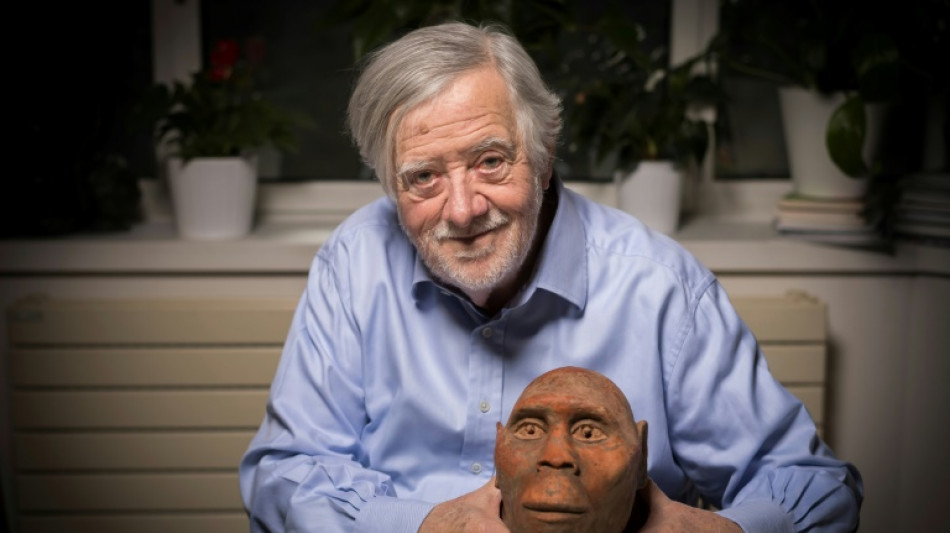
French co-discoverer of 'Lucy' dies at 87 / Photo: LIONEL BONAVENTURE, - - AFP/File

 Japan Olympic chief says 'lot more' athletes at Games than expected

 Asian carmakers besting US rivals at home, China poised to strike

 Widgets & Web Offers All-Inclusive Investor Relations Websites for Public Companies, IPOs and SPACs

 Adams named new US captain to 2030 World Cup

 China a better influence in Latin America than US: poll

 Judge pauses construction of border project in Texas national park

 Belgium's De Bruyne fires double to sink Turkey, France held by Italy

 US jobs data boosts stocks as oil prices dip

 US Supreme Court to hear high-stakes climate case
 Trump expected to name intel chief Clayton as AI czar: reports

 Argentina unveils passports-for-investment scheme

 Brazil election debate chaos sparks censorship row
 England's Carse charged by cricket body over nightclub incident

 Amazon vows $1 bn for data center towns, decries 'myths'

 Oil prices drop on G7 fuel release, US jobs data boosts stocks

 G7 agrees deal to ease global energy supply concerns

 Spain's government dealt blow as lawmakers reject housing bills

 Food, medicine shortages deepen in Russian-occupied Oleshky

 Man City whistleblower Rui Pinto facing 'dire consequences' - lawyers

 Russia 'tearing Kyiv apart', mayor says, as strikes paralyse traffic

 Taiwan boxer Lin wins Games gold as Japan edge North Korea on penalties

 Japan tame North Korea to win Games gold after shootout drama

 US posts weak job growth data in September

 Ethiopia's conflict: the regional dimension

 Life expectancy almost back to pre-Covid levels, says WHO

French palaeontologist Yves Coppens, credited with the co-discovery of the famous fossil find known as "Lucy", died on Wednesday aged 87 after a long illness, his publisher said.
"France has lost one of its great men," publisher Odile Jacob tweeted, adding that beyond his science skills, Coppens had also been "a talented writer, storyteller and non-fiction author".
He was, with Maurice Taieb and Donald Johanson, part of the team that found the most complete remnants of an Australopithecus afarensis ever discovered, in 1974 in Hadar, Ethiopia.
The team nicknamed the 3.2- million-year-old female hominid "Lucy" after the Beatles song "Lucy in the Sky with Diamonds" which they listened to while labelling the fossils.
Based on the large part of Lucy they found, 40 percent of her skeleton, the scientists were able to determine her height (one metre, 3.5 feet) and show that she was muscular and able to climb trees as well as walk upright.
Coppens, who was born in Britanny and was the son of a nuclear physicist father, co-signed six hominid discoveries over his career.
"At six or seven years old I already wanted to become an archaeologist," Coppens told AFP in 2016. "All my holiday time was spent at digs," he added.
Coppens was admitted to France's prestigious CNRS scientific centre in 1956 when he was still only 22.
He began travelling to Africa from the 1960s, starting with Algeria and Chad.
His first major discovery came in 1967, a 2.6-million-year-old fossil in the Omo valley in Ethiopia.
Then in 1974 came the international expedition in Ethiopia's Afar triangle that was to make Coppens, his friend and fellow Frenchman Taieb and Donald Johanson, an American, world famous for the discovery of Lucy.
Coppens often referred to himself as one of Lucy's "daddies" ("papas" in French).
For a long time after the find, which comprised 52 bone fragments, scientists believed that she was a direct ancestor of humanity.
But this claim is no longer widely believed, and Coppens as well as other palaeontologists came instead to view Lucy as a distant cousin of mankind.
Later Coppens ran digs in Mauritania, the Philippines, Indonesia, Siberia, China and Mongolia.
Back home, he became director of the Musee de l'Homme (Museum of Mankind) in Paris, was given the palaeontology chair in the prestigious College de France, and joined France's Academy of Science.
He also won several prizes, served as an advisor on environmental questions to the French government, and wrote several books and more than a million scientific articles.
Besides the discovery of Lucy, Coppens once told AFP, he was particularly proud to have "made an irrefutable link between the emergence of man and climate change".
As forests gave place to savannas, man stopped climbing trees, began to walk upright and needed to develop brain power to keep carnivores at bay, he said.
burs-jh/har
Ferreira--PC



