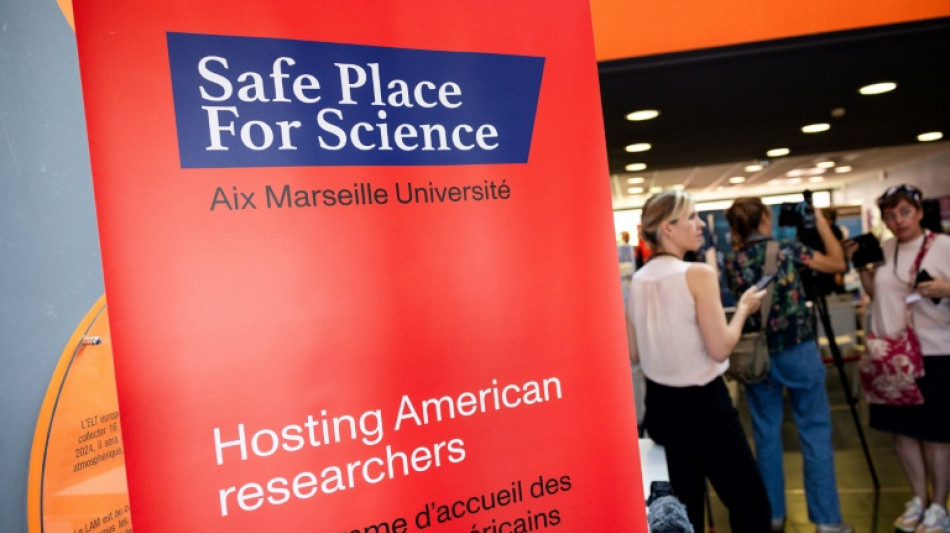
'Science refugees': French university welcomes first US researchers / Photo: CLEMENT MAHOUDEAU - AFP

 Tuchel hails 'complete' England after Croatia demolition

 Fury to invite Trump to lead ring walk before Joshua showdown

 Fashion industry in 'precarious moment', says Vivienne Westwood supremo
 Seventh heaven for England in Nations League rout of Croatia

 Storms, flooding cause chaos on Greek holiday island of Crete

 #IAmJaneDoe: online support campaign in US university rape case

 Brazil shine on Selecao's first visit to India

 Zverev sets up Djokovic quarter-final at China Open, Rybakina out

 Happier at home, Bordeaux hammer Lyon in Top 14

 Lula, Bolsonaro in final push for votes ahead of knife-edge election

 Boisterous fashion week barnstorms 'sleepy' Nigerian capital

 UAE investigators say flydubai co-pilot was planning 'terrorist act'

 Rahul smacks century in India v Windies ODI

 Daryz seeks to join exclusive club of dual Arc winners

 Russia warns diplomats to leave Kyiv over new strikes threat
 Olympic champ Zheng rebukes rowdy home crowd at China Open

 World No.1 Sinner pulls out of Shanghai Masters to delay return

 Red Bull's Verstappen grabs pole position for Bahrain GP

 India beat Pakistan in blockbuster as golfer Kim wins 'crazy' gold

 India beat arch-rivals Pakistan to win Asian Games cricket gold

 Ethiopia's Tigray rebels abandon regional capital as govt advances: journalist

 Tom Kim powers to Games gold and exemption from military service

 Split loyalties for Indian football fans at Brazil friendly

 India-Pakistan blockbuster brings cricket fever to Japan baseball field

 Wong waiting on Rafa after winning Asian Games tennis gold
Eight American researchers have arrived at a university in southern France, as the country pushes to offer "science asylum" to US academics hit by federal research spending cuts under Donald Trump.
The University of Aix-Marseille (AMU) welcomed the scholars on Thursday, following the March launch of its "Safe Place for Science" initiative, the first among 20 set to relocate there in coming months.
The programme has already drawn nearly 300 applicants from top institutions such as Stanford, NASA, and Berkeley.
The development comes as US universities have been threatened since Trump's return to the White House with massive federal funding cuts, causing research programmes to face closures.
Some staff also fear possible detention and deportation for their political views.
AMU -- one of France's largest universities, with some 12,000 international students alone -- is eager to provide a home for these scholars, with research funding for up to three years.
Historian Brian Sandberg said he decided to apply to the university in the southern Provence region on a return trip to the United States from France, when he feared he might face arrest at the border of his own country.
Though he was not detained, "it makes you think about what is your status as a researcher", said the academic from Illinois whose work focuses on religion, gender and violence.
- Academic freedom 'under attack' -
Sandberg is now one of 20 scholars specialising in subjects ranging from health, climate science, astrophysics and the humanities set to relocate to France in September. There, they hope to pursue their research in what they see as a more open academic environment.
"The principle of academic freedom, as well as the entire system of research and higher education in the United States is really under attack," said Sandberg.
"If I stay in the United States, I can continue to teach, but as a researcher, for the next four years, we're stuck," he said, referring to Trump's term in office.
One academic who requested anonymity said Trump's policies directly threatened her work on gender and human-caused global warming.
"Apparently, one of the banned words... is 'female'," she said. "I don't know how you can get around speaking about females without using the word," she said.
In February, the Washington Post reported that the National Science Foundation was flagging research using terms such as "female" and "women" that could violate Trump's orders rolling back diversity initiatives.
But she said her decision to move to France went beyond her professional freedom.
"I've got kids, I don't want them to grow up in a very hostile area," she said.
- A 'science asylum programme' -
AMU's programme is part of a broader push to cash in on US President Donald Trump's massive cuts in funding for education.
In May, France and the EU announced plans to attract US researchers in hopes of benefitting from the potential brain drain by supporting the costs of hosting foreign researchers.
French President Emmanuel Macron, who called the growing pressure on academia by Trump's administration "an error", has encouraged US scientists to "choose France".
He announced that his government would earmark 100 million euros ($117 million) to help attract foreign talent. French lawmakers have introduced a bill to create a special status for "science refugees".
European Commission head Ursula Von der Leyen has said the European Union will launch an incentives package worth 500 million euros to make the 27-nation bloc "a magnet for researchers".
For its part, AMU expects to welcome the other 12 American researchers in the coming months, with its budget of 15 million euros.
"Saving our American colleagues and welcoming them is also a way of welcoming and promoting global research," said the university's president Eric Berton.
"This is a science welcome programme, a science asylum programme. And above all, we want to enshrine the concept of science refugees in law," he added.
In recent years, France has already welcomed scholars forced into exile from Ukraine, Yemen, Afghanistan and the Palestinian territories.
A.Seabra--PC



