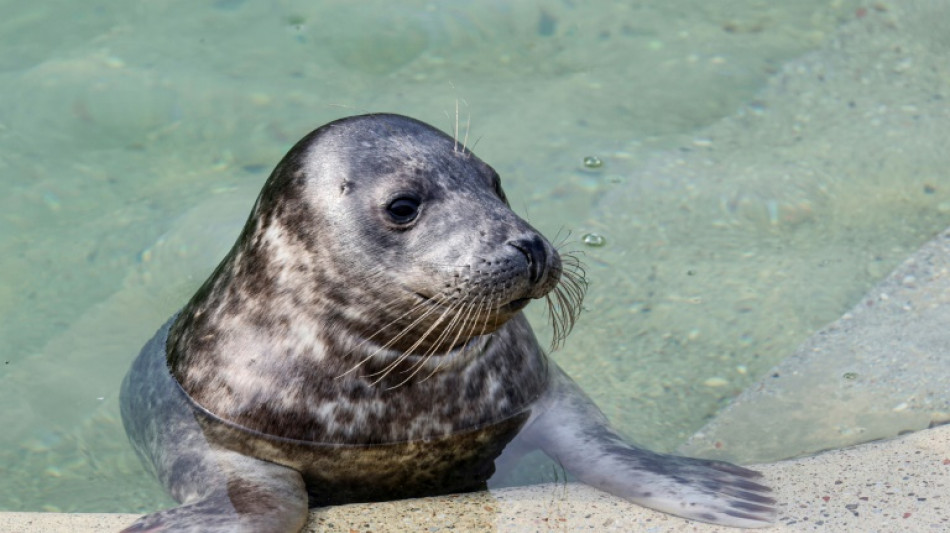
Lithuania bids to save Baltic seals as ice sheets recede / Photo: Petras Malukas - AFP

 Tuchel hails 'complete' England after Croatia demolition

 Fury to invite Trump to lead ring walk before Joshua showdown

 Fashion industry in 'precarious moment', says Vivienne Westwood supremo

 Seventh heaven for England in Nations League rout of Croatia

 Storms, flooding cause chaos on Greek holiday island of Crete

 #IAmJaneDoe: online support campaign in US university rape case

 Brazil shine on Selecao's first visit to India

 Zverev sets up Djokovic quarter-final at China Open, Rybakina out
 Happier at home, Bordeaux hammer Lyon in Top 14

 Lula, Bolsonaro in final push for votes ahead of knife-edge election

 Boisterous fashion week barnstorms 'sleepy' Nigerian capital

 UAE investigators say flydubai co-pilot was planning 'terrorist act'

 Rahul smacks century in India v Windies ODI

 Daryz seeks to join exclusive club of dual Arc winners

 Russia warns diplomats to leave Kyiv over new strikes threat

 Olympic champ Zheng rebukes rowdy home crowd at China Open

 World No.1 Sinner pulls out of Shanghai Masters to delay return

 Red Bull's Verstappen grabs pole position for Bahrain GP

 India beat Pakistan in blockbuster as golfer Kim wins 'crazy' gold

 India beat arch-rivals Pakistan to win Asian Games cricket gold

 Ethiopia's Tigray rebels abandon regional capital as govt advances: journalist

 Tom Kim powers to Games gold and exemption from military service

 Split loyalties for Indian football fans at Brazil friendly

 India-Pakistan blockbuster brings cricket fever to Japan baseball field

 Wong waiting on Rafa after winning Asian Games tennis gold

The grey seals slide out of their cages into the Baltic Sea near the Lithuanian coast, swimming off to new lives imperilled by climate change, pollution and shrinking fish stocks.
The seals have been nurtured at a rehabilitation centre in the Lithuanian port of Klaipeda.
Survival rates for cubs in the wild can be as low as five percent, according to local scientists.
The Baltic Sea, which is shared by the European Union and Russia, rarely freezes over now, depriving seals of sanctuaries to rear their cubs.
"Mothers are forced to breed on land in high concentration with other seals," said Vaida Surviliene, a scientist at Vilnius University.
"They are unable to recognise their cubs and often leave them because of it," she said.
Rearing cubs ashore also leaves them exposed to humans, other wild animals, rowdy males, as well as a higher risk of diseases, according to Arunas Grusas, a biologist at the centre.
- 'It was a sensation' -
Grusas began caring for seals in 1987 when he brought the first pup back to his office at the Klaipeda Sea Museum, which now oversees the new rehabilitation centre built in 2022.
"We taught them how to feed themselves, got them used to the water –- they had to get comfortable with the sea, which spat them out ashore practically dying," Grusas said.
The very first cubs were placed into makeshift baths set up in an office.
"It was a sensation for us, there were practically no seals left then," Grusas said.
The scientists had to learn how to nurse the cubs back to health.
First, the cubs were treated to liquid formula before moving onto solid food.
At the time in the late 1980s, the seals were close to extinction –- there were just around 4,000 to 5,000 left in the sea from a population of around 100,000 before the Second World War.
"The population began to decrease drastically in the 1950s due to hunting amid competition with fishers," said Surviliene.
- 'Nothing left to eat' -
The 1960s also saw the use of pesticides in agriculture that were "incredibly toxic for predators", the scientist said.
The seals at the top of the food chain in the Baltic Sea absorbed the pollution, leaving the females infertile and the entire population with a weak immune system, unable to ward off parasites and resist infections.
After a ban on toxic pesticide use, the population survived, with the current estimates putting the number of grey seals in the Baltic Sea at 50,000 to 60,000.
In a response to overfishing, the European Commission also finally banned commercial cod fishing in the eastern Baltic Sea in 2019.
"Over 80 percent of fish resources in the Baltic Sea have been destroyed, the seals have nothing left to eat," said Grusas.
The ban has yet to show a positive result.
"There has been no fishing of eastern Baltic cod for around five years, but it's not yet recovering -- and it's one of the main sources of food" for the seals, said Darius Daunys, a scientist at Klaipeda University.
Recently a growing number of adult seals have been washing up on Lithuanian beaches.
Scientists like Grusas point the finger at near-shore fishing nets, where seals desperate for food end up entangled and ultimately drown.
- 'Tired of the tension' -
Out in the Baltic Sea, the nine released seals took their first swim in the wild.
Previously, GPS trackers showed they favoured a route north toward the Swedish Gotland island in the middle of the Baltic Sea, where fish are more plentiful.
Others, however, needed a gentle push from the biologists.
In previous years, the released seals would even follow the boat back to shore, scared to venture off alone.
Eventually they all find their way in the wild.
Grusas is now preparing to retire after dedicating his life to saving animals.
He will leave at a time when the grey Baltic seal population has stabilised, but remains highly vulnerable.
"I've spent my whole life with seals," he said. "I'm tired of the tension –- you just don't know what can happen to them."
G.Teles--PC



