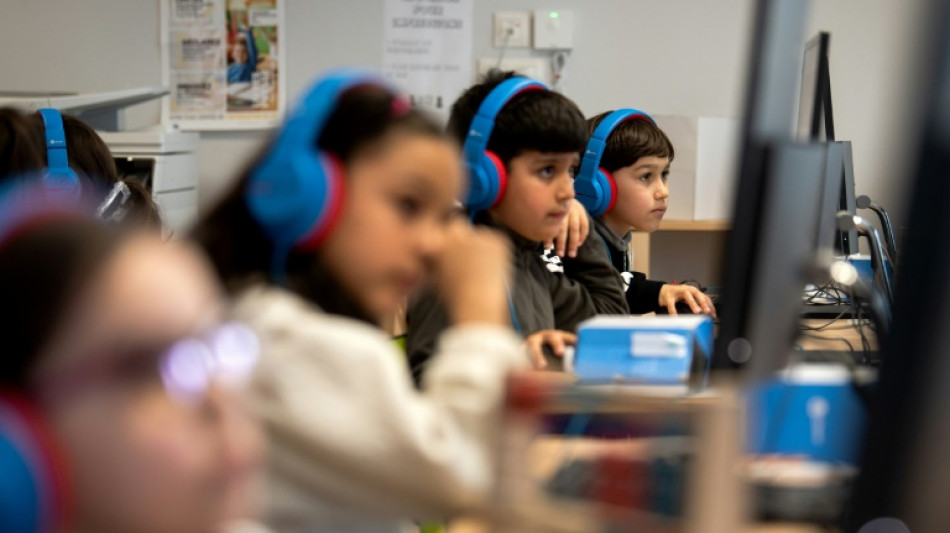
Anxious parents face tough choices on AI / Photo: Matthieu RONDEL - AFP

 Tuchel hails 'complete' England after Croatia demolition

 Fury to invite Trump to lead ring walk before Joshua showdown

 Fashion industry in 'precarious moment', says Vivienne Westwood supremo

 Seventh heaven for England in Nations League rout of Croatia

 Storms, flooding cause chaos on Greek holiday island of Crete

 #IAmJaneDoe: online support campaign in US university rape case

 Brazil shine on Selecao's first visit to India

 Zverev sets up Djokovic quarter-final at China Open, Rybakina out

 Happier at home, Bordeaux hammer Lyon in Top 14

 Lula, Bolsonaro in final push for votes ahead of knife-edge election

 Boisterous fashion week barnstorms 'sleepy' Nigerian capital

 UAE investigators say flydubai co-pilot was planning 'terrorist act'

 Rahul smacks century in India v Windies ODI

 Daryz seeks to join exclusive club of dual Arc winners

 Russia warns diplomats to leave Kyiv over new strikes threat

 Olympic champ Zheng rebukes rowdy home crowd at China Open

 World No.1 Sinner pulls out of Shanghai Masters to delay return

 Red Bull's Verstappen grabs pole position for Bahrain GP

 India beat Pakistan in blockbuster as golfer Kim wins 'crazy' gold

 India beat arch-rivals Pakistan to win Asian Games cricket gold

 Ethiopia's Tigray rebels abandon regional capital as govt advances: journalist

 Tom Kim powers to Games gold and exemption from military service

 Split loyalties for Indian football fans at Brazil friendly

 India-Pakistan blockbuster brings cricket fever to Japan baseball field

 Wong waiting on Rafa after winning Asian Games tennis gold

When it comes to AI, many parents navigate between fear of the unknown and fear of their children missing out.
"It's really hard to predict anything over five years," said Adam Tal, an Israeli marketing executive and father of two boys aged seven and nine, when describing the post-generative AI world.
Tal is "very worried" about the future this technology holds for his children -- whether it's deepfakes, "the inability to distinguish between reality and AI," or "the thousands of possible new threats that I wasn't trained to detect."
Mike Brooks, a psychologist from Austin, Texas, who specializes in parenting and technology, worries that parents are keeping their heads in the sand, refusing to grapple with AI.
"They're already overwhelmed with parenting demands," he observed -- from online pornography and TikTok to video games and "just trying to get them out of their rooms and into the real world."
For Marc Watkins, a professor at the University of Mississippi who focuses on AI in teaching, "we've already gone too far" to shield children from AI past a certain age.
Yet some parents are still trying to remain gatekeepers to the technology.
"In my circle of friends and family, I'm the only one exploring AI with my child," remarked Melissa Franklin, mother of a 7-year-old boy and law student in Kentucky.
"I don't understand the technology behind AI," she said, "but I know it's inevitable, and I'd rather give my son a head start than leave him overwhelmed."
- 'Benefits and risks' -
The path is all the more difficult for parents given the lack of scientific research on AI's effects on users.
Several parents cite a study published in June by MIT, showing that brain activity and memory were more stimulated in individuals not using generative AI than in those who had access to it.
"I'm afraid it will become a shortcut," explained a father of three who preferred to remain anonymous. "After this MIT study, I want them to use it only to deepen their knowledge."
This caution shapes many parents' approaches. Tal prefers to wait before letting his sons use AI tools. Melissa Franklin only allows her son to use AI with her supervision to find information "we can't find in a book, through Google, or on YouTube."
For her, children must be encouraged to "think for themselves," with or without AI.
But one father -- a computer engineer with a 15-year-old -- doesn't believe kids will learn AI skills from their parents anyway.
"That would be like claiming that kids learn how to use TikTok from their parents," he said. It's usually "the other way around."
Watkins, himself a father, says he is "very concerned" about the new forms that generative AI is taking, but considers it necessary to read about the subject and "have in-depth conversations about it with our children."
"They're going to use artificial intelligence," he said, "so I want them to know the potential benefits and risks."
The CEO of AI chip giant Nvidia, Jensen Huang, often speaks of AI as "the greatest equalization force that we have ever known," democratizing learning and knowledge.
But Watkins fears a different reality: "Parents will view this as a technology that will be used if you can afford it, to get your kid ahead of everyone else."
The computer scientist father readily acknowledged this disparity, saying "My son has an advantage because he has two parents with PhDs in computer science, but that's 90 percent due to the fact that we are more affluent than average" -- not their AI knowledge.
"That does have some pretty big implications," Watkins said.
E.Raimundo--PC



