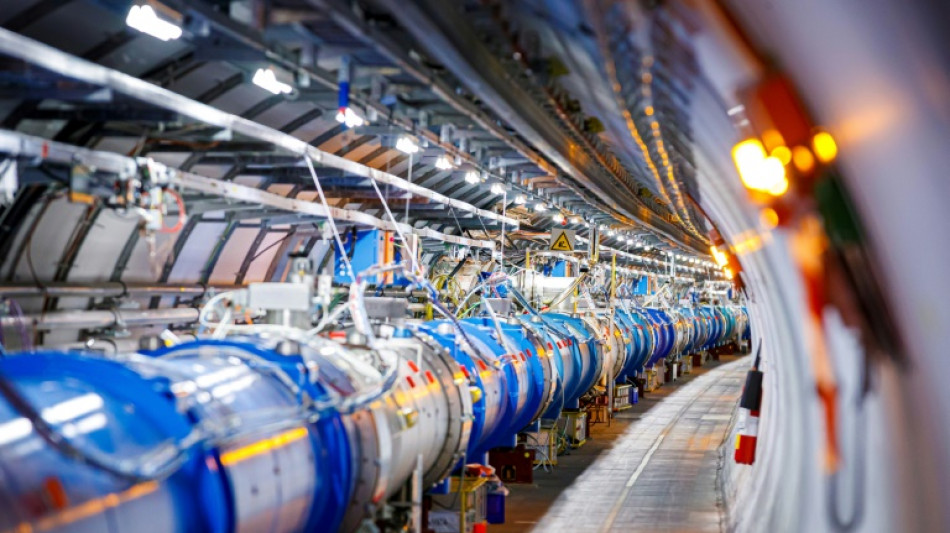
Large Hadron Collider revs up to unprecedented energy level / Photo: VALENTIN FLAURAUD - AFP/File

 Japan Olympic chief says 'lot more' athletes at Games than expected

 Asian carmakers besting US rivals at home, China poised to strike

 Widgets & Web Offers All-Inclusive Investor Relations Websites for Public Companies, IPOs and SPACs

 Adams named new US captain to 2030 World Cup

 China a better influence in Latin America than US: poll

 Judge pauses construction of border project in Texas national park

 Belgium's De Bruyne fires double to sink Turkey, France held by Italy
 US jobs data boosts stocks as oil prices dip

 US Supreme Court to hear high-stakes climate case

 Trump expected to name intel chief Clayton as AI czar: reports

 Argentina unveils passports-for-investment scheme

 Brazil election debate chaos sparks censorship row

 England's Carse charged by cricket body over nightclub incident
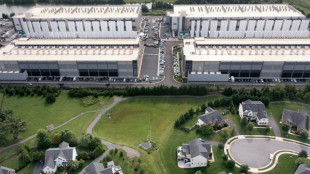 Amazon vows $1 bn for data center towns, decries 'myths'
 Oil prices drop on G7 fuel release, US jobs data boosts stocks

 G7 agrees deal to ease global energy supply concerns

 Spain's government dealt blow as lawmakers reject housing bills

 Food, medicine shortages deepen in Russian-occupied Oleshky

 Man City whistleblower Rui Pinto facing 'dire consequences' - lawyers
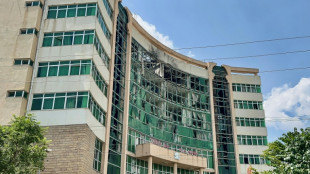
 Russia 'tearing Kyiv apart', mayor says, as strikes paralyse traffic

 Taiwan boxer Lin wins Games gold as Japan edge North Korea on penalties

 Japan tame North Korea to win Games gold after shootout drama

 US posts weak job growth data in September

 Ethiopia's conflict: the regional dimension

 Life expectancy almost back to pre-Covid levels, says WHO

Ten years after it discovered the Higgs boson, the Large Hadron Collider is about to start smashing protons together at unprecedented energy levels in its quest to reveal more secrets about how the universe works.
The world's largest and most powerful particle collider started back up in April after a three-year break for upgrades in preparation for its third run.
From Tuesday it will run around the clock for nearly four years at a record energy of 13.6 trillion electronvolts, the European Organisation for Nuclear Research (CERN) announced at a press briefing last week.
It will send two beams of protons -- particles in the nucleus of an atom -- in opposite directions at nearly the speed of light around a 27-kilometre (17-mile) ring buried 100 metres under the Swiss-French border.
The resulting collisions will be recorded and analysed by thousands of scientists as part of a raft of experiments, including ATLAS, CMS, ALICE and LHCb, which will use the enhanced power to probe dark matter, dark energy and other fundamental mysteries.
- 1.6 billion collisions a second -
"We aim to be delivering 1.6 billion proton-proton collisions per second" for the ATLAS and CMS experiments, CERN's head of accelerators and technology Mike Lamont said.
This time around the proton beams will be narrowed to less than 10 microns -- a human hair is around 70 microns thick -- to increase the collision rate, he added.
The new energy rate will allow them to further investigate the Higgs boson, which the Large Hadron Collider first observed on July 4, 2012.
The discovery revolutionised physics in part because the boson fit within the Standard Model -- the mainstream theory of all the fundamental particles that make up matter and the forces that govern them.
However several recent findings have raised questions about the Standard Model, and the newly upgraded collider will look at the Higgs boson in more depth.
"The Higgs boson is related to some of the most profound open questions in fundamental physics today," said CERN director-general Fabiola Gianotti, who first announced the boson's discovery a decade ago.
Compared to the collider's first run that discovered the boson, this time around there will be 20 times more collisions.
"This is a significant increase, paving the way for new discoveries," Lamont said.
Joachim Mnich, CERN's head of research and computing, said there was still much more to learn about the boson.
"Is the Higgs boson really a fundamental particle or is it a composite?" he asked.
"Is it the only Higgs-like particle that exists -- or are there others?"
- 'New physics season' -
Past experiments have determined the mass of the Higgs boson, as well as more than 60 composite particles predicted by the Standard Model, such as the tetraquark.
But Gian Giudice, head of CERN's theoretical physics department, said observing particles is only part of the job.
"Particle physics does not simply want to understand the how -- our goal is to understand the why," he said.
Among the Large Hadron Collider's nine experiments is ALICE, which probes the matter that existed in the first 10 microseconds after the Big Bang, and LHCf, which uses the collisions to simulate cosmic rays.
After this run, the collider will come back in 2029 as the High-Luminosity LHC, increasing the number of detectable events by a factor of 10.
Beyond that, the scientists are planning a Future Circular Collider -- a 100-kilometre ring that aims to reach energies of a whopping 100 trillion electronvolts.
But for now, physicists are keenly awaiting results from the Large Hadron Collider's third run.
"A new physics season is starting," CERN said.
E.Paulino--PC



