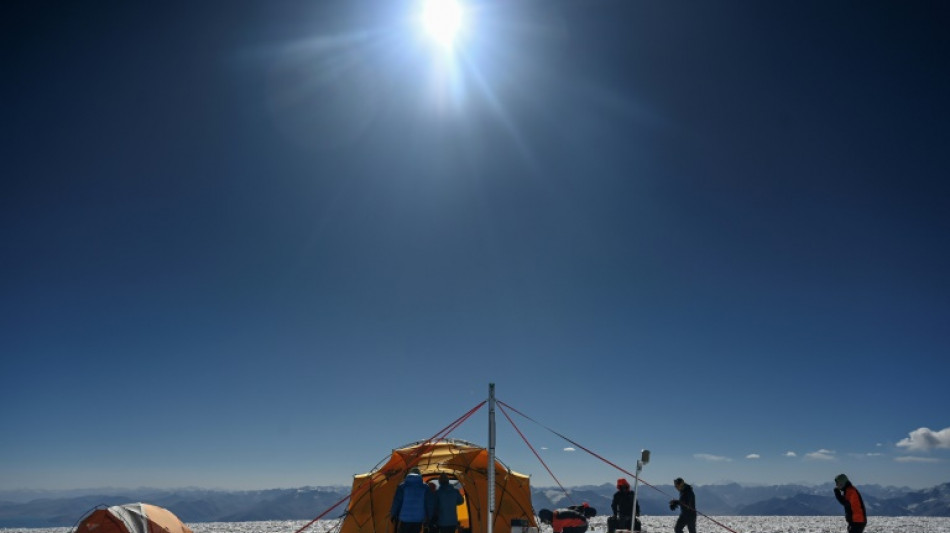
Scientists probe Tajik glacier for clues to climate resistance / Photo: Prakash MATHEMA - AFP

 Lula, Bolsonaro in final push for votes ahead of knife-edge election

 Boisterous fashion week barnstorms 'sleepy' Nigerian capital

 UAE investigators say flydubai co-pilot was planning 'terrorist act'

 Rahul smacks century in India v Windies ODI

 Daryz seeks to join exclusive club of dual Arc winners

 Russia warns diplomats to leave Kyiv over new strikes threat
 Olympic champ Zheng rebukes rowdy home crowd at China Open

 World No.1 Sinner pulls out of Shanghai Masters to delay return
 Red Bull's Verstappen grabs pole position for Bahrain GP

 India beat Pakistan in blockbuster as golfer Kim wins 'crazy' gold

 India beat arch-rivals Pakistan to win Asian Games cricket gold

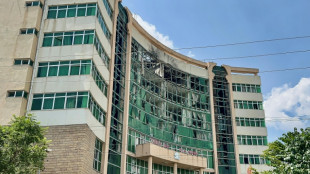 Ethiopia's Tigray rebels abandon regional capital as govt advances: journalist

 Tom Kim powers to Games gold and exemption from military service

 Split loyalties for Indian football fans at Brazil friendly

 India-Pakistan blockbuster brings cricket fever to Japan baseball field

 Wong waiting on Rafa after winning Asian Games tennis gold

 With Russia next door and rising costs, Latvia goes to the polls

 Penalty hero rues empty seats as Games hosts Japan win football gold

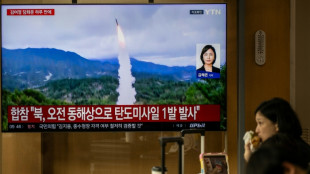 North Korea fires ballistic missile after Seoul's apology demand

 US regulator finds Boeing 737 MAX software bug 'not a safety concern'

 Ohtani 'managing' injuries as Dodgers launch MLB post-season

 Botched US execution leaves murderer unconscious on ventilator: lawyers

 Cornell rape case exposes sexual violence at US colleges

 France held by Italy in Zidane's homecoming after Olise stunner

 Ethiopian pro-government militia claims Tigray airport as regional tensions spike

Greenland is melting, the Alps are melting and the Himalayas are melting -- yet in one vast mountain region, huge glaciers have remained stable, or even gained mass, in recent decades. Can it last?
To find out, a dozen scientists, accompanied exclusively by an AFP photographer, trekked high over one glacier in eastern Tajikistan to drill for ice cores -- ancient, deep samples that can shed precious light on climate change.
In September and October, they first spent four days crossing the country from west to east in four-wheel drives, then climbed on foot to over 5,800 metres altitude on the Kon-Chukurbashi ice cap, near the Chinese border.
Camping for a week at the summit, in freezing temperatures and despite a day-long blizzard, the scientists from Switzerland, Japan, the United States and Tajikistan drilled the glacier to extract two 105-metre-long ice cores, in sections.
These layers of ice, compacted over centuries, perhaps millennia, form an archive of climate indicators, yielding data on past snowfall, temperatures, atmosphere and dust.
They must now be analysed in a laboratory to reveal their dates, said the leader of the team, Evan Miles, a glaciologist affiliated with the universities of Fribourg and Zurich.
"We're hopeful for a truly unique core, not just for the region, but for the broader region actually, probably extending back 20 to 25 or 30,000 years."
- Glacier temperature anomaly -
The apparently resistant glaciers are spread over thousands of kilometres of high mountain ranges in Central Asia, including Karakoram, Tian Shan, Kun Lun and the Pamir mountains of Tajikistan.
By delving back in time in the ice there, researchers hope to find out why these glaciers have resisted the general planetary warming of recent decades -- and whether this so-called "Karakoram anomaly" could be ending.
"This whole region is globally unique because over the last 25 years, these glaciers have shown very, very limited mass loss and even mass gain," said Miles.
The glaciers have shown some limited signs of loss in recent years, but scientists want to determine whether this is a natural variation or the beginning of a real decline.
"In order to understand that, we really, really need to have a longer time period of records of both temperature and precipitation at the glacier sites," said Miles.
"That's the type of information that an ice core can tell us."
- Glacier climate analysis -
One core will be sent to Japan for analysis and another stored in an underground sanctuary in Antarctica at minus 50C.
That naturally cold storage site is a project of the Ice Memory Foundation, which supported the Tajikistan expedition along with main funder, the Swiss Polar Institute.
The foundation, created in 2021 by French, Italian and Swiss universities and research centres, has already collected several cores in the Alps, Greenland, the Andes and elsewhere.
Future scientists will "be able to analyse (them) with their most modern analytical tools in 50, 100, 200 years and extract new information", said Ice Memory's president Thomas Stocker.
"We will probably lose 90 percent of our glacier mass on the Earth," Stocker told AFP. "So we are trying to help preserve a thing that is threatened by human action."
The scientists were scheduled to review their mission during a news conference in the Tajik capital Dushanbe on Monday.
T.Vitorino--PC



