
Japan ex-PM Murayama, famous for WW2 apology, dies aged 101 / Photo: YOSHIKAZU TSUNO - AFP

 Zverev thrashes Shang to set up Djokovic quarter-final at China Open

 Turkey football ref chief jailed pending trial for graft

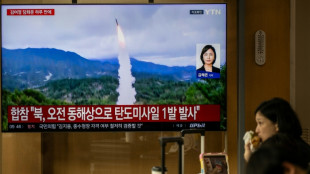
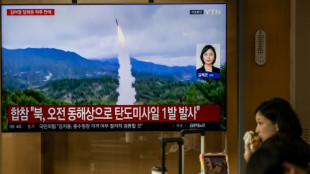 North Korea says test of intermediate-range strategic missile included use of AI

 Rampant Sayers leads Hong Kong to third men's rugby gold in a row

 Ethiopia's Tigray rebels abandon regional capital as govt advances

 Bulgaria's Tsar Samuel returns 'home' after 1,000 years

 'Glad it's over': Kim powers to Games gold and military exemption

 After 11 World Cups, football finally comes home for one Indian fan

 Marc Marquez wins sprint at Japan MotoGP, Martin grabs pole

 Alcaraz fends off Arnaldi to reach Japan Open quarters

 Antonelli tops times in final practice at Bahrain GP

 Gauff digs deep to beat Osorio in China Open second round

 Fresh protests to hit Spain after housing measures defeated

 'He's here with me': Japan cycle queen dedicates gold to late brother

 Japan Olympic chief says 'lot more' athletes at Games than expected
 Asian carmakers besting US rivals at home, China poised to strike

 Widgets & Web Offers All-Inclusive Investor Relations Websites for Public Companies, IPOs and SPACs

 Adams named new US captain to 2030 World Cup

 China a better influence in Latin America than US: poll

 Judge pauses construction of border project in Texas national park

 Belgium's De Bruyne fires double to sink Turkey, France held by Italy

 US jobs data boosts stocks as oil prices dip

 US Supreme Court to hear high-stakes climate case

 Trump expected to name intel chief Clayton as AI czar: reports

 Argentina unveils passports-for-investment scheme

Japan's former prime minister Tomiichi Murayama, best known for making a statement apologising over World War II, died Friday aged 101, officials said.
Murayama issued the 1995 proclamation on the 50th anniversary of Japan's surrender, expressing "deep remorse" over the country's atrocities in Asia.
The statement became a benchmark for Tokyo's subsequent apologies over World War II.
"Tomiichi Murayama, the father of Japanese politics, passed away today at 11:28 am at a hospital in Oita City at the age of 101," Mizuho Fukushima, head of the Social Democratic Party, seen as the successor to Murayama's now-defunct Socialist Party, said on X.
Hiroyuki Takano, the secretary general of the Social Democratic Party in Oita, Murayama's hometown, told AFP he had been informed that the former premier died of old age.
In the landmark statement in August 1995, Murayama said that "Japan... through its colonial rule and aggression, caused tremendous damage and suffering to the people of many countries, particularly to those of Asian nations".
"In the hope that no such mistake be made in the future, I regard, in a spirit of humility, these irrefutable facts of history, and express here once again my feelings of deep remorse and state my heartfelt apology," he added.
The phrases "deep remorse" and "heartfelt apology" were used by successive Japanese prime ministers when marking the 60th and 70th World War II anniversaries.
Murayama, who was also well-known for his distinctive bushy eyebrows, was elected as the prime minister in a coalition government that also included the Liberal Democratic Party, Japan's dominant postwar political force.
He was in office from 1994 to 1996, a turbulent period that saw a huge 1995 earthquake in western Japan, and a sarin gas attack on Tokyo's subway that killed more than a dozen people and injured more than 5,800.
Murayama was conscripted into the Japanese Imperial Army in 1944 while studying at university.
In a 2015 interview with public broadcaster NHK, he called the military a "dreadful thing", describing how "rebellion or argument was absolutely forbidden".
He also recalled his difficult memories of the run-up to the end of the war, when "food was already scarce, and very few weapons remained".
"We had weapons made of bamboo. I wondered if we could wage war in this condition," he said at the time.
tmo-kh-stu-aph/mjw
F.Moura--PC



