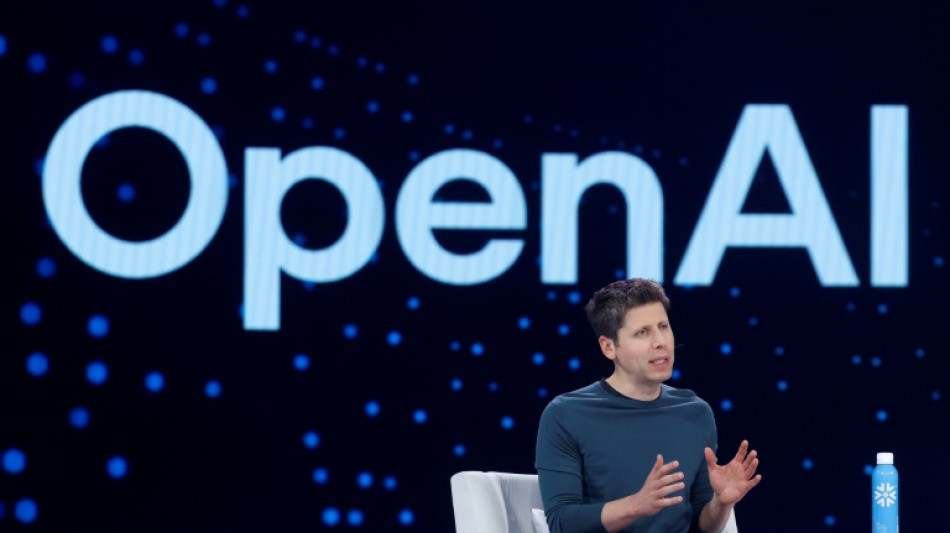
OpenAI big chip orders dwarf its revenues -- for now / Photo: JUSTIN SULLIVAN - GETTY IMAGES NORTH AMERICA/AFP

 Zverev thrashes Shang to set up Djokovic quarter-final at China Open

 Turkey football ref chief jailed pending trial for graft
 North Korea says test of intermediate-range strategic missile included use of AI

 Rampant Sayers leads Hong Kong to third men's rugby gold in a row

 Ethiopia's Tigray rebels abandon regional capital as govt advances

 Bulgaria's Tsar Samuel returns 'home' after 1,000 years

 'Glad it's over': Kim powers to Games gold and military exemption

 After 11 World Cups, football finally comes home for one Indian fan

 Marc Marquez wins sprint at Japan MotoGP, Martin grabs pole

 Alcaraz fends off Arnaldi to reach Japan Open quarters

 Antonelli tops times in final practice at Bahrain GP

 Gauff digs deep to beat Osorio in China Open second round

 Fresh protests to hit Spain after housing measures defeated

 'He's here with me': Japan cycle queen dedicates gold to late brother

 Japan Olympic chief says 'lot more' athletes at Games than expected

 Asian carmakers besting US rivals at home, China poised to strike
 Widgets & Web Offers All-Inclusive Investor Relations Websites for Public Companies, IPOs and SPACs

 Adams named new US captain to 2030 World Cup

 China a better influence in Latin America than US: poll

 Judge pauses construction of border project in Texas national park

 Belgium's De Bruyne fires double to sink Turkey, France held by Italy

 US jobs data boosts stocks as oil prices dip

 US Supreme Court to hear high-stakes climate case

 Trump expected to name intel chief Clayton as AI czar: reports

 Argentina unveils passports-for-investment scheme

OpenAI is ordering hundreds of billions of dollars worth of chips in the artificial intelligence race, raising questions among investors about how the startup will finance these purchases.
In less than a month, the San Francisco startup behind ChatGPT has committed to acquiring a staggering 26 gigawatts of sophisticated data processors from Nvidia, AMD, and Broadcom -- more than 10 million units that would consume power equivalent to 20 standard nuclear reactors.
"They will need hundreds of billions of dollars to live up to their obligations," said Gil Luria, managing director at D.A. Davidson, a financial consulting firm.
The challenge is daunting: OpenAI doesn't expect to be profitable until 2029 and is forecasting billions in losses this year, despite generating about $13 billion in revenue.
OpenAI declined to comment on its financing strategy.
However, in a CNBC interview, co-founder Greg Brockman acknowledged the difficulty of building sufficient computing infrastructure to handle the "avalanche of demand" for AI, noting that creative financing mechanisms will be necessary.
- Creative financing -
Nvidia, AMD, and Broadcom all declined to discuss specific deals with OpenAI.
Silicon Valley-based Nvidia has announced plans to invest up to $100 billion in OpenAI over several years to build the world's largest AI infrastructure.
OpenAI would use those funds to buy chips from Nvidia in a game of "circular financing," with Nvidia recouping its investment by taking a share in OpenAI, one of its biggest customers and the world's hottest AI company.
AMD has taken a different approach, offering OpenAI options to acquire equity in AMD -- a transaction considered unusual in financial circles and a sign that it is AMD that is seeking to seize some of OpenAI's limelight with investors.
"It represents another unhealthy dynamic," Luria said, suggesting the arrangement reveals AMD's desperation to compete in a market dominated by Nvidia.
- Crash or soar? -
The stakes couldn't be higher.
OpenAI co-founder and CEO Sam Altman "has the power to crash the global economy for a decade or take us all to the promised land," Bernstein Research senior analyst Stacy Rasgon wrote in a note to investors this month.
"Right now, we don't know which is in the cards."
Even selling stakes in OpenAI at its current $500 billion valuation won't cover the startup's chip commitments, according to Luria, meaning the company will need to borrow money.
One possibility: using the chips themselves as collateral for loans.
Meanwhile, deep-pocketed competitors like Google and Meta can fund their AI efforts from massive profits generated by their online advertising businesses -- a luxury OpenAI doesn't have.
The unbridled spending has sparked concerns about a speculative bubble reminiscent of the late 1990s dot-com frenzy, which collapsed and wiped out massive investments.
However, some experts see key differences. "There is very real demand today for AI in a way that seems a little different than the boom in the 1990s," said Josh Lerner, a Harvard Business School professor of investment banking.
CFRA analyst Angelo Zino pointed to OpenAI's remarkable growth and more than 800 million ChatGPT users as evidence that a partnership approach to financing makes sense.
Still, Lerner acknowledges the uncertainty: "It's a real dilemma. How does one balance this future potential with the speculative nature" of its investments today?
L.Mesquita--PC