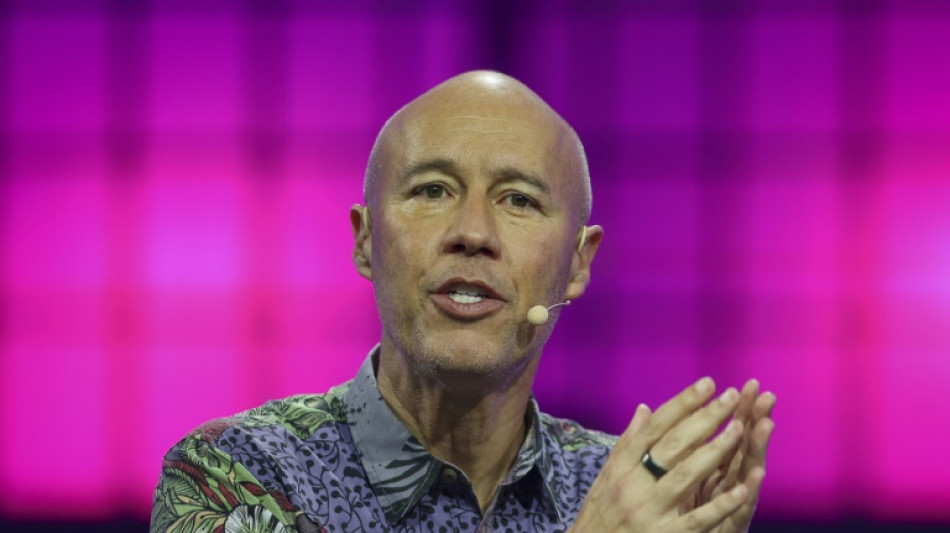
Big platforms chart gradual path to self-driving at Web Summit / Photo: PATRICIA DE MELO MOREIRA - AFP

 Zverev thrashes Shang to set up Djokovic quarter-final at China Open

 Turkey football ref chief jailed pending trial for graft
 North Korea says test of intermediate-range strategic missile included use of AI

 Rampant Sayers leads Hong Kong to third men's rugby gold in a row

 Ethiopia's Tigray rebels abandon regional capital as govt advances
 Bulgaria's Tsar Samuel returns 'home' after 1,000 years

 'Glad it's over': Kim powers to Games gold and military exemption

 After 11 World Cups, football finally comes home for one Indian fan
 Marc Marquez wins sprint at Japan MotoGP, Martin grabs pole
 Alcaraz fends off Arnaldi to reach Japan Open quarters

 Antonelli tops times in final practice at Bahrain GP

 Gauff digs deep to beat Osorio in China Open second round

 Fresh protests to hit Spain after housing measures defeated

 'He's here with me': Japan cycle queen dedicates gold to late brother

 Japan Olympic chief says 'lot more' athletes at Games than expected
 Asian carmakers besting US rivals at home, China poised to strike
 Widgets & Web Offers All-Inclusive Investor Relations Websites for Public Companies, IPOs and SPACs

 Adams named new US captain to 2030 World Cup
 China a better influence in Latin America than US: poll

 Judge pauses construction of border project in Texas national park

 Belgium's De Bruyne fires double to sink Turkey, France held by Italy
 US jobs data boosts stocks as oil prices dip

 US Supreme Court to hear high-stakes climate case

 Trump expected to name intel chief Clayton as AI czar: reports

 Argentina unveils passports-for-investment scheme

Major Western ride-hailing platforms like Uber and Lyft sketched a gradual path towards introducing self-driving cars at this week's Web Summit in Lisbon, with infrastructure, developing regulation and passengers' preference for human contact weighing on the brakes.
Building autonomous vehicles many times safer than human drivers is "almost largely solved", Uber's operations chief Andrew Macdonald told Web Summit attendees on Tuesday.
"Now what you have is a commercialisation question."
"In five years, if (autonomous driving) achieves even ten percent of our business, that would be enormously successful," Lyft chief David Risher told AFP in a Wednesday interview.
In today's terms, that would represent around $500 million of the just under $5 billion of gross bookings Lyft reported in its fourth quarter.
That was a fraction of the roughly $50 billion reported by Uber for the same period, albeit on a broader slate of activities including food delivery.
For now, Lyft -- which accounts for around 30 percent of the US market and recently bought leading European taxi-hailing app FreeNow -- is planning pilot schemes in individual cities.
It expects to partner from next year on a Nashville project with Californian startup Waymo -- which already offers self-driving rides in San Francisco -- and with Chinese tech giant Baidu in Germany and Britain.
Those two countries have been the fastest in Europe to launch official application schemes to run self-driving pilots, FreeNow boss Thomas Zimmermann told AFP.
Uber's Macdonald said Tuesday that Germany and the UK were also first in line for European pilots from the sector's juggernaut.
- Across US-China divide -
A thicket of partnerships has sprung up in autonomous driving, with Uber also working with Waymo in US cities Austin and Atlanta, and with China's WeRide in Gulf locations such as Abu Dhabi.
Lyft has joined forces with American developers like Tensor and May Mobility and US-Israeli firm Mobileye.
Where American and Chinese companies are competing fiercely in sectors like AI and semiconductors, collaborations are more common in autonomous vehicles.
Geopolitical tensions mean China's manufacturers are unlikely to push to conquer the American car market with their self-driving offerings for the time being, Risher said.
And in markets like Europe, where they may lack local contacts and knowledge, "Chinese companies have a view that they need a partnership with a company like ours to commercialise their technology," he added.
Familiarity with each market is vital, as beyond getting cars on the road "you need supportive regulatory frameworks... you need to figure out ownership and infrastructure models and that means financing, it means real estate, it means power, and you need a hell of a lot of power," Uber's Macdonald said.
"This is not something that you do sitting at a desk 10,000 miles away," Risher said.
Web Summit kicked off with a warning from organiser Paddy Cosgrave that "the era of Western tech dominance is fading".
But in self driving, technology levels are comparable enough that "I wouldn't say this is an area where the Chinese have a particular advantage," Risher said.
- Human touch -
Both the heavyweight platforms say that human drivers will be operating most of their rides for the foreseeable future.
"This is gonna be a delicate transition going from fully human labour to AI in the physical world in the form of autonomous vehicles," Macdonald said.
"Our network, I think, will help us feather in these vehicles and make that transition work".
For now, "there's just not enough autonomous vehicles in the world to satisfy all the demand," Risher said.
What's more, "there are plenty of times when people are going to want help with their luggage or a kind word at the end of the day" from a human driver.
S.Pimentel--PC