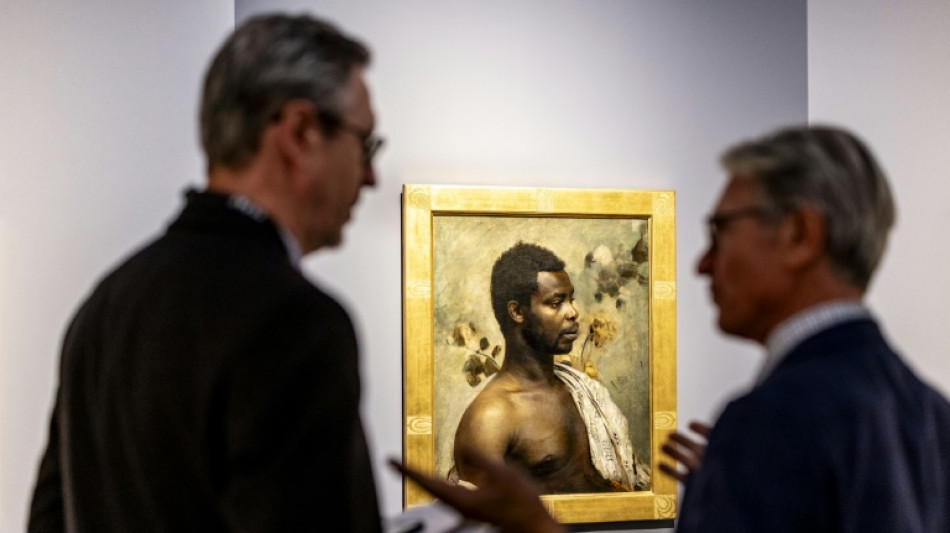
'Black Klimt' steps out of shadows and into political tug-of-war / Photo: Marcel van Hoorn - AFP

 Zverev thrashes Shang to set up Djokovic quarter-final at China Open

 Turkey football ref chief jailed pending trial for graft

 North Korea says test of intermediate-range strategic missile included use of AI
 Rampant Sayers leads Hong Kong to third men's rugby gold in a row

 Ethiopia's Tigray rebels abandon regional capital as govt advances

 Bulgaria's Tsar Samuel returns 'home' after 1,000 years

 'Glad it's over': Kim powers to Games gold and military exemption

 After 11 World Cups, football finally comes home for one Indian fan

 Marc Marquez wins sprint at Japan MotoGP, Martin grabs pole

 Alcaraz fends off Arnaldi to reach Japan Open quarters
 Antonelli tops times in final practice at Bahrain GP
 Gauff digs deep to beat Osorio in China Open second round
 Fresh protests to hit Spain after housing measures defeated
 'He's here with me': Japan cycle queen dedicates gold to late brother

 Japan Olympic chief says 'lot more' athletes at Games than expected

 Asian carmakers besting US rivals at home, China poised to strike

 Widgets & Web Offers All-Inclusive Investor Relations Websites for Public Companies, IPOs and SPACs

 Adams named new US captain to 2030 World Cup

 China a better influence in Latin America than US: poll

 Judge pauses construction of border project in Texas national park

 Belgium's De Bruyne fires double to sink Turkey, France held by Italy

 US jobs data boosts stocks as oil prices dip

 US Supreme Court to hear high-stakes climate case

 Trump expected to name intel chief Clayton as AI czar: reports

 Argentina unveils passports-for-investment scheme

A man walked into a Viennese gallery one day in the summer of 2023 looking to sell a Gustav Klimt painting. The person who greeted him thought it was a joke, and gently sent him on his way.
But when the owner of the W&K gallery was told what had happened, he ran down the street after the man.
Ebi Kohlbacher is an expert on the great Austrian symbolist artist and knew some Klimt paintings had been lost.
He caught up with the man, who showed him a photo of a canvas lost for eight decades -- a portrait of Prince William Nii Nortey Dowuona, an African aristocrat who is known to have met Klimt and posed for him.
It is "one of the rare paintings of a black person in European art created by a great artist", Kohlbacher told AFP.
Experts say Dowuona was the head of a group of the Ga people from near Accra in Ghana who were part of a notorious "human zoo" exhibition of African village life that drew huge crowds in Vienna in 1897.
The painting vanished after World War II, having been owned by a wealthy Jewish Austrian family, the Kleins.
"We had to determine where the work came from without a trace of doubt," Kohlbacher told AFP.
Another expert Alfred Weidinger helped confirm the portrait was genuine and mapped out its history.
The Kleins, who were wine dealers, acquired the painting after Klimt's death in 1918. They fled Austria after the Nazi annexation of in 1938, entrusting the painting to a woman, who later moved to Hungary.
But when the communists took power in Budapest in 1949, the woman ignored all the family's pleas to give it back and the painting vanished from the public eye.
It had four known owners in Hungary between 1988 and 2023, when it was taken back to Austria for expert analysis after Hungary granted an export licence.
- Klimt 'respected' him -
Klimt's work now sells for astronomical sums -- his "Lady with a Fan" sold for $108 million in 2023 -- and Weidinger hailed it as one of the artist's "prominent" works.
The oil painting's floral elements, which later became one of Klimt's characteristic traits, show "a key phase in the evolution of his artistic language", Weidinger said.
"This transition phase is defined in particular by the tension between the meticulously detailed and naturalist figure" of the prince and the "vibrant, almost expressionist rendering of the background", he added.
Kohlbacher said Klimt must have known and respected the prince.
"It is obvious that the painting radiates his admiration," he said.
The prince led a delegation of 120 Africans who travelled through the Austro-Hungarian empire and posed for six months in a show that was visited by up to 10,000 people a day.
The painting marked a turning point in the European perception of Africans, Weidinger said.
Despite problematic colonial prejudices and the obvious "voyeurism" of the show, the Africans "were no longer separated from the public", the expert said.
"The Viennese bourgeoisie took them to cafes and shopping, and showed them the local monuments," he added.
- Enter Viktor Orban's Hungary -
But the tale has another twist thanks to Hungary's new-found passion for the lost African prince.
The last owner of the painting is allowed to sell it under an agreement signed in line with the 1998 Washington Principles for the return of assets seized from Holocaust victims.
He has a confidential deal with the descendants of Ernestine Klein, the original owner who died in 1973.
But Budapest will have none of that as it insists the export licence was not valid, arguing that an item of such value should never have left the country.
While the W&K gallery hopes that Hungary will respect the Washington Principles, the Vienna prosecutor confirmed to AFP he has received a seizure order from Budapest, which wants the "Black Klimt" back.
X.M.Francisco--PC



