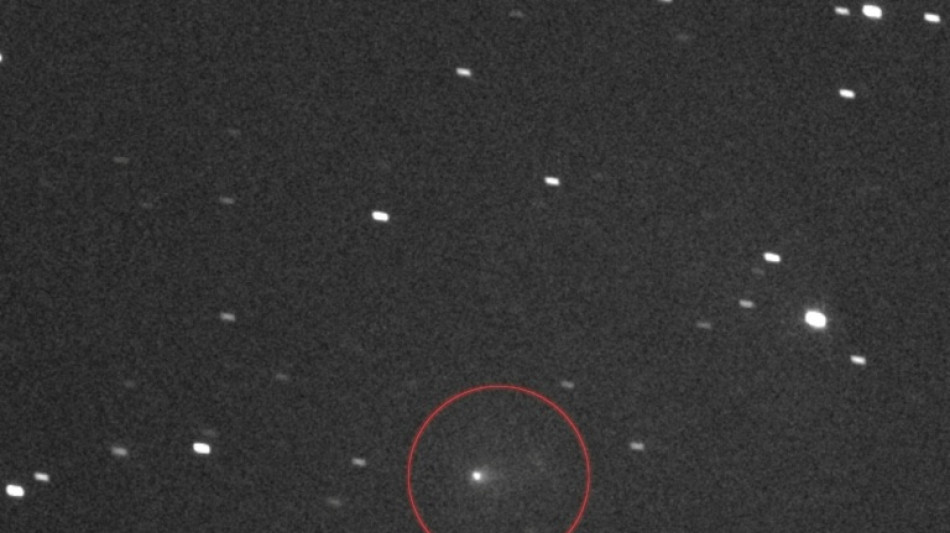
Comet sparks scientific fascination, online furor over 'alien' origins / Photo: NASA - NASA/AFP

 Zverev thrashes Shang to set up Djokovic quarter-final at China Open

 Turkey football ref chief jailed pending trial for graft

 North Korea says test of intermediate-range strategic missile included use of AI

 Rampant Sayers leads Hong Kong to third men's rugby gold in a row

 Ethiopia's Tigray rebels abandon regional capital as govt advances

 Bulgaria's Tsar Samuel returns 'home' after 1,000 years

 'Glad it's over': Kim powers to Games gold and military exemption

 After 11 World Cups, football finally comes home for one Indian fan

 Marc Marquez wins sprint at Japan MotoGP, Martin grabs pole

 Alcaraz fends off Arnaldi to reach Japan Open quarters

 Antonelli tops times in final practice at Bahrain GP

 Gauff digs deep to beat Osorio in China Open second round

 Fresh protests to hit Spain after housing measures defeated

 'He's here with me': Japan cycle queen dedicates gold to late brother

 Japan Olympic chief says 'lot more' athletes at Games than expected

 Asian carmakers besting US rivals at home, China poised to strike

 Widgets & Web Offers All-Inclusive Investor Relations Websites for Public Companies, IPOs and SPACs

 Adams named new US captain to 2030 World Cup

 China a better influence in Latin America than US: poll

 Judge pauses construction of border project in Texas national park

 Belgium's De Bruyne fires double to sink Turkey, France held by Italy

 US jobs data boosts stocks as oil prices dip

 US Supreme Court to hear high-stakes climate case

 Trump expected to name intel chief Clayton as AI czar: reports

 Argentina unveils passports-for-investment scheme

A flying piece of cosmic rock or an alien threat? Comet 3I/ATLAS is hurtling through our solar system and captivating scientists and internet users alike, even prompting Kim Kardashian to ask NASA for answers.
Questions on whether the comet could actually be an alien spacecraft are coming from sources as varied as the reality TV star, a member of US Congress and a Harvard researcher, as well as from prominent conspiracy theorists.
But that theory has been shot down by NASA, which released new images of the comet on Wednesday after the speculation gained traction online.
"It's amazing to see how people are really engaged in the discussion," said Thomas Puzia, an astrophysicist who led the team at the Chilean observatory that made the discovery.
But, "it's very dangerous and to a certain degree misleading to put speculations ahead of scientific process," he told AFP in a thinly veiled criticism of another researcher who has been insisting for weeks that the extraterrestrial spacecraft hypothesis cannot be ruled out.
"The facts, all of them without exception, point to a normal object that is coming from the interstellar space to us," he said.
He added the comet was "very exceptional in its nature, but it's nothing that we cannot explain with physics."
- Seeking signs of life –
Since its detection in July, the comet has generated intense speculation -- unsurprisingly so, given it is only the third interstellar object foreign to our solar system ever discovered to be passing through.
The first was the Oumuamua comet, which sparked similar ripples of excitement and debate in 2017.
Even then, Harvard Professor Avi Loeb supported the theory that Oumuamua could be a spacecraft, a controversial position he later defended in a book.
He has now accused his scientific peers of lacking open-mindedness when it comes to Comet 3I/ATLAS.
"Obviously, it could be natural," he told AFP. "But I said: we have to consider the possibility that it's technological because if it is then the implications for humanity will be huge."
NASA, however, did not agree.
"We want very much to find signs of life in the universe... but 3I/ATLAS is a comet," said Amit Kshatriya, a senior NASA official, at a press conference on Wednesday.
The debate risked overshadowing the very real wonder that 3I/ATLAS represents, according to Puzia who said it offered "an unprecedented insight into an extrasolar system, potentially billions of years older than our own solar system."
- 'Goosebumps' -
If there is one thing everyone agrees on, it is that 3I/ATLAS is anything but ordinary.
The comet holds many mysteries, particularly regarding its origin and exact composition, which scientists hope to unravel through close observation in the coming weeks as it gets closer to Earth.
This small, solid body composed of rock and ice from the far reaches of space could help us better understand how "planets might form" or even "how life might form around other stars in the Milky Way Galaxy in different times of the evolutionary history of the galaxy," according to Puzia.
NASA scientist Tom Statler described having "goosebumps" when thinking about the comet's origins.
"We can't say this for sure, but the likelihood is it came from a solar system older than our own solar system itself," he said. "It's a window into the deep past, and so deep in the past that it predates even the formation of our Earth and our Sun."
Unlike the two interstellar objects detected previously and only briefly studied, astronomers have had months to observe 3I/ATLAS.
And they hope this is just the beginning, thanks to improving technology for observation and detection.
"We should be finding many, many more of them every year," Darryl Seligman of Michigan State University told AFP.
P.Serra--PC



