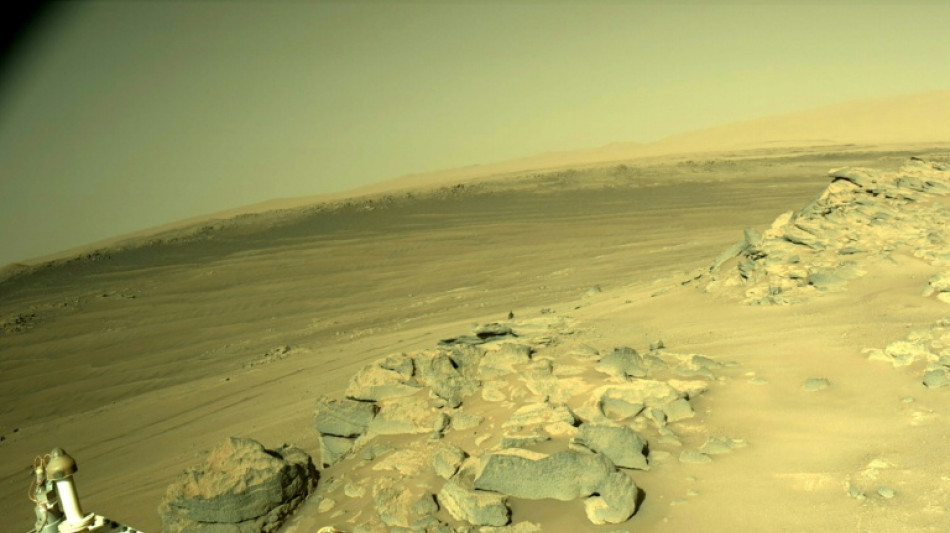
NASA rover records first evidence of lightning on Mars / Photo: Handout - NASA/AFP/File

 Zverev thrashes Shang to set up Djokovic quarter-final at China Open

 Turkey football ref chief jailed pending trial for graft

 North Korea says test of intermediate-range strategic missile included use of AI

 Rampant Sayers leads Hong Kong to third men's rugby gold in a row

 Ethiopia's Tigray rebels abandon regional capital as govt advances

 Bulgaria's Tsar Samuel returns 'home' after 1,000 years

 'Glad it's over': Kim powers to Games gold and military exemption

 After 11 World Cups, football finally comes home for one Indian fan

 Marc Marquez wins sprint at Japan MotoGP, Martin grabs pole

 Alcaraz fends off Arnaldi to reach Japan Open quarters

 Antonelli tops times in final practice at Bahrain GP

 Gauff digs deep to beat Osorio in China Open second round

 Fresh protests to hit Spain after housing measures defeated

 'He's here with me': Japan cycle queen dedicates gold to late brother

 Japan Olympic chief says 'lot more' athletes at Games than expected

 Asian carmakers besting US rivals at home, China poised to strike

 Widgets & Web Offers All-Inclusive Investor Relations Websites for Public Companies, IPOs and SPACs

 Adams named new US captain to 2030 World Cup

 China a better influence in Latin America than US: poll

 Judge pauses construction of border project in Texas national park

 Belgium's De Bruyne fires double to sink Turkey, France held by Italy

 US jobs data boosts stocks as oil prices dip

 US Supreme Court to hear high-stakes climate case

 Trump expected to name intel chief Clayton as AI czar: reports

 Argentina unveils passports-for-investment scheme

A NASA rover has recorded evidence of lightning on Mars for the first time, its microphone picking up the sounds of tiny "zaps" whipped up by the dust storms constantly sweeping across the planet.
Scientists have long debated whether electrical discharges could be sparking in the dusty and little-known Martian climate -- but proof has been hard to come by.
It turns out that NASA's Perseverance rover, which has been roaming the red planet since 2021, was inadvertently recording the sounds of lightning, according to a study published in Nature this week.
These are far from the thundering, kilometre-long lightning bolts we see on Earth.
Instead, they are "little zaps" similar to "what you might feel in dry weather when you touch your car door and there's a bit of static electricity," lead author Baptiste Chide of France's CNRS research centre told AFP.
While low in energy, these discharges are happening "absolutely all the time -- and everywhere" on Mars, the planetary scientist said.
The process starts when tiny grains of dust rub against each other. They become charged with electrons and release this energy in electrical arcs a few centimetres (inches) -- or even millimetres -- long, sending off an audible shock wave.
Here on Earth, dust storms and dust devils in desert areas also create electrical fields. But they rarely build up into electrical discharges.
However on Mars, "because of the very low pressure and the composition of the atmosphere, the amount of charge that needs to accumulate to generate a discharge is much smaller," Chide explained.
This phenomenon has been theorised since Mars first started to be explored -- and has been reproduced in the laboratory.
Chide said it had been "such an important issue for Martian science" that an instrument on the European Space Agency's Schiaparelli lander was dedicated to searching for it.
Unfortunately the spacecraft crashed while trying to land on Mars in 2016.
Since then, "it was somewhat of a forgotten area for Martian exploration," Chide said.
That is, until "by chance" the microphone on Perserverance's SuperCam recorded signals of what appeared to be electrical discharges, he added.
Daniel Mitchard, a lightning expert at Cardiff University not involved in the study, commented in Nature that the research provided "persuasive evidence of dust-induced discharges".
But because the discharges "were only heard and not seen," he expected debate between scientists on the subject "to continue for some time".
- Electrified astronauts? -
The research could shed some light on the mysterious Martian climate.
"Dust drives the Martian climate", similar to the water cycle on Earth, Chide said. For example, a season of dust storms will have begun by the end of the year.
The electrical discharges could also kick off a process that destroys organic molecules -- which are the building blocks of life -- on the Martian surface.
It could also explain the surprisingly rapid disappearance of methane on the planet -- a phenomenon that has baffled scientists.
It may also have implications for future Mars missions.
Scientists will now be able to design their instruments to better protect the future robots sent to Mars, Chide said.
And of course, there are also plans for humans to finally step foot on the planet's red surface.
"In the long term, isn't there a risk that the suits of the astronauts who stay on the Martian surface for a long time will be damaged by these discharges?" Chide asked.
"We will have to ask ourselves this question."
R.Veloso--PC



