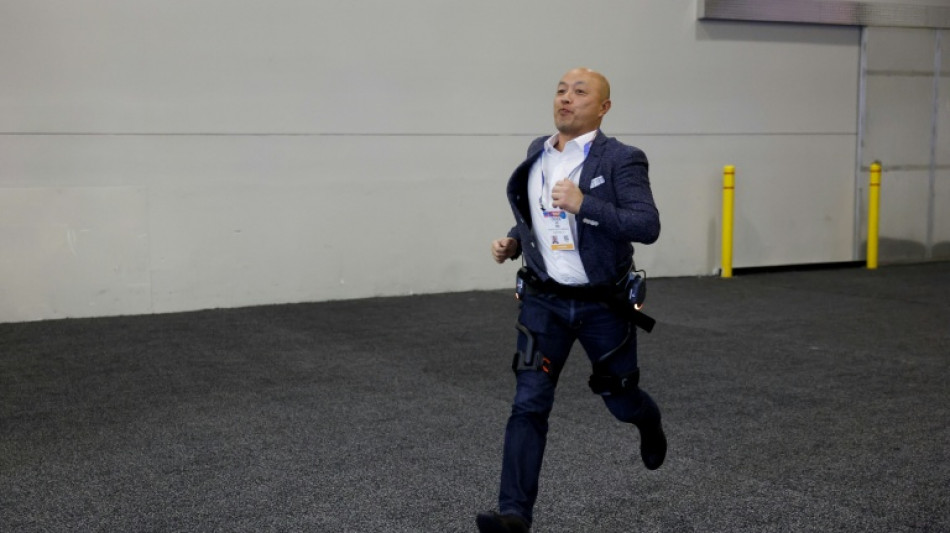
From sci-fi to sidewalk: exoskeletons go mainstream / Photo: Caroline Brehman - AFP

 World No.1 Sinner pulls out of Shanghai Masters to delay return
 Red Bull's Verstappen grabs pole position for Bahrain GP

 India beat Pakistan in blockbuster as golfer Kim wins 'crazy' gold

 India beat arch-rivals Pakistan to win Asian Games cricket gold

 Ethiopia's Tigray rebels abandon regional capital as govt advances: journalist
 Tom Kim powers to Games gold and exemption from military service
 Split loyalties for Indian football fans at Brazil friendly
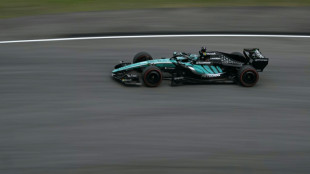
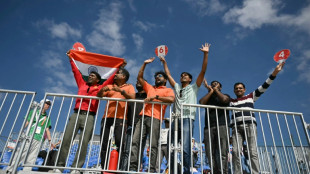 India-Pakistan blockbuster brings cricket fever to Japan baseball field
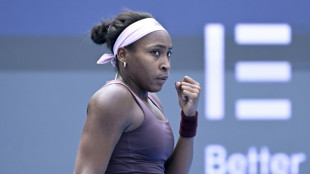
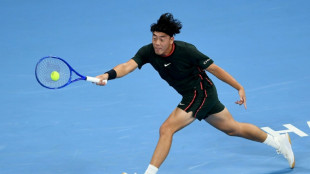 Wong waiting on Rafa after winning Asian Games tennis gold

 With Russia next door and rising costs, Latvia goes to the polls
 Penalty hero rues empty seats as Games hosts Japan win football gold

 North Korea fires ballistic missile after Seoul's apology demand
 US regulator finds Boeing 737 MAX software bug 'not a safety concern'

 Ohtani 'managing' injuries as Dodgers launch MLB post-season

 Botched US execution leaves murderer unconscious on ventilator: lawyers
 Cornell rape case exposes sexual violence at US colleges
 France held by Italy in Zidane's homecoming after Olise stunner

 Ethiopian pro-government militia claims Tigray airport as regional tensions spike
 Ohtani shaking off injuries as Dodgers launch MLB post-season
 Sea levels to rise in California as coastal wave surges up west coast
 New rallies urged in France as protests disrupt over 730 schools
 Djokovic survives China Open scare, Sabalenka starts strong
 King Charles to evoke colonial 'darkest days' on Caribbean tour
 Tesla shares jump after global car sales top estimates
 DR Congo Ebola outbreak killed more than 4,000: official figures
Exoskeletons are shedding their bulky, sci-fi image to become lightweight, AI-powered consumer devices that manufacturers hope will become as commonplace as smartwatches, targeting everyone from hikers to seniors seeking to stay active.
The metal contraptions are impossible to miss in the aisles of the CES consumer technology show in Las Vegas, with visitors eager to try out devices that, depending on the model, help to train the legs, support the knees, and strengthen the back.
Some say they do all three at once.
The Hardiman suit, the first exoskeleton of the modern era created by engineer Ralph Mosher for General Electric in the mid-1960s, is a far cry from these new models.
It was massive in appearance, resembling the boxy "Transformers" characters from the toys and movies.
By contrast, several models presented in Las Vegas weigh less than two kilograms (4.4 pounds) without batteries.
Although exoskeletons gradually made their way into industry and healthcare more than 20 years ago to relieve warehouse workers or assist in patient rehabilitation, they have remained niche products until now.
Today, a host of startups are looking to capitalize on equipment more adapted to everyday use, with improved battery life and more affordable prices.
Several of them offer products costing around $1,000 each, equipped with sensors that use artificial intelligence to adapt the mechanical assistance to the terrain and walking pace.
Some are also designed for running, such as an offering from Dnsys, which claims a maximum speed of 27 kilometers (16.8 miles) per hour -- faster than the sprinting pace of the vast majority of humans.
Casual walkers and experienced hikers alike are being targeted by exoskeleton manufacturers, which are almost exclusively Chinese and dream of success in the vast US market.
"We're working hard to make exoskeletons commonplace so people don't feel that social anxiety of wearing something like this," said Toby Knisely, communications manager at Hypershell, which says it has already sold 20,000 units.
"It'll hit a critical mass at some point, and maybe become as commonplace as smartwatches or glasses," he said.
- You do the work -
After trying out an Ascentiz exoskeleton, Trevor Bills, a Canadian entrepreneur visiting CES, was quite impressed.
"You hardly feel it, because it seems to be very good at keeping up with you," he said.
"It was only when I slowed down that I was fighting it a little bit."
One of the obstacles to overcome is the idea that exoskeletons reduce physical effort and diminish the health benefits of exercise.
"It doesn't do the work for you," said Bills, his forehead glistening with sweat.
"If it gets people out and about and makes them more active, that's a good thing."
Half of Dnsys's customers are over-50s "who enjoy walking but do so less as they get older," says Xiangyu Li, co-founder of the company.
Hypershell states on its website that users must be able to walk and balance on their own to ensure that everyone uses the device safely and not as a crutch or walking aid.
When these machines become more common on the streets, "social anxiety, or the embarrassment associated with wearing an exoskeleton" will fade, said Knisely.
"People don't want to look like robots," said Xiangyu Li.
L.Henrique--PC



