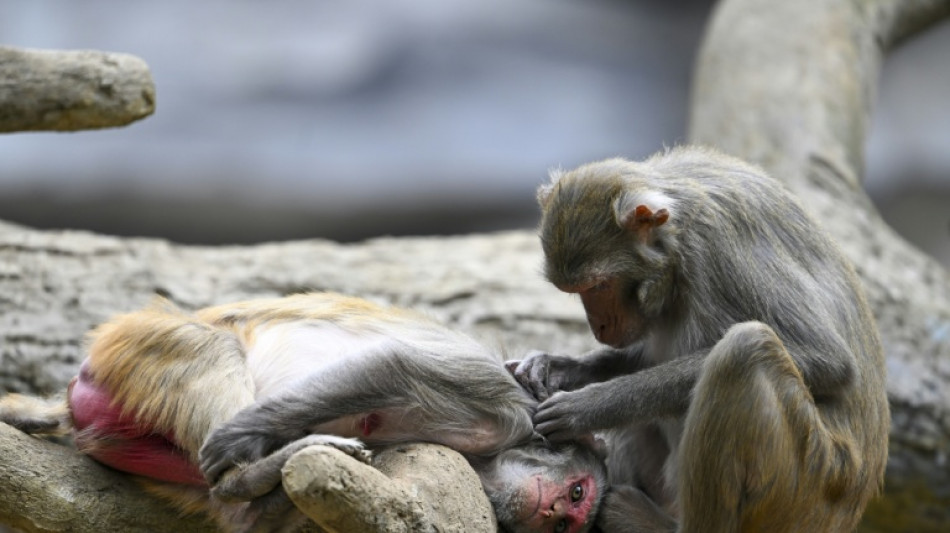
Scientists reveal what drives homosexual behaviour in primates / Photo: JOHAN ORDONEZ - AFP/File

 World No.1 Sinner pulls out of Shanghai Masters to delay return

 Red Bull's Verstappen grabs pole position for Bahrain GP

 India beat Pakistan in blockbuster as golfer Kim wins 'crazy' gold

 India beat arch-rivals Pakistan to win Asian Games cricket gold

 Ethiopia's Tigray rebels abandon regional capital as govt advances: journalist

 Tom Kim powers to Games gold and exemption from military service

 Split loyalties for Indian football fans at Brazil friendly

 India-Pakistan blockbuster brings cricket fever to Japan baseball field

 Wong waiting on Rafa after winning Asian Games tennis gold

 With Russia next door and rising costs, Latvia goes to the polls

 Penalty hero rues empty seats as Games hosts Japan win football gold

 North Korea fires ballistic missile after Seoul's apology demand

 US regulator finds Boeing 737 MAX software bug 'not a safety concern'

 Ohtani 'managing' injuries as Dodgers launch MLB post-season

 Botched US execution leaves murderer unconscious on ventilator: lawyers

 Cornell rape case exposes sexual violence at US colleges

 France held by Italy in Zidane's homecoming after Olise stunner

 Ethiopian pro-government militia claims Tigray airport as regional tensions spike

 Ohtani shaking off injuries as Dodgers launch MLB post-season

 Sea levels to rise in California as coastal wave surges up west coast

 New rallies urged in France as protests disrupt over 730 schools

 Djokovic survives China Open scare, Sabalenka starts strong

 King Charles to evoke colonial 'darkest days' on Caribbean tour

 Tesla shares jump after global car sales top estimates

 DR Congo Ebola outbreak killed more than 4,000: official figures

Homosexual behaviour in primates has a deep evolutionary basis and is more likely to occur in species that live in harsh environments, are hunted by predators or live in more complex societies, scientists said Monday.
Males or females of the same sex mounting or otherwise stimulating each other have been documented across the animal kingdom.
More than 1,500 different species have been observed engaging in same-sex sexual behaviour, with some of the earliest reports dating back to the ancient Greek philosopher Aristotle.
But this relatively common behaviour was long dismissed by the scientific community as a "Darwinian paradox". This held that homosexual behaviour in animals goes against Charles Darwin's theory of evolution because it does not pass down genes through reproduction.
More recently, scientists have shown that this behaviour can in part be inherited from an animal's parents -- and can provide an evolutionary advantage.
"Diversity of sexual behaviour is very common in nature, among species and in animal societies -- it is as important as caring for offspring, fighting off predators or foraging for food," Imperial College London biologist Vincent Savolainen told AFP.
Savolainen has been studying rhesus macaques in Puerto Rico for eight years. His team found that male macaques who mount each other form alliances that could give them access to more females -- and therefore eventually more offspring.
In 2023, the team also determined that the macaques inherited same-sex behaviour from their parents more than six percent of the time -- but whether this trait was passed down depended on a range of factors.
- 'Deep evolutionary root' -
For his new study, published in the journal Nature Ecology & Evolution, Savolainen and colleagues collected data on 491 non-human primate species.
They identified same-sex sexual behaviour in 59 species, including lemurs, great apes and monkeys across the Americas, Africa and Asia.
That the behaviour was so widespread indicates it has a "deep evolutionary root," the study said.
The researchers then investigated how environment, social organisation and "life history" traits affected whether primates engaged in homosexual acts.
They found that the behaviour was more common in species that lived in harsh environments with limited access to food, such as barbary macaques.
It was also more common in species more likely to be hunted by predators -- vervet monkeys, for example, have to avoid all sorts of big cats and snakes in Africa.
- Stress reliever? -
This all suggests that homosexual behaviour could help manage tension among primate groups during periods of stress, the researchers said.
The behaviour was also more common among species in which males and females are dramatically different sizes, such as mountain gorillas.
These size differences often occur in animals which live in larger social groups with intense competition and stricter social hierarchies. Animals which have males and females of a similar size tend to live in pairs or smaller family units.
Same-sex sexual behaviour therefore "may function as a flexible social strategy, used to reinforce social bonds, manage conflict or build alliances, depending on the ecological and social pressures faced by different species," the study said.
The researchers theorised that similar factors could have played a role in human ancestors.
"Our ancestors certainly had to face the same environmental and social complexities," Savolainen said.
"But there are things that are completely unique to modern humans, who have a complexity of sexual orientation and preference that we do not address at all," he said.
The study also warned against "misinterpretation or misuse of our findings," such as "a misguided notion that social equality might eliminate" same-sex sexual behaviour in modern humans.
Isabelle Winder, an anthropologist at Bangor University in the UK not involved in the study, praised the research.
"It is their study's demonstration that modern comparative methods can, for perhaps the first time, realistically illuminate some of the complexities of the evolution of 'humanlike' behaviours that I find most exciting," she commented in Nature.
M.A.Vaz--PC



