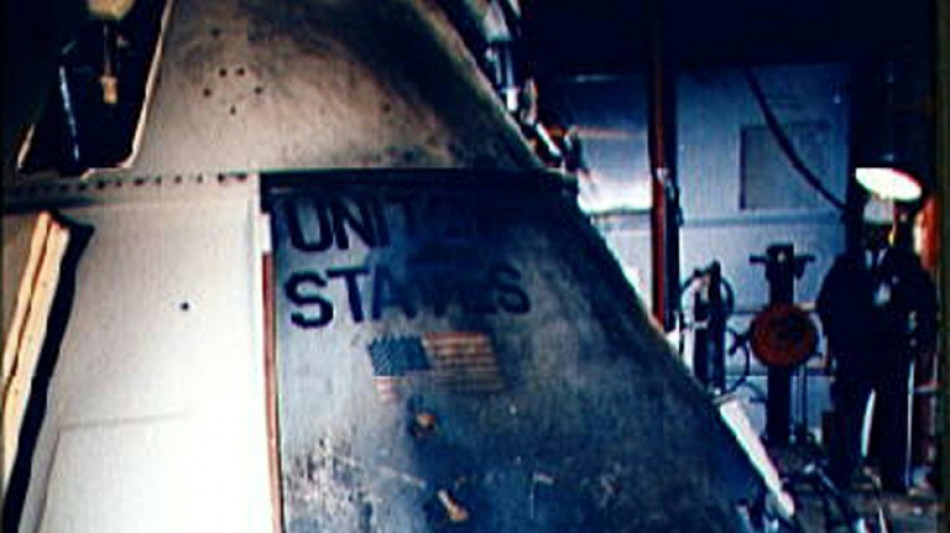
What happens when fire ignites in space? 'A ball of flame' / Photo: HO - NASA/AFP/File

 World No.1 Sinner pulls out of Shanghai Masters to delay return

 Red Bull's Verstappen grabs pole position for Bahrain GP

 India beat Pakistan in blockbuster as golfer Kim wins 'crazy' gold

 India beat arch-rivals Pakistan to win Asian Games cricket gold

 Ethiopia's Tigray rebels abandon regional capital as govt advances: journalist

 Tom Kim powers to Games gold and exemption from military service

 Split loyalties for Indian football fans at Brazil friendly
 India-Pakistan blockbuster brings cricket fever to Japan baseball field

 Wong waiting on Rafa after winning Asian Games tennis gold

 With Russia next door and rising costs, Latvia goes to the polls

 Penalty hero rues empty seats as Games hosts Japan win football gold

 North Korea fires ballistic missile after Seoul's apology demand

 US regulator finds Boeing 737 MAX software bug 'not a safety concern'

 Ohtani 'managing' injuries as Dodgers launch MLB post-season

 Botched US execution leaves murderer unconscious on ventilator: lawyers

 Cornell rape case exposes sexual violence at US colleges

 France held by Italy in Zidane's homecoming after Olise stunner

 Ethiopian pro-government militia claims Tigray airport as regional tensions spike

 Ohtani shaking off injuries as Dodgers launch MLB post-season

 Sea levels to rise in California as coastal wave surges up west coast

 New rallies urged in France as protests disrupt over 730 schools

 Djokovic survives China Open scare, Sabalenka starts strong

 King Charles to evoke colonial 'darkest days' on Caribbean tour

 Tesla shares jump after global car sales top estimates

 DR Congo Ebola outbreak killed more than 4,000: official figures

When fire breaks out in the low-gravity, high-stakes conditions inside spacecraft or space stations, it behaves very differently than back here on Earth.
So, as humans aim to set foot on Mars in the coming decades, researchers are seeking to learn how flames spark and spread in space -- and how best to stamp them out.
The deadly threat fire poses in space goes all the way back to the first mission of NASA's Apollo programme, which would go on to put the first humans on the Moon.
Just days before the Apollo 1 mission was scheduled to launch in January 1967, its three crew members were killed by a fire that broke out in the spacecraft's cabin during a training exercise on the ground.
"At that time, the capsules were filled with 100 percent pure oxygen at low pressure, instead of atmospheric pressure, so the astronauts could breathe," explained Serge Bourbigot, a researcher at France's Centrale Lille institute.
"However the more oxygen you have, the more it burns," he told AFP.
Since the Apollo 1 disaster, the oxygen levels in spacecraft carrying astronauts have been set to 21 percent -- the same amount as here on Earth.
But fire still acts differently in these cramped conditions hurtling through the vastness of space.
- A spherical flame -
When you light a candle on Earth, the heat rises because hot air is less dense than cold air.
However if you lit that candle inside a spacecraft or a station orbiting our planet, the heat would stay put because of the lack of gravity.
So instead of seeing a feather-shaped plume rise from the candle's wick, "you get a ball of flame," Bourbigot said.
"This ball will create and radiate heat, sending heat into the local environment -- the fire will spread that way," expanding in every direction, he added.
To find out more, Bourbigot and three other scientists have been awarded a grant from the European Research Council.
Their work has proved particularly timely because NASA recently recommended that oxygen levels be increased to 35 percent in new spacecraft and space stations, mainly to cut costs.
"With 35 percent oxygen, less pressure is needed inside the spacecraft, so the structure can be lighter," Bourbigot explained.
Heavier spacecraft require bigger rockets to launch them into space, making them more expensive.
But when oxygen levels rise, so does the risk of fire. So the grantees are investigating different ways to track and stamp out any space blazes in the future.
- Lighting a fire on a rocket -
Guillaume Legros of France's Sorbonne University is trying to use acoustic waves to smother the flames.
Tests have already been carried out on parabolic flights, which simulate the weightless conditions of space for 22 seconds.
Bourbigot is meanwhile looking into flame retardants. While these chemicals work well here on Earth, low gravity again throws up new hurdles.
Because smoke does not rise in the same way, it is more dense and "poses an opacity problem", Bourbigot said.
Florian Meyer from Germany's University of Bremen is developing sensors to closely monitor temperatures and track how fires would spread in space.
And fire safety researcher Bart Merci from Belgium's Ghent University is planning to digitally simulate how flames behave in low gravity.
To test their theories, a rocket is planned to launch within the next four years that will provide six minutes of microgravity to investigate how fire behaves in these conditions.
European aerospace manufacturer Airbus will build the rocket, which is set to launch from northern Sweden.
For their research, which is grouped under the Firespace programme, the four scientists have received 14 million euros ($16 million) -- enough to fund their work for the next six years.
G.M.Castelo--PC



