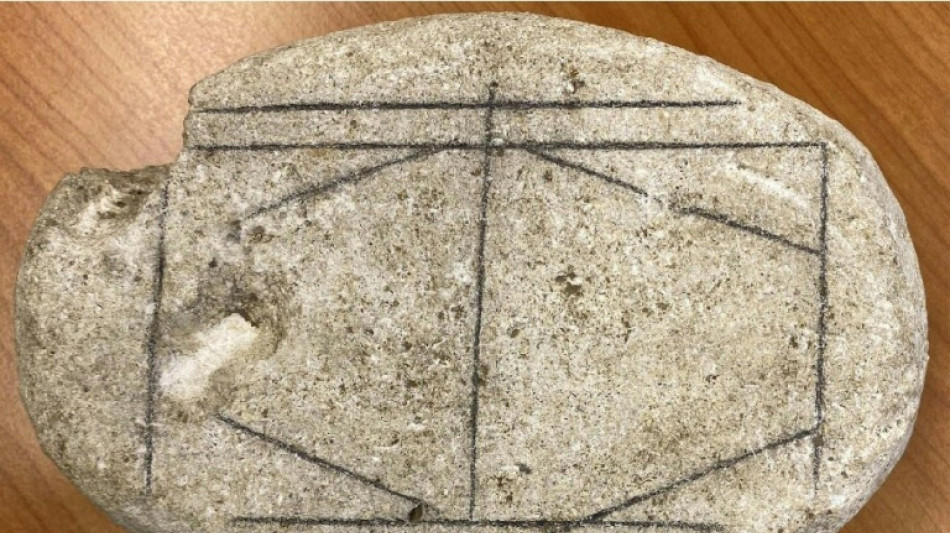
AI cracks Roman-era board game / Photo: Handout - Antiquity/AFP

 'Glad it's over': Kim powers to Games gold and military exemption

 After 11 World Cups, football finally comes home for one Indian fan

 Marc Marquez wins sprint at Japan MotoGP, Martin grabs pole

 Alcaraz fends off Arnaldi to reach Japan Open quarters

 Antonelli tops times in final practice at Bahrain GP

 Gauff digs deep to beat Osorio in China Open second round

 Fresh protests to hit Spain after housing measures defeated

 'He's here with me': Japan cycle queen dedicates gold to late brother

 Japan Olympic chief says 'lot more' athletes at Games than expected

 Asian carmakers besting US rivals at home, China poised to strike

 Widgets & Web Offers All-Inclusive Investor Relations Websites for Public Companies, IPOs and SPACs

 Adams named new US captain to 2030 World Cup

 China a better influence in Latin America than US: poll

 Judge pauses construction of border project in Texas national park

 Belgium's De Bruyne fires double to sink Turkey, France held by Italy

 US jobs data boosts stocks as oil prices dip

 US Supreme Court to hear high-stakes climate case

 Trump expected to name intel chief Clayton as AI czar: reports

 Argentina unveils passports-for-investment scheme

 Brazil election debate chaos sparks censorship row

 England's Carse charged by cricket body over nightclub incident

 Amazon vows $1 bn for data center towns, decries 'myths'

 Oil prices drop on G7 fuel release, US jobs data boosts stocks

 G7 agrees deal to ease global energy supply concerns

 Spain's government dealt blow as lawmakers reject housing bills

A smooth, white stone dating from the Roman era and unearthed in the Netherlands has long baffled researchers.
Now with the help of artificial intelligence, scientists believe they have cracked the mystery: the stone is an ancient board game and they have even guessed the rules.
The circular piece of limestone has diagonal and straight lines cut into it.
Using 3D imaging, scientists discovered some lines were deeper than others, suggesting pieces were moved along them, some more than others.
"We can see wear along the lines on the stone, exactly where you would slide a piece," said Walter Crist, an archaeologist at Leiden University who specialises in ancient games.
Other researchers at Maastricht University then used an artificial intelligence programme that can deduce the rules to ancient games.
They trained this AI, baptised Ludii, with the rules of about 100 ancient games from the same area as the Roman stone.
The computer "produced dozens of possible rule sets. It then played the game against itself and identified a few variants that are enjoyable for humans to play," said Dennis Soemers, from Maastricht University.
They then cross-checked the possible rules with the wear on the stone to uncover the most likely set of movements in the game.
However, Soemers also sounded a note of caution.
"If you present Ludii with a line pattern like the one on the stone, it will always find game rules. Therefore, we cannot be sure that the Romans played it in precisely that way," he said.
The aim of the "deceptively simple but thrilling strategy game" was to hunt and trap the opponent's pieces in as few moves as possible.
The research and the possible rules were published in the journal Antiquity.
X.Brito--PC



