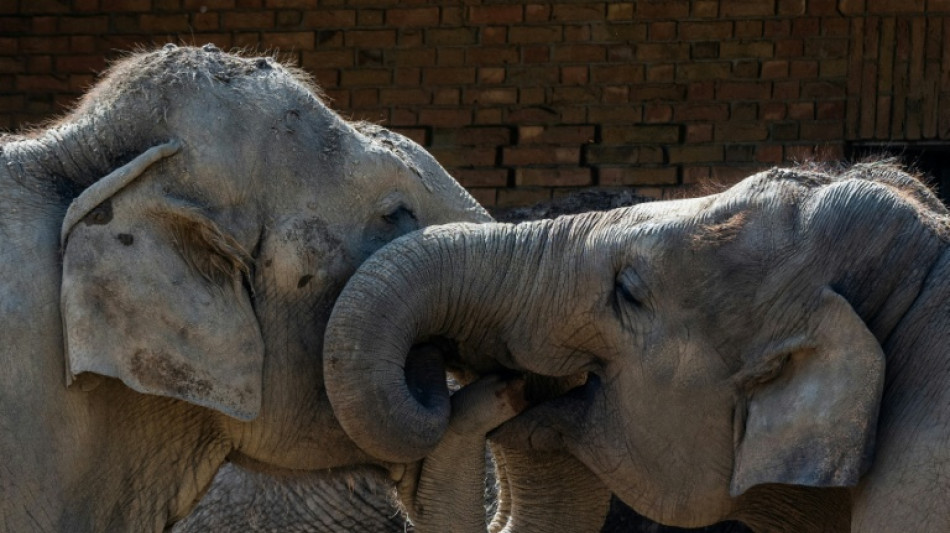
The secret to an elephant's grace? Whiskers / Photo: John MACDOUGALL - AFP

 'Glad it's over': Kim powers to Games gold and military exemption

 After 11 World Cups, football finally comes home for one Indian fan

 Marc Marquez wins sprint at Japan MotoGP, Martin grabs pole

 Alcaraz fends off Arnaldi to reach Japan Open quarters

 Antonelli tops times in final practice at Bahrain GP

 Gauff digs deep to beat Osorio in China Open second round

 Fresh protests to hit Spain after housing measures defeated

 'He's here with me': Japan cycle queen dedicates gold to late brother

 Japan Olympic chief says 'lot more' athletes at Games than expected

 Asian carmakers besting US rivals at home, China poised to strike

 Widgets & Web Offers All-Inclusive Investor Relations Websites for Public Companies, IPOs and SPACs

 Adams named new US captain to 2030 World Cup

 China a better influence in Latin America than US: poll

 Judge pauses construction of border project in Texas national park

 Belgium's De Bruyne fires double to sink Turkey, France held by Italy

 US jobs data boosts stocks as oil prices dip

 US Supreme Court to hear high-stakes climate case

 Trump expected to name intel chief Clayton as AI czar: reports

 Argentina unveils passports-for-investment scheme

 Brazil election debate chaos sparks censorship row

 England's Carse charged by cricket body over nightclub incident
 Amazon vows $1 bn for data center towns, decries 'myths'

 Oil prices drop on G7 fuel release, US jobs data boosts stocks

 G7 agrees deal to ease global energy supply concerns

 Spain's government dealt blow as lawmakers reject housing bills

An elephant's trunk can surpass a human's height and lift trees -- a marvel of strength that's conversely so gentle it can grasp a tortilla chip without breaking it.
So how do the thick-skinned animals with poor eyesight pull off such delicate tasks? In a word, whiskers.
New research published Thursday in the journal Science details how the whiskers that cover an elephant's trunk have unique properties that lend the largest land mammals remarkable dexterity.
Elephants are born with about 1,000 of these bristles, lead author Andrew Schulz told AFP, many of them anchored in the trunk's wrinkles to act like feelers and help the animals assess their surroundings.
A team of engineers, materials scientists and neuroscientists analyzed the geometry, porosity and material properties of these whiskers, and expected them to mimic the whiskers found on mice or rats -- circular at a cross-section, solid and uniformly stiff.
In fact, elephant whiskers are almost blade-like, with a porous architecture similar to sheep horns, which helps with shock absorption while eating.
And a gradiated shape and structure from base to tip allows for an amplified sense of touch, Schulz said.
"The craziest finding that we had, I think, was that these whiskers have this transition from a really, really rigid base to a very, very soft tip," said the researcher at the Max Planck Institute for Intelligent Systems in Stuttgart, Germany.
Part of elephants' whisker evolution is to prevent breakage, said Schulz. Unlike most mammals with whiskers, those of elephants don't grow back.
- Elephant-inspired advances -
Many animals have sensory hairs that can act as a radar, but few quite so precise as the elephant's.
Schulz said a rat's whiskers, for example, also picks up vibrations -- but it's akin to smashing down a handful of keys on a piano.
To an elephant's whiskers, it's more like hitting specific notes.
Researchers voiced excitement that cat whiskers have a similar kind of material intelligence and stiffness gradient.
The elephant's gradiated structure can help with things like object differentiation while foraging and eating -- which they spend the vast majority of their time doing.
Elephants are also well-documented using their trunks for social touch -- "they're using the outside of their trunk," Schulz said, "so they're using those portions that are covered in the whiskers."
Caitlin O'Connell-Rodwell -- a behavioral ecologist and elephant expert who has focused on how the giant mammals communicate and detect signals through their feet -- called the findings "fascinating."
"This is really exciting for me to see just more affirmation of how sensitive their trunks really are," she told AFP.
"There's some really interesting, intriguing thoughts for the next steps, for what one could ask in terms of the behavioral application of this," O'Connell-Rodwell said.
"Not only would this allow them to say, reach up into a tree and feel around for fruit or a seed pod with better agility, but it also has implications for communication."
There's also a wealth of technological possibilities elephant whiskers could inspire, not least when it comes to robotics, Schulz said.
And "part of the novelty of this work is functional gradients exist everywhere in biology," the researcher said.
The stiff base-to-soft tip structure also appears in rotator cuffs or ACL ligaments, he said for example -- and better understanding those structures and how they might impact sensing could perhaps allow for improved repair techniques.
P.Serra--PC



