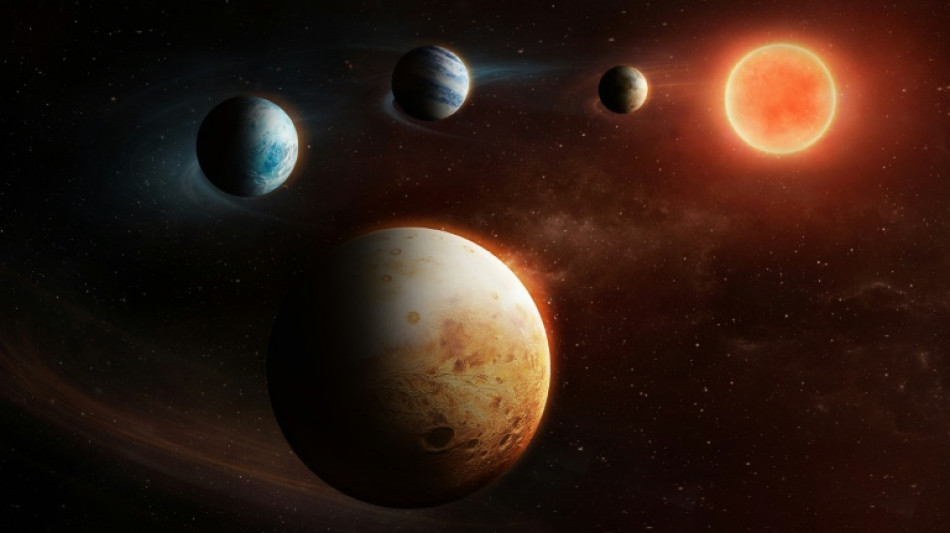
Strange 'inside-out' planetary system baffles astronomers / Photo: Handout - ESA/AFP

 'Glad it's over': Kim powers to Games gold and military exemption

 After 11 World Cups, football finally comes home for one Indian fan

 Marc Marquez wins sprint at Japan MotoGP, Martin grabs pole

 Alcaraz fends off Arnaldi to reach Japan Open quarters

 Antonelli tops times in final practice at Bahrain GP

 Gauff digs deep to beat Osorio in China Open second round

 Fresh protests to hit Spain after housing measures defeated

 'He's here with me': Japan cycle queen dedicates gold to late brother

 Japan Olympic chief says 'lot more' athletes at Games than expected

 Asian carmakers besting US rivals at home, China poised to strike

 Widgets & Web Offers All-Inclusive Investor Relations Websites for Public Companies, IPOs and SPACs

 Adams named new US captain to 2030 World Cup

 China a better influence in Latin America than US: poll

 Judge pauses construction of border project in Texas national park

 Belgium's De Bruyne fires double to sink Turkey, France held by Italy

 US jobs data boosts stocks as oil prices dip

 US Supreme Court to hear high-stakes climate case

 Trump expected to name intel chief Clayton as AI czar: reports

 Argentina unveils passports-for-investment scheme

 Brazil election debate chaos sparks censorship row

 England's Carse charged by cricket body over nightclub incident

 Amazon vows $1 bn for data center towns, decries 'myths'

 Oil prices drop on G7 fuel release, US jobs data boosts stocks

 G7 agrees deal to ease global energy supply concerns

 Spain's government dealt blow as lawmakers reject housing bills

Surprised astronomers said Thursday they have discovered a star with planets in a bizarre order that defies scientific expectations -- and suggests these faraway worlds formed in a manner never seen before.
In our Solar System, the four planets closest to the Sun are small and rocky, while the four farther out are gas giants.
Scientists had thought this planetary order -- rocky first, then gaseous -- was consistent across the universe.
However, a star called LHS 1903 discovered in the Milky Way's thick disc suggests otherwise.
An international team of astronomers analysing data from several different telescopes had already spotted three planets orbiting the red dwarf star, which is cooler and less bright than our Sun.
The closest planet to the star was rocky, followed by two gas giants. That is the order scientists expect.
But digging into observations made by Europe's exoplanet-probing Cheops space telescope revealed a fourth planet farther out in the system -- and it is rocky.
"That makes this an inside-out system, with a planet order of rocky-gaseous-gaseous-and then rocky again," explained Thomas Wilson, the lead author of a new study describing the discovery in the journal Science.
"Rocky planets don't usually form so far away from their home star," the planetary astrophysicist from University of Warwick in the UK said in a statement.
- One planet after another -
Inner planets are expected to be small and rocky because intense radiation from the nearby star blasts most of the gas away from their rocky core.
But farther out in the cold reaches of the system, a thick atmosphere can form around cores, creating gas giants.
Puzzled by the weird LHS 1903 planetary system, the team of astronomers tried to figure out what could have happened.
After ruling out several possibilities, they came up with a scenario: what if the planets formed one at a time?
According to the most widely accepted theory, planets form simultaneously in a massive ring of gas and dust called a protoplanetary disc. This involves tiny dust grains clumping together then snowballing into cores that eventually evolve into mighty planets.
However, by the time the fourth planet orbiting LHS 1903 formed, "the system may have already run out of gas," Wilson said.
"Yet here is a small, rocky world, defying expectations," he added.
"It seems that we have found first evidence for a planet which formed in what we call a gas-depleted environment."
Since the 1990s, astronomers have discovered more than 6,000 planets outside our Solar System -- called exoplanets -- mostly by spotting slight changes in brightness as they cross in front of their star.
"Historically, our planet formation theories are based on what we see and know about our Solar System," said Isabel Rebollido, a planetary disc researcher at the European Space Agency.
"As we are seeing more and more different exoplanet systems, we are starting to revisit these theories."
V.Dantas--PC



