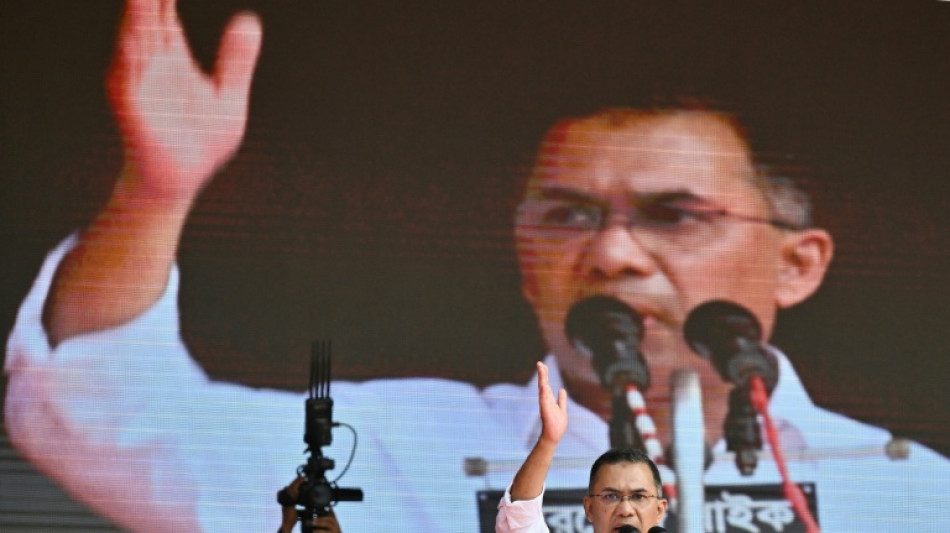
Bangladesh's new PM, political heir Tarique Rahman / Photo: MUNIR UZ ZAMAN - AFP

 'Glad it's over': Kim powers to Games gold and military exemption

 After 11 World Cups, football finally comes home for one Indian fan

 Marc Marquez wins sprint at Japan MotoGP, Martin grabs pole
 Alcaraz fends off Arnaldi to reach Japan Open quarters

 Antonelli tops times in final practice at Bahrain GP
 Gauff digs deep to beat Osorio in China Open second round
 Fresh protests to hit Spain after housing measures defeated

 'He's here with me': Japan cycle queen dedicates gold to late brother

 Japan Olympic chief says 'lot more' athletes at Games than expected

 Asian carmakers besting US rivals at home, China poised to strike

 Widgets & Web Offers All-Inclusive Investor Relations Websites for Public Companies, IPOs and SPACs

 Adams named new US captain to 2030 World Cup

 China a better influence in Latin America than US: poll

 Judge pauses construction of border project in Texas national park

 Belgium's De Bruyne fires double to sink Turkey, France held by Italy

 US jobs data boosts stocks as oil prices dip

 US Supreme Court to hear high-stakes climate case

 Trump expected to name intel chief Clayton as AI czar: reports

 Argentina unveils passports-for-investment scheme

 Brazil election debate chaos sparks censorship row

 England's Carse charged by cricket body over nightclub incident

 Amazon vows $1 bn for data center towns, decries 'myths'

 Oil prices drop on G7 fuel release, US jobs data boosts stocks

 G7 agrees deal to ease global energy supply concerns
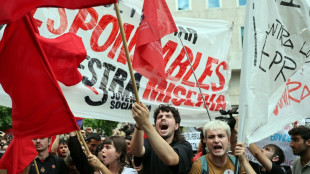 Spain's government dealt blow as lawmakers reject housing bills
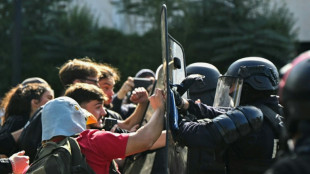
Long overshadowed by his parents and heir to one of Bangladesh's most powerful political dynasties, the country's new Prime Minister Tarique Rahman has finally stepped into the spotlight.
At 60, the leader of the Bangladesh Nationalist Party (BNP) takes charge of the South Asian nation of 170 million, driven by what he calls an ambition to "do better".
A year and a half after the deadly uprising that toppled previous prime minister Sheikh Hasina's iron-fisted rule, the BNP won a "sweeping victory" in parliamentary elections on February 12.
He was sworn in on Tuesday, leading a more than two-thirds majority in parliament.
"This victory belongs to people who aspire to and have sacrificed for democracy," he said in a speech.
His rise marks a remarkable turnaround for a man who only returned to Bangladesh in December after 17 years in exile in Britain, far from Dhaka's political storms.
Widely known as Tarique Zia, he carries a political name that has shaped every stage of his life.
He was 15 when his father, president Ziaur Rahman, was assassinated in 1981.
Tarique's mother, Khaleda Zia -- a three-time prime minister and a towering figure in Bangladeshi politics for decades -- died aged 80 in December, just days after his return home.
- 'My country' -
Rahman, speaking to AFP just before the vote, vowed to build on their legacy.
"They are them, I am me," he said from his office, beneath gold-framed portraits of his late parents. "I will try to do better than them."
He described the "mixed feelings" that overwhelmed him when he arrived home in December -- the joy of returning, swiftly eclipsed by grief at his mother's death.
Instead of celebrating, however, he had to bid farewell to his ailing mother, who had long been in intensive care.
"When you come home after so long, any son wants to hug his mother," he said. "I didn't have that chance."
Within days of landing in Dhaka, the still grieving heir assumed leadership of the BNP.
- 'Unnerves many' -
Born when the country was still East Pakistan, he was briefly detained as a child during the 1971 independence war.
His party hails him as "one of the youngest prisoners of war".
His father, Ziaur Rahman, an army commander, gained influence months after a 1975 coup when founding leader Sheikh Mujibur Rahman -- Sheikh Hasina's father -- was murdered.
It entrenched a rivalry between the two families that would define the country's politics for decades. Ziaur Rahman himself was killed in 1981.
Rahman grew up in his mother's political orbit as she went on to become the country's first female prime minister, alternating power with Hasina in a long and bitter duel.
"In her seats, I used to go and I used to campaign," Rahman said. "So this is how slowly and gradually I started getting involved in the politics."
But his career has also been shadowed by allegations of corruption and abuse of power.
A 2006 US embassy cable said he "inspires few but unnerves many".
Other cables labelled him a "symbol of kleptocratic government and violent politics" and accused him of being "phenomenally corrupt".
Arrested on corruption charges in 2007, Rahman says he was tortured in custody.
He fled to London the following year, where he faced multiple cases in absentia. He denied all charges and dismissed them as politically motivated.
But he also told AFP he offered an apology.
"If there are any mistakes which were unwanted, we are sorry for that," he told AFP.
After Hasina's fall, Rahman was acquitted of the most serious charge against him -- a life sentence handed down in absentia for a 2004 grenade attack on a Hasina rally -- which he had always denied.
Married to a cardiologist and father to a daughter, a lawyer, he led a quiet life in Britain.
That changed with his dramatic return in December, accompanied by his fluffy ginger cat, Zebu, images of which went viral on Bangladeshi social media.
He admits the task ahead is now "immense", rebuilding a country he says was "destroyed" by the former government.
O.Gaspar--PC



