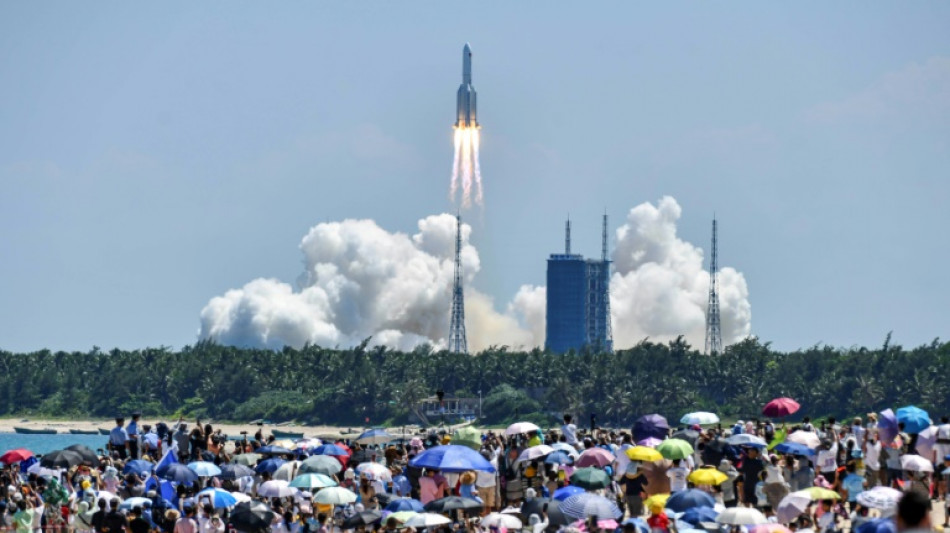
Chinese booster rocket makes uncontrolled return to Earth / Photo: - - CNS/AFP/File

 'He's here with me': Japan cycle queen dedicates gold to late brother

 Japan Olympic chief says 'lot more' athletes at Games than expected
 Asian carmakers besting US rivals at home, China poised to strike

 Widgets & Web Offers All-Inclusive Investor Relations Websites for Public Companies, IPOs and SPACs

 Adams named new US captain to 2030 World Cup

 China a better influence in Latin America than US: poll

 Judge pauses construction of border project in Texas national park

 Belgium's De Bruyne fires double to sink Turkey, France held by Italy

 US jobs data boosts stocks as oil prices dip

 US Supreme Court to hear high-stakes climate case

 Trump expected to name intel chief Clayton as AI czar: reports

 Argentina unveils passports-for-investment scheme

 Brazil election debate chaos sparks censorship row

 England's Carse charged by cricket body over nightclub incident

 Amazon vows $1 bn for data center towns, decries 'myths'

 Oil prices drop on G7 fuel release, US jobs data boosts stocks

 G7 agrees deal to ease global energy supply concerns

 Spain's government dealt blow as lawmakers reject housing bills

 Food, medicine shortages deepen in Russian-occupied Oleshky

 Man City whistleblower Rui Pinto facing 'dire consequences' - lawyers
 Russia 'tearing Kyiv apart', mayor says, as strikes paralyse traffic

 Taiwan boxer Lin wins Games gold as Japan edge North Korea on penalties

 Japan tame North Korea to win Games gold after shootout drama

 US posts weak job growth data in September
 Ethiopia's conflict: the regional dimension

A Chinese booster rocket made an uncontrolled return to Earth on Saturday, leading US officials to chide Beijing for not sharing information about the potentially hazardous object's descent.
US Space Command "can confirm the People's Republic of China (PRC) Long March 5B (CZ-5B) re-entered over the Indian Ocean at approx 10:45 am MDT on 7/30," the US military unit said on Twitter.
"We refer you to the #PRC for further details on the reentry’s technical aspects such as potential debris dispersal+ impact location," it said.
In a statement posted to its official WeChat profile, the China Manned Space Agency later gave coordinates for an impact area in the Sulu Sea, about 35 miles (57 kilometers) off the east coast of the Philippines' Palawan Island.
"Most of its devices were ablated and destroyed during re-entry," the agency said of the booster rocket, which was used last Sunday to launch the second of three modules China needed to complete its new Tiangong space station.
Malaysia's space agency said it detected rocket debris burning up on re-entry before falling in the Sulu Sea northeast of the island of Borneo.
"The debris of the rocket caught fire while entering the Earth's airspace and the movement of the burning debris also crossed Malaysian airspace and could be detected in several areas including crossing the airspace around the state of Sarawak," it said.
- NASA criticism -
NASA administrator Bill Nelson criticized Beijing on Twitter, saying the failure to share details of the rocket's descent was irresponsible and risky.
"All spacefaring nations should follow established best practices, and do their part to share this type of information in advance," Nelson wrote, "to allow reliable predictions of potential debris impact risk, especially for heavy-lift vehicles, like the Long March 5B, which carry a significant risk of loss of life and property."
He added: "Doing so is critical to the responsible use of space and to ensure the safety of people here on Earth".
The Tiangong space station is one of the crown jewels of Beijing's ambitious space program, which has landed robotic rovers on Mars and the Moon, and made China only the third nation to put humans in orbit.
The new module, propelled by the Long March 5B, successfully docked with Tiangong's core module on Monday and the three astronauts who had been living in the main compartment since June successfully entered the new lab.
When China launched its first Tiangong module in April 2021, there was a similar frenzy around the possibility of damage caused by an unpredictable booster reentry.
Objects generate immense amounts of heat and friction when they enter the atmosphere, which can cause them to burn up and disintegrate. But larger ones such as the Long March-5B may not be destroyed entirely.
In 2020, debris from another Chinese rocket fell on villages in the Ivory Coast, causing structural damage but no injuries or deaths.
China has poured billions of dollars into space flight and exploration as it seeks to build a program that reflects its stature as a rising global power.
H.Silva--PC



