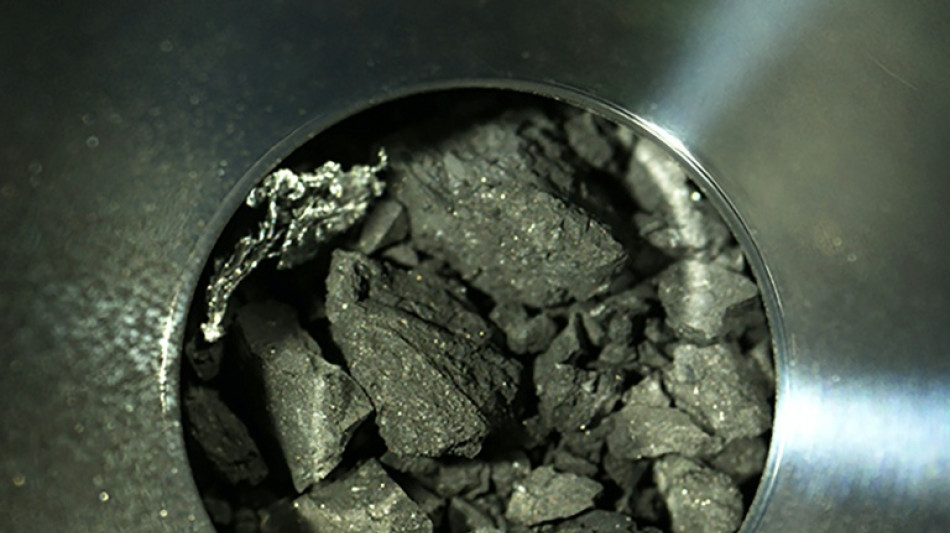
Ingredients of life discovered in Ryugu asteroid samples / Photo: Handout - JAXA/AFP/File

 'Glad it's over': Kim powers to Games gold and military exemption

 After 11 World Cups, football finally comes home for one Indian fan

 Marc Marquez wins sprint at Japan MotoGP, Martin grabs pole

 Alcaraz fends off Arnaldi to reach Japan Open quarters

 Antonelli tops times in final practice at Bahrain GP

 Gauff digs deep to beat Osorio in China Open second round

 Fresh protests to hit Spain after housing measures defeated

 'He's here with me': Japan cycle queen dedicates gold to late brother

 Japan Olympic chief says 'lot more' athletes at Games than expected
 Asian carmakers besting US rivals at home, China poised to strike

 Widgets & Web Offers All-Inclusive Investor Relations Websites for Public Companies, IPOs and SPACs

 Adams named new US captain to 2030 World Cup

 China a better influence in Latin America than US: poll

 Judge pauses construction of border project in Texas national park

 Belgium's De Bruyne fires double to sink Turkey, France held by Italy

 US jobs data boosts stocks as oil prices dip

 US Supreme Court to hear high-stakes climate case

 Trump expected to name intel chief Clayton as AI czar: reports

 Argentina unveils passports-for-investment scheme

 Brazil election debate chaos sparks censorship row

 England's Carse charged by cricket body over nightclub incident

 Amazon vows $1 bn for data center towns, decries 'myths'
 Oil prices drop on G7 fuel release, US jobs data boosts stocks

 G7 agrees deal to ease global energy supply concerns

 Spain's government dealt blow as lawmakers reject housing bills

All the essential ingredients to make the DNA and RNA underpinning life on Earth have been discovered in samples collected from the asteroid Ryugu, scientists said Monday.
The discovery comes after these building blocks of life were detected on another asteroid called Bennu, suggesting they are abundant throughout the Solar System.
One longstanding theory is that life first began on Earth when asteroids carrying fundamental elements crashed into our planet long ago.
The asteroids that hurtle through our Solar System give scientists a rare chance to study this possibility.
In 2014, the Japanese spacecraft Hayabusa-2 blasted off on a 300-million-kilometre (185-million-mile) mission to land on Ryugu, a 900-metre-wide (2,950-feet-wide) asteroid.
It successfully managed to collect two samples of rocks weighing 5.4 grams (under a fifth of an ounce) each and bring them back to Earth in 2020.
Research in 2023 showed that these samples contained uracil, which is one of the four bases that make up RNA.
While DNA, the famed double helix, functions as a genetic blueprint, single-strand RNA is an all-important messenger, converting the instructions contained in DNA for implementation.
On Monday, a new study by a Japanese team of researchers in Nature Astronomy demonstrated that the samples contained all the "nucleobases" for both DNA and RNA.
These included uracil as well as adenine, guanine, cytosine and thymine.
This "does not mean that life existed on Ryugu", the study's lead author, Toshiki Koga, told AFP.
"Instead, their presence indicates that primitive asteroids could produce and preserve molecules that are important for the chemistry related to the origin of life," added the biochemist from the Japan Agency for Marine-Earth Science and Technology.
The discovery also "demonstrates their widespread presence throughout the Solar System and reinforces the hypothesis that carbonaceous asteroids contributed to the prebiotic chemical inventory of early Earth," according to the study.
Cesar Menor Salvan, an astrobiologist at Spain's University of Alcala not involved in the research, emphasised that "these results do not suggest that the origin of life took place in space".
However, "with this and the results from Bennu, we have a very clear idea of which organic materials can form under prebiotic conditions anywhere in the universe," he added.
- 'Unique' ammonia finding -
Last year, the same building blocks were found in fragments brought back to Earth by NASA from the asteroid Bennu.
Scientists have also detected their presence in the meteorites Orgueil and Murchison, which were part of asteroids that fell to Earth.
For the new research, the Japanese team compared the amount of each nucleobase detected in these different space rocks, finding the quantities varied depending on their history.
They also identified a correlation between the ratios of the building blocks and the concentration of another important chemical for life: ammonia.
"Because no known formation mechanism predicts such a relationship, this finding may point to a previously unrecognised pathway for nucleobase formation in early Solar System materials," Toshiki Koga said.
Morgan Cable, a scientist at the Victoria University of Wellington in Australia not involved in the research, called this particular finding "unique".
"This discovery has important implications for how biologically important molecules may have originally formed and promoted the genesis of life on Earth," she said.
A.Magalhes--PC



