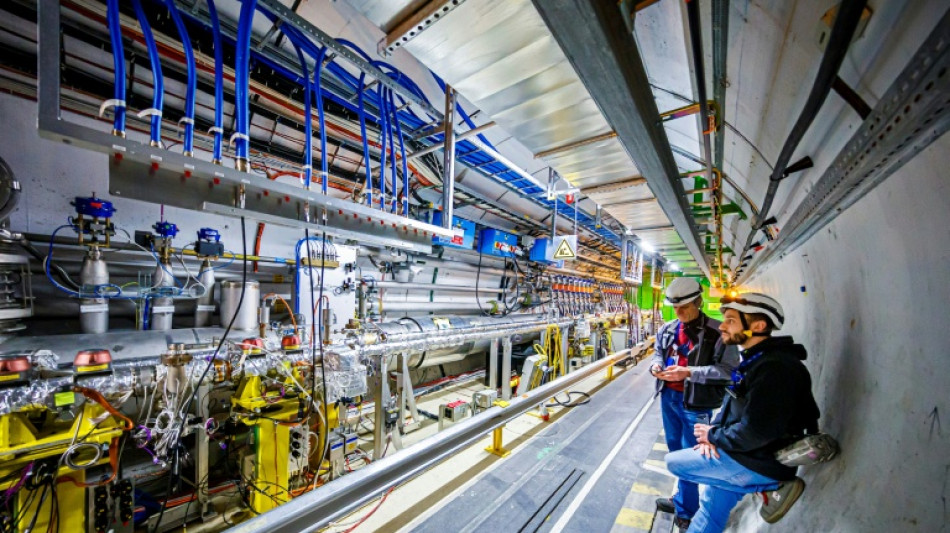
New particle discovered by Large Hadron Collider / Photo: VALENTIN FLAURAUD - AFP/File

 'Glad it's over': Kim powers to Games gold and military exemption

 After 11 World Cups, football finally comes home for one Indian fan

 Marc Marquez wins sprint at Japan MotoGP, Martin grabs pole

 Alcaraz fends off Arnaldi to reach Japan Open quarters

 Antonelli tops times in final practice at Bahrain GP

 Gauff digs deep to beat Osorio in China Open second round

 Fresh protests to hit Spain after housing measures defeated

 'He's here with me': Japan cycle queen dedicates gold to late brother

 Japan Olympic chief says 'lot more' athletes at Games than expected

 Asian carmakers besting US rivals at home, China poised to strike

 Widgets & Web Offers All-Inclusive Investor Relations Websites for Public Companies, IPOs and SPACs

 Adams named new US captain to 2030 World Cup

 China a better influence in Latin America than US: poll

 Judge pauses construction of border project in Texas national park

 Belgium's De Bruyne fires double to sink Turkey, France held by Italy

 US jobs data boosts stocks as oil prices dip

 US Supreme Court to hear high-stakes climate case

 Trump expected to name intel chief Clayton as AI czar: reports

 Argentina unveils passports-for-investment scheme

 Brazil election debate chaos sparks censorship row

 England's Carse charged by cricket body over nightclub incident

 Amazon vows $1 bn for data center towns, decries 'myths'
 Oil prices drop on G7 fuel release, US jobs data boosts stocks

 G7 agrees deal to ease global energy supply concerns

 Spain's government dealt blow as lawmakers reject housing bills

The Large Hadron Collider has discovered a new particle, the 80th identified so far by the world's most powerful particle smasher, Europe's CERN physics laboratory announced Tuesday.
The new particle has been named "Xi-cc-plus". Scientists hope the particle -- which is similar to a proton but four times heavier -- will reveal more about the strange behaviour of quantum mechanics.
All the matter around us -- including the protons and neutrons that make up the nucleus of atoms -- are made of baryons.
These common particles are composed of three quarks, which are fundamental building blocks of matter.
Quarks come in six "flavours": up, down, charm, strange, top and bottom. Each has varying mass, electric charge and quantum properties.
In theory, there could be many different types of baryons that mix these flavours -- however most are extremely difficult to observe.
To chase them down, the Large Hadron Collider sends particles whizzing around an underground ring at phenomenal speeds until they smash into each other.
This gives scientists a brief chance to measure how the more stable elements decay, then deduce the properties of the original particle.
The newly discovered "Xi-cc-plus" contains two "charm" quarks and one "down" quark.
Normal protons have two "up" quarks and one "down" quark. Because the new particle has two heavier "charm" quarks instead of "up" ones, it has a much greater mass.
Vincenzo Vagnoni, spokesman for the Large Hadron Collider beauty (LHCb) experiment, said it was "only the second time a baryon with two heavy quarks has been observed".
It is also "the first new particle identified after the upgrades to the LHCb detector that were completed in 2023," he said in a statement.
"The result will help theorists test models of quantum chromodynamics, the theory of the strong force that binds quarks into not only conventional baryons and mesons but also more exotic hadrons such as tetraquarks and pentaquarks."
In 2017, the LHCb experiment announced that it had discovered a similar particle, made of two "charmed" quarks and one "up" quark.
The new particle has an expected lifetime six times shorter than this earlier one, making it far more tricky to spot, CERN said.
The Large Hadron Collider is a 27-kilometre (17 mile) long proton-smashing ring running about 100 metres below France and Switzerland. Mostly famously, it proved the existence of the Higgs boson -- known as the "God particle" -- in 2012.
The latest discovery comes as CERN plans to build an even bigger particle smasher, the Future Circular Collider, to continue probing the mysteries of the universe.
P.Cavaco--PC



