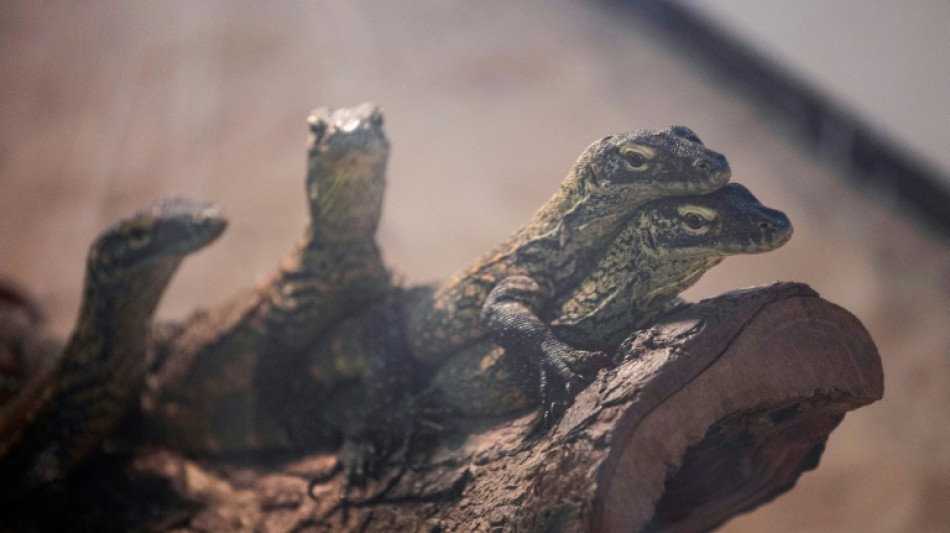
Half of species not assessed for endangered list risk extinction: study / Photo: Juni Kriswanto - AFP/File

 'He's here with me': Japan cycle queen dedicates gold to late brother

 Japan Olympic chief says 'lot more' athletes at Games than expected

 Asian carmakers besting US rivals at home, China poised to strike

 Widgets & Web Offers All-Inclusive Investor Relations Websites for Public Companies, IPOs and SPACs

 Adams named new US captain to 2030 World Cup

 China a better influence in Latin America than US: poll

 Judge pauses construction of border project in Texas national park

 Belgium's De Bruyne fires double to sink Turkey, France held by Italy

 US jobs data boosts stocks as oil prices dip

 US Supreme Court to hear high-stakes climate case

 Trump expected to name intel chief Clayton as AI czar: reports

 Argentina unveils passports-for-investment scheme

 Brazil election debate chaos sparks censorship row

 England's Carse charged by cricket body over nightclub incident

 Amazon vows $1 bn for data center towns, decries 'myths'

 Oil prices drop on G7 fuel release, US jobs data boosts stocks

 G7 agrees deal to ease global energy supply concerns

 Spain's government dealt blow as lawmakers reject housing bills

 Food, medicine shortages deepen in Russian-occupied Oleshky

 Man City whistleblower Rui Pinto facing 'dire consequences' - lawyers

 Russia 'tearing Kyiv apart', mayor says, as strikes paralyse traffic

 Taiwan boxer Lin wins Games gold as Japan edge North Korea on penalties

 Japan tame North Korea to win Games gold after shootout drama

 US posts weak job growth data in September

 Ethiopia's conflict: the regional dimension

More than half of species whose endangered status cannot be assessed due to a lack of data are predicted to face the risk of extinction, according to a machine-learning analysis published Thursday.
The International Union for the Conservation of Nature (IUCN) currently has nearly 150,000 entries on its Red List for threatened species, including some 41,000 species threatened with extinction.
These include 41 percent of amphibians, 38 percent of sharks and rays, 33 percent of reef building corals, 27 percent of mammals and 13 percent of birds.
But there are thousands of species that the IUCN has been unable to categorise as they are "data insufficient" and are not on the Red List even though they live in the same regions and face similar threats to those species that have so far been assessed.
Researchers from the Norwegian University of Science and Technology used a machine learning technique to predict the likelihood of 7,699 data deficient species being at risk of extinction.
They trained the algorithm on a list of more than 26,000 species that the IUCN has been able to categorise, incorporating data on the regions where species live and other factors known to influence biodiversity to determine whether it predicted their extinction risk status.
"These could include climatic conditions, land use conditions or land use changes, pesticide use, threats from invasive species or really a range of different stressors," lead author Jan Borgelt, from the university's Industrial Ecology Programme, told AFP.
After comparing the algorithm's results with the IUCN's lists, the team then applied it to predict the data deficient species' extinction risk.
Writing in the journal Communications Biology, they found that 4,336 species -- or 56 percent of those sampled -- were likely threatened with extinction, including 85 percent of amphibians and 61 percent of mammals.
This compares to the 28 percent of species assessed by the IUCN Red List.
"We see that across most land areas and coastal areas around the world that the average extinction risk would be higher if we included data deficient species," said Borgelt.
A global United Nations biodiversity assessment in 2019 warned that as many as a million species were threatened with extinction due to a number of factors including habitat loss, invasive species and climate change.
Borgelt said the analysis revealed some hotspots for data-deficient species risk, including Madagascar and southern India. He said he hoped the study could help the IUCN develop its strategy for underreported species, adding that the team had reached out to the union.
"With these predictions from machine learning we can get really sort of pre-assessments or we could use those as predictions to prioritise which species have to be looked at by the IUCN," he said.
Head of the IUCN's Red List Craig Hilton-Taylor said the organisation was continuously harnessing new technology with a view to reduce the number of data deficient species.
"We also understand that a proportion of data deficient species are at risk of extinction, and include this in our calculations when we estimate the proportion of threatened species in a group," he told AFP.
X.M.Francisco--PC



