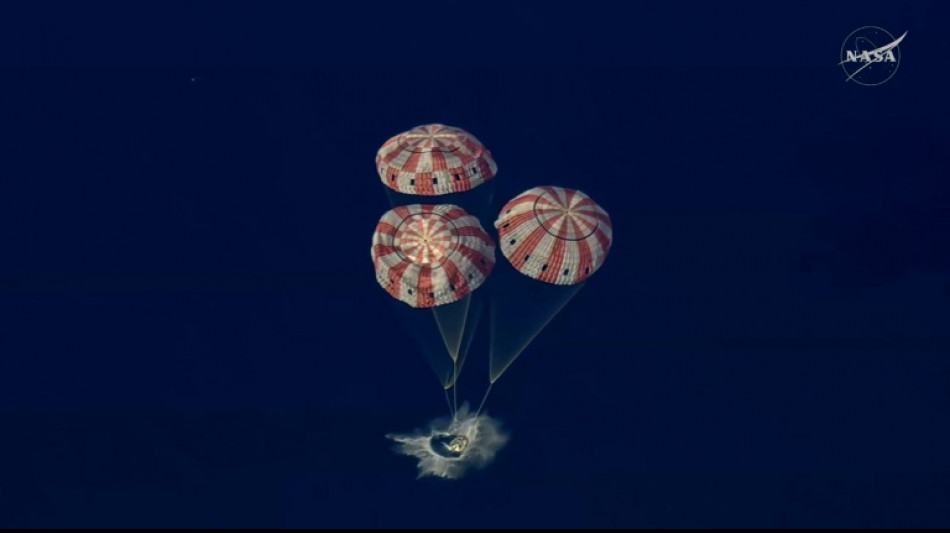
Artemis II astronauts return to Earth, capping historic Moon mission / Photo: - - NASA/AFP

 Split loyalties for Indian football fans at Brazil friendly

 India-Pakistan blockbuster brings cricket fever to Japan baseball field

 Wong waiting on Rafa after winning Asian Games tennis gold

 With Russia next door and rising costs, Latvia goes to the polls

 Penalty hero rues empty seats as Games hosts Japan win football gold

 North Korea fires ballistic missile after Seoul's apology demand

 US regulator finds Boeing 737 MAX software bug 'not a safety concern'

 Ohtani 'managing' injuries as Dodgers launch MLB post-season

 Botched US execution leaves murderer unconscious on ventilator: lawyers

 Cornell rape case exposes sexual violence at US colleges

 France held by Italy in Zidane's homecoming after Olise stunner

 Ethiopian pro-government militia claims Tigray airport as regional tensions spike

 Ohtani shaking off injuries as Dodgers launch MLB post-season

 Sea levels to rise in California as coastal wave surges up west coast

 New rallies urged in France as protests disrupt over 730 schools

 Djokovic survives China Open scare, Sabalenka starts strong

 King Charles to evoke colonial 'darkest days' on Caribbean tour

 Tesla shares jump after global car sales top estimates

 DR Congo Ebola outbreak killed more than 4,000: official figures

 Djokovic survives China Open scare against wildcard world no. 104

 Lula, Bolsonaro trade blows in final scramble for votes in Brazil

 New clashes erupt as protests disrupt over 560 French schools

 NY governor vows to close loophole after alleged Cornell gang rape

 Ethiopia Tigray rebels pushed back as regional tensions spike

 Stocks rise, yields fall as US job numbers disappoint

The NASA spacecraft carrying four astronauts splashed down as planned Friday off the California coast, capping the US space agency's successful crewed test mission around the Moon, the first such flyby in more than 50 years.
Mission commander Reid Wiseman reported that the crewmembers -- himself along with Christina Koch, Victor Glover and Jeremy Hansen -- were "stable" and "green."
"They're in great condition, that's what that means," said Rob Navias, the NASA public affairs official who narrated their return on the agency's livestream.
Following a brief but nerve-wracking communications blackout during their high-stakes re-entry, mission commander Wiseman's voice triggered relief that the astronauts were well on their way back home.
"Houston. Integrity. We have you loud and clear," he said following a voice check from mission control.
NASA and the US military will now help them leave the bobbing capsule, after which they will be flown to a recovery ship off the Pacific coast near San Diego.
As the astronauts returned to Earth their spacecraft reached maximum speeds more than 30 times the speed of sound, and faced searing temperatures around half as hot as the surface of the Sun. It was a key test of their heat shield, which in an earlier trial mission had faced complications.
But the Artemis II re-entry went off without a hitch.
"This was a textbook entry and a textbook touchdown," said Navias.
- Historic journey -
The approximately 10-day mission that began with a dramatic launch from Florida on April 1 was studded with firsts, records and extraordinary moments.
It was considered a key stepping stone towards eventual crewed lunar landings.
It was the first crewed mission of NASA's program aiming to install a sustained presence on the Moon, including the eventual construction of a base.
The second phase of the Artemis program was a test mission to verify the reliability of the Orion capsule, which before now had not carried humans.
The voyage also broke a record: the four astronauts become the humans to travel furthest away from the Earth, at 252,756 miles (406,771 kilometers).
While hurtling through deep space and zipping around the Moon the astronauts took thousands of photographs, amassing a stunning portfolio of images that captivated people on Earth.
They also witnessed a solar eclipse along with extraordinary meteorite strikes on the lunar surface that had left NASA scientists awe-struck.
Several achievements added to the voyage's historic nature: Glover was the first person of color to fly around the Moon, Koch was the first woman, and Canadian Hansen the first non-American.
- Vital heat shield -
The Orion capsule passed a key test: the re-entry stakes were particularly high given concerns that arose during Artemis I, when an uncrewed 2022 test flight to the Moon and back saw a crucial heat shield erode in unexpected ways.
To minimize risks this time around, NASA shifted the re-entry path they had used in the test mission, after determining it had played a role in the complications.
The astronauts returned at a steeper and thus shorter trajectory, which NASA officials in discussion with the astronauts concluded would reduce risk to an acceptable degree.
Still, the heat shield situation prompted uneasy comparisons to the Challenger and Columbia space shuttle disasters of 1986 and 2003 respectively, when astronauts died after warning signs were set aside.
But to the relief of NASA, the astronauts and their families along with the public at large, Artemis II completed a successful return.
Loved ones were watching the journey home from mission control in Houston, where the astronauts are due to reunite with their families, likely this weekend.
O.Salvador--PC



